Loans 

Credit Card
IndiaLends App is available in


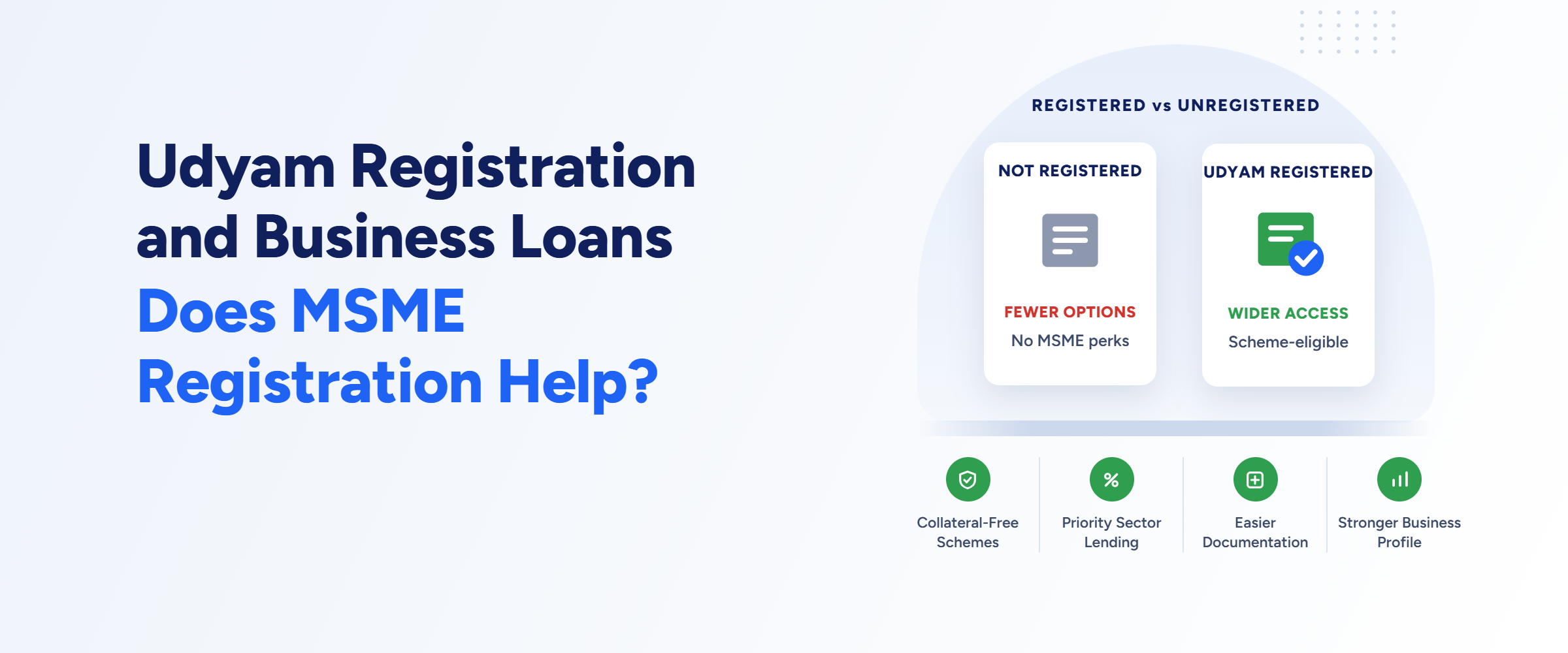
If you run a small or medium business in India and haven't registered on the Udyam portal yet, you might be missing out on more than just government schemes. When it comes to business loans, Udyam registration can genuinely influence how lenders view your application, though it's not a magic ticket to automatic approval.
Let's break down exactly what Udyam registration does, what it doesn't do, and how it fits into your overall business loan strategy.
What Is Udyam Registration?
Udyam registration is the official government process for classifying a business as a Micro, Small, or Medium Enterprise (MSME) in India, based on investment in plant/equipment and annual turnover. It replaced the older Udyog Aadhaar system and is fully online, free of cost, and based on self-declaration linked to PAN and GST data.
Once registered, your business receives a Udyam Registration Certificate with a unique registration number, a document that's increasingly recognised across banks, NBFCs, and government schemes.
1. MSME Classification Explained
| Category | Investment in Plant/Equipment | Annual Turnover |
|---|---|---|
| Micro Enterprise | Up to ₹1 crore | Up to ₹5 crore |
| Small Enterprise | Up to ₹10 crore | Up to ₹50 crore |
| Medium Enterprise | Up to ₹50 crore | Up to ₹250 crore |
(Thresholds as per current government MSME classification norms, always verify the latest figures on the official Udyam portal, as these can be revised periodically.)
Your classification determines which government schemes and lender-specific MSME loan products you may be eligible for.
2. Does Udyam Registration Directly Improve Loan Approval?
Here's the honest answer: Udyam registration doesn't override your fundamentals, your CIBIL score, bank statement history, and repayment capacity still matter most. But it does provide real, tangible advantages that can meaningfully influence the overall picture:
Think of Udyam registration as strengthening your application's credibility and unlocking specific product categories, not as a replacement for solid financials.
MSME Registration Loan Benefits: What You Actually Get
| Benefit | How It Helps Your Loan Application |
|---|---|
| Priority sector lending recognition | Some banks prioritise MSME-classified businesses in lending targets |
| Access to collateral-free loan schemes | Certain government-backed schemes offer loans without collateral for registered MSMEs |
| Interest rate subvention (scheme-dependent) | Some MSME schemes offer subsidised interest rates, subject to eligibility |
| Faster documentation verification | Udyam certificate serves as standardised proof of business classification |
| Eligibility for MSME-specific lender products | Many banks/NBFCs have dedicated MSME loan products with tailored terms |
Business Loan With Udyam Certificate: What Changes in the Process
Without Udyam Registration
With Udyam Registration
Example: Same Business, With and Without Udyam Registration
Business: A small furniture manufacturing unit in Jaipur, annual turnover ₹1.8 crore, applying for a ₹15,00,000 business loan for equipment upgrade.
| Without Udyam Registration | With Udyam Registration | |
|---|---|---|
| Loan product access | Standard business loan only | Standard + MSME-specific loan schemes |
| Collateral requirement | Likely required based on lender policy | May qualify for certain collateral-free scheme options |
| Documentation | GST returns, ITR, bank statements, business proof | Same, plus Udyam certificate as standardised proof |
| Approval speed | Standard processing | Potentially faster verification due to certified classification |
The underlying financials (turnover, bank statement health, CIBIL score) still drive the core approval decision, but Udyam registration widens the pool of loan products the business can access and can smoothen parts of the process.
Udyam Loan Documents: What You'll Typically Need
| Document | Purpose |
|---|---|
| Udyam Registration Certificate | Proof of MSME classification |
| PAN card (business and/or proprietor) | Identity and tax verification |
| GST returns (last 12 months) | Revenue verification |
| Bank statements (last 6–12 months) | Cash flow assessment |
| ITR (last 2–3 years) | Income verification |
| Business address proof | Establishment verification |
| KYC documents of proprietor/partners/directors | Identity verification |
Having your Udyam certificate ready alongside these documents can reduce back-and-forth during the verification process.
Common Mistakes Business Owners Make
Expert Tips for Leveraging Udyam Registration
Explore Business Loan Options for Your MSME
Check your business loan eligibility on IndiaLends and get matched with lenders offering MSME-focused loan products based on your business profile and Udyam classification.
Check Your Business Loan Eligibility Now
Conclusion
Udyam registration isn't a shortcut to automatic loan approval, but it's a genuinely valuable step for any small or medium business in India. It widens your access to MSME-specific loan products, adds credibility to your application, and can smoothen documentation, especially when combined with strong bank statement history and a healthy CIBIL score. If you haven't registered yet, it's a free, one-time process that's worth completing well before you actually need financing.
Related reading: Business Loan for Seasonal Businesses: Planning Funds Around Inventory and Revenue Cycles.
Frequently Asked Questions (FAQs)
1. Does Udyam registration guarantee business loan approval?
No. Udyam registration improves your business's credibility and unlocks access to MSME-specific loan products and schemes, but approval still depends on your financials, CIBIL score, bank statement health, and repayment capacity.
2. Is Udyam registration free?
Yes, Udyam registration is free of cost and can be completed online through the official Udyam portal using your PAN and Aadhaar details.
3. Can I get a collateral-free business loan with Udyam registration?
Certain government-backed MSME schemes offer collateral-free loans to registered businesses, subject to eligibility criteria and lender participation. Not all lenders or loan amounts qualify, so it's important to check scheme-specific terms.
4. What documents are required along with Udyam registration for a business loan?
Typically, lenders ask for the Udyam certificate alongside PAN, GST returns, bank statements, ITRs, business address proof, and KYC documents of the proprietor or partners.
5. Does Udyam registration affect the interest rate on a business loan?
It can, in specific cases. Some government-linked MSME schemes offer interest rate subvention or preferential pricing for registered businesses, though this depends on the specific scheme and lender, not universal across all business loans.
Download the IndiaLends App Now
Scan this QR code to download the app