Credit Card 
IndiaLends App is available in


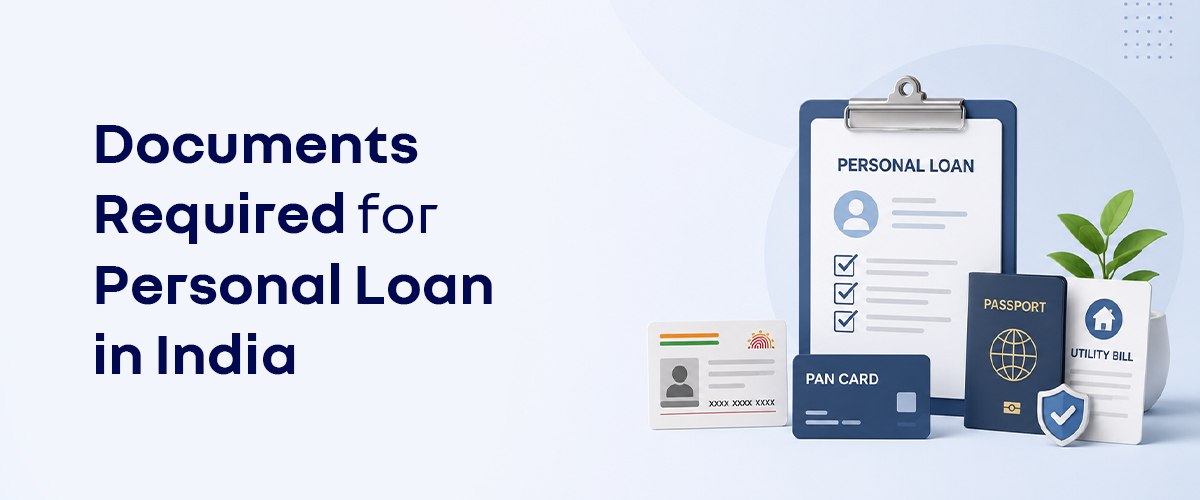
Documents Required for Personal Loan in India
One of the most common reasons personal loan applications get delayed isn't a low CIBIL score or insufficient income, it's incomplete or mismatched documentation. Knowing exactly what you need beforehand can save you days of back-and-forth with your lender.
Here's a complete, practical breakdown of the documents required for a personal loan in India.
Why Documentation Matters
Lenders use your documents to verify three key things: your identity, your current address, and your income and repayment capacity. Getting these right the first time speeds up verification and reduces the chances of your application being stuck in processing.
Basic Documents Required for Personal Loan (Salaried Applicants)
1. Identity Proof (KYC) — any one of the following: PAN Card (mandatory in most cases), Aadhaar Card, Passport, Voter ID, or Driving License
2. Address Proof — any one of the following: Aadhaar Card, a recent utility bill (electricity, water, gas), rental agreement, or Passport
3. Income Proof — salary slips for the last 3 months, Form 16 or income tax returns (in some cases), and bank statements for the last 3-6 months showing salary credits
4. Employment Proof — offer letter or appointment letter, and employee ID card (in some cases)
5. Photograph — a recent passport-size photograph
Documents Required for Self-Employed Applicants
Self-employed individuals typically need to submit additional documents to establish business stability and income.
Document Checklist Table
| Document Type | Salaried Applicants | Self-Employed Applicants |
|---|---|---|
| Identity Proof | PAN, Aadhaar, Passport | PAN, Aadhaar, Passport |
| Address Proof | Aadhaar, Utility Bill, Rental Agreement | Aadhaar, Utility Bill, Business Address Proof |
| Income Proof | Salary Slips, Form 16 | ITR, P&L Statement |
| Bank Statements | Last 3–6 months | Last 6-12 months |
| Business Proof | Not Applicable | GST/Registration Certificate |
| Photograph | Required | Required |
How Digital Lending Has Simplified Documentation
Traditionally, submitting these documents meant visiting a branch with physical photocopies. Today, most digital lenders, including online marketplaces like IndiaLends, allow e-KYC verification using Aadhaar-based authentication, digital upload of scanned documents or PDFs, bank statement analysis through secure, consent-based data sharing, and e-signing of loan agreements.
This has significantly reduced the time from application to disbursal, in many cases bringing it down to a matter of hours rather than days.
Common Documentation Mistakes to Avoid
Example: A Smooth Documentation Experience
Consider Meera, a salaried professional applying for a personal loan online. Before applying, she keeps the following ready: PAN card and Aadhaar card (scanned, clear copies), her last 3 months' salary slips, her last 3 months' bank statement showing salary credits, and a recent passport-size photo.
Because everything is organized and consistent, her application moves through verification without back-and-forth requests, and she receives an approval decision much faster than if she had submitted documents in bits and pieces.
Expert Tips for Hassle-Free Documentation
Check Your Personal Loan Eligibility Now
Conclusion
Good documentation isn't just paperwork, it's what determines how quickly and smoothly your personal loan gets approved. By keeping your documents accurate, consistent, and ready in advance, you set yourself up for a faster, frustration-free borrowing experience. Check your eligibility and explore personal loan offers on IndiaLends.

Scan this QR Code


Latest Articles
How to Improve Your Personal Loan Approval Chances
15 Jul 2026
Why Personal Loan Applications Get Rejected in India
14 Jul 2026
Personal Loan Balance Transfer Explained
14 Jul 2026
How to Improve Your Credit Score Fast in India
13 Jul 2026
Best Credit Cards for Cashback in India 2026
13 Jul 2026
Relevant Articles
How to Improve Your Personal Loan Approval Chances
15 Jul 2026
Why Personal Loan Applications Get Rejected in India
14 Jul 2026
Personal Loan Balance Transfer Explained
14 Jul 2026
Gold Loan vs Personal Loan, Which is Cheaper
10 Jul 2026
Best Personal Loan Interest Rates Today India
10 Jul 2026
FAQ’s
The basic documents include identity proof (PAN, Aadhaar), address proof, income proof (salary slips or ITR), bank statements, and a recent photograph.
Yes, in most cases, a PAN card is mandatory as it's used for identity verification and credit bureau checks.
Self-employed applicants typically need PAN, Aadhaar, business registration proof, ITR for the last 2–3 years, and bank statements, along with financial statements in some cases.
Some lenders may accept alternate income proof like bank statements or Form 16, but salary slips are the most commonly requested document for salaried applicants.
Most lenders require the last 3-6 months of bank statements for salaried applicants and 6-12 months for self-employed applicants.
 URL copied to clipboard successfully !
Download the IndiaLends App Now
Scan this QR code to download the app