Loans 

Credit Card
IndiaLends App is available in


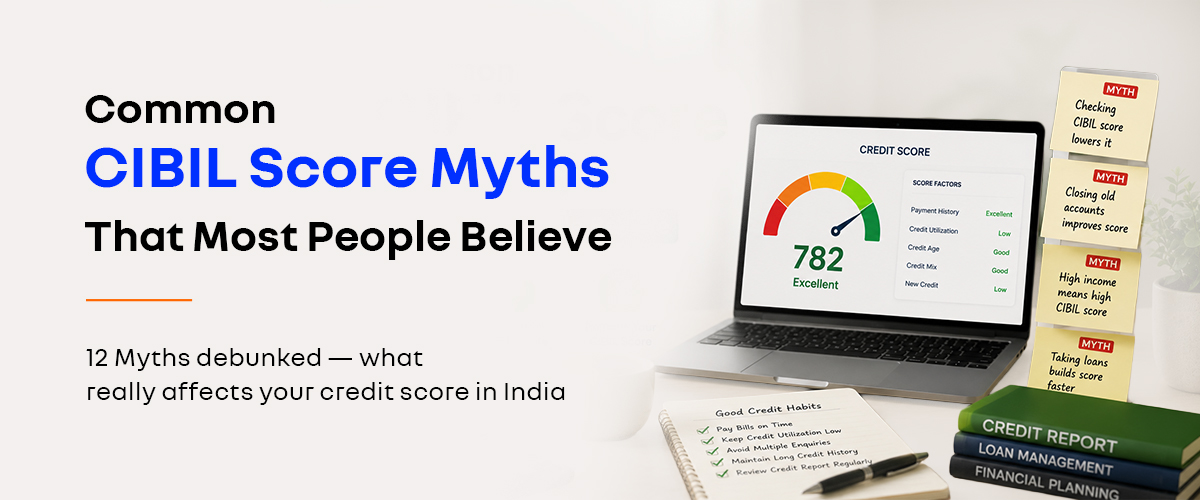
Common CIBIL Score Myths That Most People Believe
Credit awareness in India has grown, but so has misinformation around CIBIL scores. Many people follow outdated advice that can actually damage their credit health instead of improving it.
This guide debunks the most common CIBIL score myths and explains what really affects your credit score in India.
Myth 1: Checking My Own CIBIL Score Lowers It
This is false. Checking your own CIBIL score is a soft inquiry and has no impact on your score. Only lender-initiated hard inquiries made during loan or credit card applications may temporarily affect your score.
Myth 2: My Income or Salary Affects My CIBIL Score
Your income does not directly affect your CIBIL score. CIBIL tracks your borrowing and repayment behaviour, not your salary, savings balance, or assets.
Myth 3: Closing Old Credit Cards Always Helps
Closing old credit cards can hurt your score because it reduces your total available credit limit and may shorten your credit history. If an old card has no high annual fee, keeping it active can be useful.
Myth 4: Paying the Minimum Due Fully Protects My CIBIL Score
Paying the minimum due helps you avoid a late payment mark, but the remaining balance continues to attract interest and can keep your credit utilization high. Paying the full balance is better for your score.
Myth 5: A CIBIL Score of -1 Means Bad Credit
A CIBIL score of -1 means there is no credit history available. It does not mean bad credit. It simply means CIBIL does not have enough borrowing and repayment data to generate a score.
Myth 6: Settling a Loan is the Same as Closing It
A Closed account means you paid the full outstanding amount. A Settled account means you paid less than the full amount after negotiation. Settled status is negative and can affect future loan approvals.
Myth 7: More Savings Means a Better CIBIL Score
Savings account balance, fixed deposits, mutual funds, or investments do not directly improve your CIBIL score. Credit score depends on how responsibly you use loans and credit cards.
Myth 8: My Spouse’s CIBIL Score Affects Mine
Credit scores are individual in India. Your spouse’s CIBIL score does not affect yours unless both of you are joint borrowers or guarantors on the same loan.
Myth 9: Once I Reach 750, I Can Stop Monitoring My Score
A 750+ score is strong, but it is not permanent. Missed payments, credit report errors, high utilization, or identity fraud can reduce your score. Regular monitoring is still important.
Myth 10: A Perfect 900 CIBIL Score is Necessary
A perfect 900 score is not necessary. A score above 750 is generally enough to access strong loan offers, good interest rates, and premium credit products.
Myth 11: Credit Repair Companies Can Quickly Fix My Score
No legitimate company can instantly fix your CIBIL score. They may help dispute genuine errors, but accurate negative entries cannot be removed quickly for a fee. Be cautious of false promises.
Myth 12: Debit Card and Bank Transactions Build CIBIL Score
Debit card usage, UPI payments, salary credits, and savings account activity do not build your CIBIL score. Only formal credit products such as loans and credit cards are reported to credit bureaus.
Summary: CIBIL Score Myths vs Facts
| Myth | Fact |
|---|---|
| Checking your own score lowers it | Self-checks are soft inquiries and have no impact |
| Income affects CIBIL score | CIBIL tracks credit behaviour, not salary |
| Closing old cards helps | It may hurt utilization and credit history length |
| Settlement means loan closure | Settled is negative; Closed is positive |
| Debit cards build score | Only credit products help build credit history |
Check Your Real CIBIL Score
Now that you know the facts, check your real CIBIL score and understand your credit health clearly.
Check Your Free CIBIL Score Now
Conclusion
Understanding what really affects your CIBIL score helps you avoid costly mistakes. Focus on timely payments, low credit utilization, active credit monitoring, and responsible borrowing instead of following common myths.

Scan this QR Code


Latest Articles
How to Read a CIBIL Report Line by Line
20 Aug 2026
CIBIL Report Account Status Codes: Current, Settled, Written Off, and Closed
20 Aug 2026
CIBIL Score After Loan Settlement: What Borrowers Should Know
18 Aug 2026
Why a Closed Loan Still Appears on Your Credit Report
18 Aug 2026
How to Redeem Credit Card Reward Points Before They Expire
17 Aug 2026
Relevant Articles
How to Read a CIBIL Report Line by Line
20 Aug 2026
CIBIL Report Account Status Codes: Current, Settled, Written Off, and Closed
20 Aug 2026
CIBIL Score After Loan Settlement: What Borrowers Should Know
18 Aug 2026
Why a Closed Loan Still Appears on Your Credit Report
18 Aug 2026
How to Improve Your Credit Score Fast in India
13 Jul 2026
FAQ’s
No. Checking your own CIBIL score is a soft inquiry and does not reduce your score. Only lender hard inquiries during credit applications may temporarily affect it.
No. Your salary, savings, or assets do not directly affect your CIBIL score. CIBIL score is based on your credit behaviour, repayment history, credit utilization, and loan or credit card usage.
No. A CIBIL score of -1 means you do not have enough credit history to generate a score. It is not bad credit, but you may need to build credit through a secured card or small loan.
Usually, no. Closing a credit card can reduce your available credit limit and shorten your credit history, which may lower your score. Keeping old no-fee cards active can help.
No genuine company can instantly improve your CIBIL score. They can only help identify and dispute real errors. Timely payments, low utilization, and responsible credit behaviour are the reliable ways to improve your score.
 URL copied to clipboard successfully !
Download the IndiaLends App Now
Scan this QR code to download the app