Credit Card 
IndiaLends App is available in


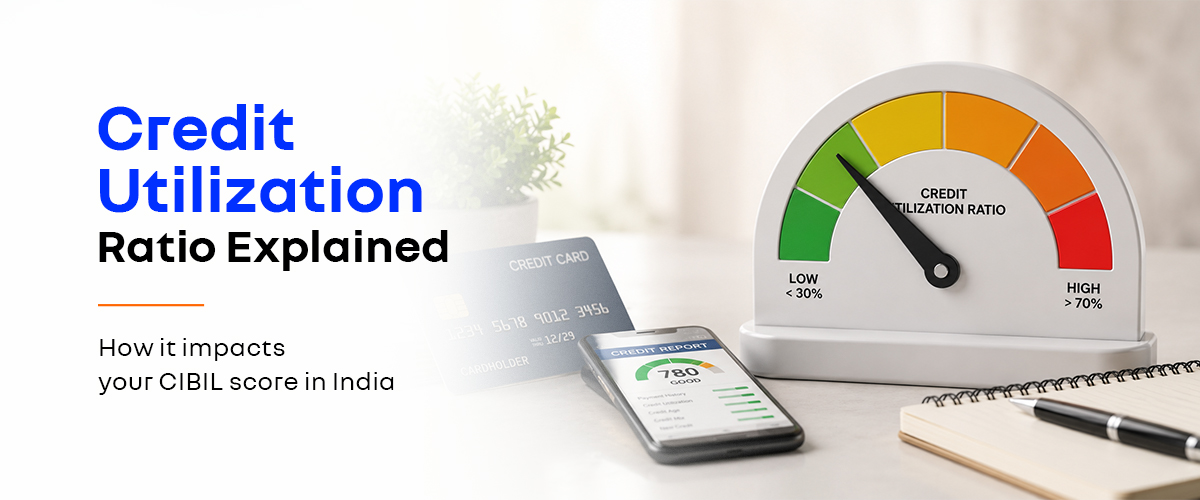
Credit Utilization Ratio Explained
If you have a credit card and have wondered why your CIBIL score improves when you pay off balances or drops after a large purchase, credit utilization ratio is the answer.
Credit utilization is one of the most important factors in your CIBIL score calculation. Understanding and managing it properly can help you improve your credit score faster and increase your loan eligibility.
What is Credit Utilization Ratio?
Credit utilization ratio is the percentage of your total available credit card limit that you are currently using. A lower utilization ratio is generally better for your CIBIL score.
The formula is: Credit Utilization Ratio = (Total Credit Card Balance / Total Credit Card Limit) × 100.
Credit Utilization Ratio Example
| Details | Amount |
|---|---|
| Credit Card 1 Limit | Rs. 50,000 |
| Credit Card 2 Limit | Rs. 1,00,000 |
| Total Credit Limit | Rs. 1,50,000 |
| Total Outstanding Balance | Rs. 45,000 |
| Credit Utilization Ratio | 30% |
How CIBIL Measures Credit Utilization
CIBIL generally looks at both your overall utilization and individual card-level utilization.
Both matter. Even if your total utilization is low, maxing out one card can negatively affect your CIBIL score.
When is Credit Utilization Reported to CIBIL?
Credit card issuers usually report your balance to CIBIL on the statement date, not the payment due date. This means the balance shown on your statement may be the balance reported to CIBIL.
If your statement is generated on the 15th and you pay the full amount on the 20th, the balance on the 15th may still be reported. Paying before the statement date can help reduce the utilization that appears in your credit report.
What is the Ideal Credit Utilization Ratio?
| Utilization Ratio | Impact on CIBIL Score |
|---|---|
| Below 10% | Excellent |
| 10% to 30% | Good |
| 30% to 50% | Fair |
| 50% to 75% | Poor |
| 75% to 100% | Very poor |
As a rule of thumb, keep your credit utilization below 30%. For the best score impact, aim to keep it below 10% while still using your credit card occasionally.
Why Does High Utilization Hurt Your CIBIL Score?
High utilization can make lenders view you as credit-dependent or financially stretched. Even if you pay your full bill every month, consistently high utilization may keep your CIBIL score lower than expected.
5 Practical Strategies to Reduce Credit Utilization
Credit Utilization vs Debt: What is the Difference?
Credit utilization applies mainly to revolving credit products like credit cards. It does not apply to instalment loans such as home loans, personal loans, or car loans.
Real-Life Example: How Utilization Impacts Score
Suppose Priya has a credit card limit of Rs. 2,00,000 and spends Rs. 1,40,000 every month. Her utilization is 70%, which may keep her score lower despite timely payments.
If her limit increases to Rs. 4,00,000 and her spending remains Rs. 1,40,000, utilization drops to 35%. If she also pays part of the balance before the statement date, her reported utilization can fall below 30%, supporting score improvement.
Check Your Credit Score and Utilization Level
Your credit report can help you understand your current utilization level and how it may be affecting your CIBIL score.
Check Your Free CIBIL Score Now
Conclusion
Credit utilization ratio is one of the fastest ways to influence your CIBIL score. By keeping utilization below 30%, paying before the statement date, and avoiding maxed-out cards, you can build stronger credit health and improve your chances of better loan and credit card offers.

Scan this QR Code


Latest Articles
Common CIBIL Score Myths That Most People Believe
14 May 2026
How Long Does It Take to Improve a CIBIL Score?
14 May 2026
CIBIL vs Experian vs Equifax vs CRIF
13 May 2026
How to Check Your CIBIL Score for Free in India
13 May 2026
Why Loan Applications Get Rejected
13 May 2026
Relevant Articles
Common CIBIL Score Myths That Most People Believe
14 May 2026
How Long Does It Take to Improve a CIBIL Score?
14 May 2026
CIBIL vs Experian vs Equifax vs CRIF
13 May 2026
How to Check Your CIBIL Score for Free in India
13 May 2026
Why Loan Applications Get Rejected
13 May 2026
FAQ’s
A good credit utilization ratio in India is below 30%. For stronger CIBIL score impact, keeping utilization below 10% is generally considered ideal.
Yes. Credit card balances are usually reported to CIBIL every month, often around the statement date. Your utilization can therefore affect your CIBIL score on a monthly basis.
Yes. Reducing high utilization below 30% can help improve your CIBIL score within one or two reporting cycles, provided there are no fresh missed payments or negative entries.
No. Credit utilization applies mainly to revolving credit products such as credit cards. Personal loans, home loans, and car loans are instalment loans and are evaluated through repayment history instead.
Yes. Closing a credit card reduces your total available credit limit. If your spending or outstanding balance remains the same, your utilization ratio can increase and may negatively affect your CIBIL score.
 URL copied to clipboard successfully !
Download the IndiaLends App Now
Scan this QR code to download the app