Credit Card 
IndiaLends App is available in


Personal Loan Eligibility Criteria in India – Complete Guide
Before you get excited about that personal loan offer flashing on your banking app, there's one crucial question to answer: do you actually meet the eligibility criteria? Understanding this upfront saves you from unnecessary rejections and multiple hard inquiries on your credit report.
Let's walk through exactly what lenders look at when evaluating a personal loan application in India.
Why Eligibility Matters
Every lender wants to be reasonably confident that you'll repay the loan on time. Since personal loans are unsecured, there's no asset backing the loan, so lenders rely entirely on your financial profile to assess risk.
Meeting the eligibility criteria doesn't just get you approved; it can also influence the loan amount you qualify for, the interest rate offered to you, and the tenure options available.
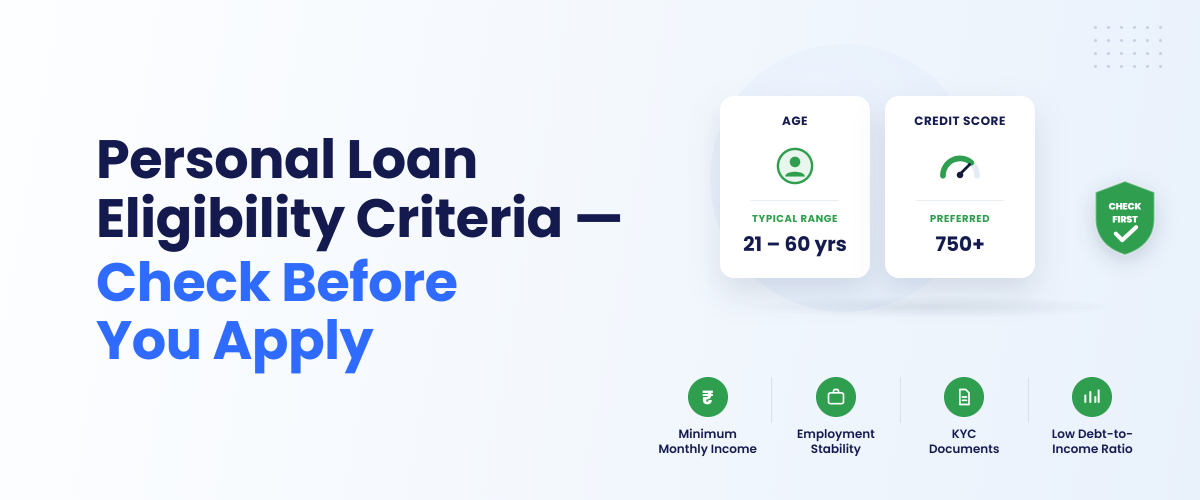
Key Personal Loan Eligibility Factors
| CIBIL Score Range | General Interpretation |
|---|---|
| 750 and above | Excellent - strong approval chances, better rate potential |
| 700-749 | Good - generally favorable for approval |
| 650-699 | Fair - approval possible but may come with stricter terms |
| Below 650 | Poor - higher chance of rejection or unfavorable terms |
Personal Loan Eligibility Criteria Table (General Overview)
| Criteria | Salaried Applicants | Self-Employed Applicants |
|---|---|---|
| Age | 21-60 years | 24-65 years |
| Minimum Income | Varies by lender and city | Varies by lender and city |
| Work/Business Experience | Typically 1+ years | Typically 2-3+ years |
| CIBIL Score | 700+ preferred | 700+ preferred |
| Documents | Salary slips, bank statements | ITR, business proof, bank statements |
Note: These are general industry patterns. Exact requirements differ from lender to lender.
How Lenders Calculate Your Eligible Loan Amount
Most lenders use a combination of an income-based calculation, a multiple of your monthly income after accounting for existing obligations, and the Fixed Obligation to Income Ratio (FOIR), which ensures your total EMIs including the new loan don't exceed a certain percentage of your income.
For example, if a lender follows a FOIR guideline where total EMIs shouldn't exceed 50% of your monthly income, and you already have EMI commitments, your new personal loan eligibility will be calculated based on the remaining headroom.
Example: Understanding Eligibility in Practice
Let's say Arjun earns ₹60,000 per month and already pays ₹10,000 towards an existing car loan EMI. If a lender caps total EMI obligations at 50% of income (₹30,000), Arjun has ₹20,000 of "eligible EMI space" left for a new personal loan.
This directly affects how much loan amount he can be approved for, based on the applicable interest rate and tenure.
Common Mistakes That Hurt Eligibility
Expert Tips to Improve Your Eligibility
Check Your Personal Loan Eligibility Now
Conclusion
Understanding personal loan eligibility criteria before applying isn't just a formality, it's a smart financial habit. It helps you apply to the right lender, avoid unnecessary rejections, and even improve your chances of getting better loan terms. A little preparation goes a long way in making your borrowing experience smooth and stress-free. Check your eligibility and explore personal loan offers on IndiaLends.

Scan this QR Code


Latest Articles
Personal Loan EMI Calculator Guide – How to Calculate Your EMI
29 Jul 2026
Secured vs Unsecured Loans – Key Differences Explained
28 Jul 2026
12 Common Personal Loan Myths That Most Borrowers Believe
28 Jul 2026
Documents Required for Personal Loan in India
15 Jul 2026
How to Improve Your Personal Loan Approval Chances
15 Jul 2026
Relevant Articles
Personal Loan EMI Calculator Guide – How to Calculate Your EMI
29 Jul 2026
12 Common Personal Loan Myths That Most Borrowers Believe
28 Jul 2026
Documents Required for Personal Loan in India
15 Jul 2026
How to Improve Your Personal Loan Approval Chances
15 Jul 2026
Why Personal Loan Applications Get Rejected in India
14 Jul 2026
FAQ’s
Minimum salary requirements vary by lender and city, with metro cities often having higher thresholds than smaller towns. Check the specific lender's criteria for exact numbers.
A CIBIL score of 700 or above is generally considered favorable for approval and better interest rates.
Lenders generally prefer applicants with stable employment. Self-employed individuals can also apply with proper income proof, though the exact criteria for job stability may differ.
Yes, most lenders set age criteria (commonly 21-60 years for salaried and 24-65 years for self-employed) to ensure the loan can be repaid within the applicant's working years.
Most lenders, including IndiaLends, offer online eligibility calculators where you can input basic details to get an estimate before formally applying.
 URL copied to clipboard successfully !
Download the IndiaLends App Now
Scan this QR code to download the app