Credit Card 
IndiaLends App is available in


Secured vs Unsecured Loans – Key Differences Explained
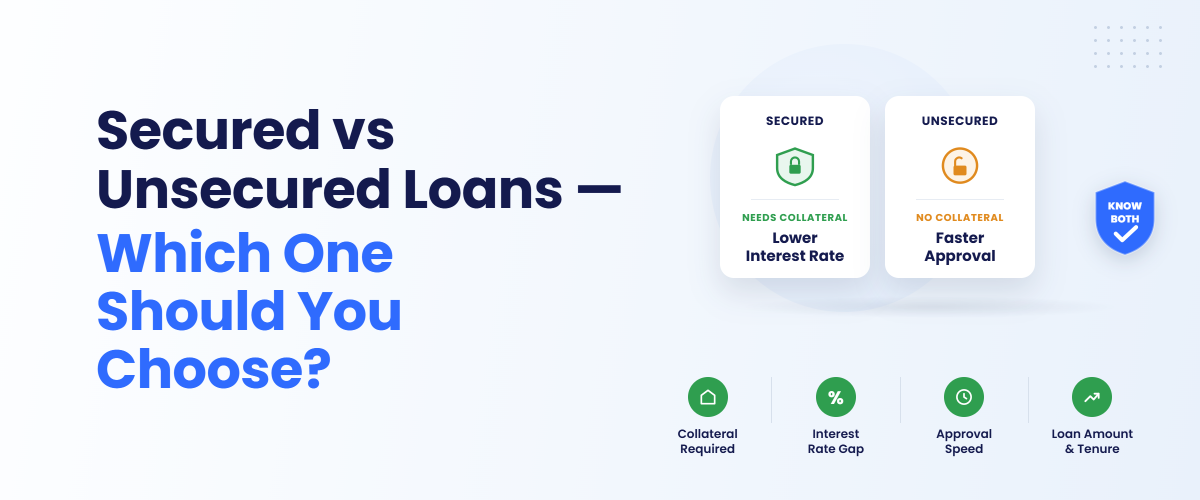
When you're exploring borrowing options in India, you'll often come across two broad categories: secured loans and unsecured loans. Understanding the difference isn't just academic — it directly affects your interest rate, approval process, and risk exposure.
Let's break this down clearly.
What is a Secured Loan?
A secured loan is a loan backed by collateral — an asset that the lender can claim if you fail to repay. Common examples include home loans (property as collateral), car loans (vehicle as collateral), gold loans (gold jewelry/ornaments as collateral), and loans against fixed deposits or securities.
Because the lender has an asset to fall back on, secured loans are generally considered lower risk for the lender, which often translates into more favorable interest rates for the borrower.
What is an Unsecured Loan?
An unsecured loan doesn't require any collateral. Approval is based entirely on your income, credit history, and repayment capacity. Common examples include personal loans, credit cards, and education loans (in many cases, though some may require collateral for larger amounts).
Since there's no asset backing the loan, lenders typically charge a higher interest rate to offset the increased risk.
Secured vs Unsecured Loan: Key Differences
| Factor | Secured Loan | Unsecured Loan |
|---|---|---|
| Collateral Required | Yes | No |
| Interest Rate | Generally lower | Generally higher |
| Approval Process | Can involve asset valuation, longer processing | Often faster, especially digitally |
| Loan Amount | Can be higher, tied to asset value | Based on income and creditworthiness |
| Risk to Borrower | Asset can be seized on default | No asset at risk, but credit score impact on default |
| End-Use Restriction | Often restricted (e.g., home loan for property only) | Usually flexible |
| Documentation | Asset-related documents plus KYC | Primarily KYC and income proof |
How Lenders Assess Risk Differently
For secured loans, the lender's risk is partially offset by the collateral's value. Even if income documentation is slightly weaker, the presence of a valuable asset can support approval.
For unsecured loans, the entire risk assessment hinges on your financial profile — CIBIL score, income stability, and existing debt obligations become far more critical.
Personal Loan vs Gold Loan: A Common Comparison
| Factor | Personal Loan | Gold Loan |
|---|---|---|
| Collateral | None | Gold ornaments/jewelry |
| Interest Rate | Generally higher | Generally lower |
| Processing Speed | Fast, especially digital | Very fast, often same-day |
| Loan Amount | Based on income/credit profile | Based on gold value (loan-to-value ratio) |
| Risk | No asset at risk | Gold can be auctioned on default |
This comparison highlights a common trade-off: gold loans often come with lower interest rates due to the collateral, but they carry the risk of losing a valuable, sometimes sentimental asset if repayment isn't managed carefully.
When Does a Secured Loan Make Sense?
When Does an Unsecured Loan Make Sense?
Example: Choosing Between Secured and Unsecured Borrowing
Consider Anita, who needs ₹3,00,000 for a medical emergency. She has gold jewelry she could pledge, but doing so would mean parting with a family heirloom, even temporarily. Given the urgency and her stable income with a good CIBIL score, she opts for a personal loan instead — accepting a slightly higher interest rate in exchange for not risking the asset and completing the process quickly online.
This illustrates how the "right" choice often depends on personal priorities, not just the interest rate alone.
Common Mistakes When Choosing Between Secured and Unsecured Loans
Expert Tips
Check Your Personal Loan Eligibility Now
Conclusion
Secured and unsecured loans each serve different purposes, and there's no universally "better" option — it depends on your need, urgency, risk appetite, and financial profile. Understanding these differences helps you choose the borrowing path that aligns with both your immediate requirement and your long-term financial comfort. Check your eligibility and explore personal loan offers on IndiaLends.

Scan this QR Code


Latest Articles
Personal Loan EMI Calculator Guide – How to Calculate Your EMI
29 Jul 2026
Personal Loan Eligibility Criteria in India – Complete Guide
29 Jul 2026
12 Common Personal Loan Myths That Most Borrowers Believe
28 Jul 2026
Documents Required for Personal Loan in India
15 Jul 2026
How to Improve Your Personal Loan Approval Chances
15 Jul 2026
Relevant Articles
FAQ’s
Secured loans require collateral, while unsecured loans do not — this difference typically affects the interest rate, approval process, and risk involved.
Secured loans generally offer lower interest rates because the collateral reduces the lender's risk, while personal loans (unsecured) typically carry higher rates.
The lender has the right to seize and, in some cases, sell the pledged collateral to recover the outstanding amount.
A personal loan doesn't put a physical asset at risk, but defaulting still damages your credit score significantly. A gold loan risks the pledged asset itself if not repaid.
Unsecured loan amounts depend on your income and creditworthiness, and while they can be substantial for well-qualified applicants, they're generally more conservative than secured loan limits tied to asset value.
 URL copied to clipboard successfully !
Download the IndiaLends App Now
Scan this QR code to download the app