Loans 

Credit Card
IndiaLends App is available in


Business Loan for New Business in India: What Options Exist Without Strong Revenue History
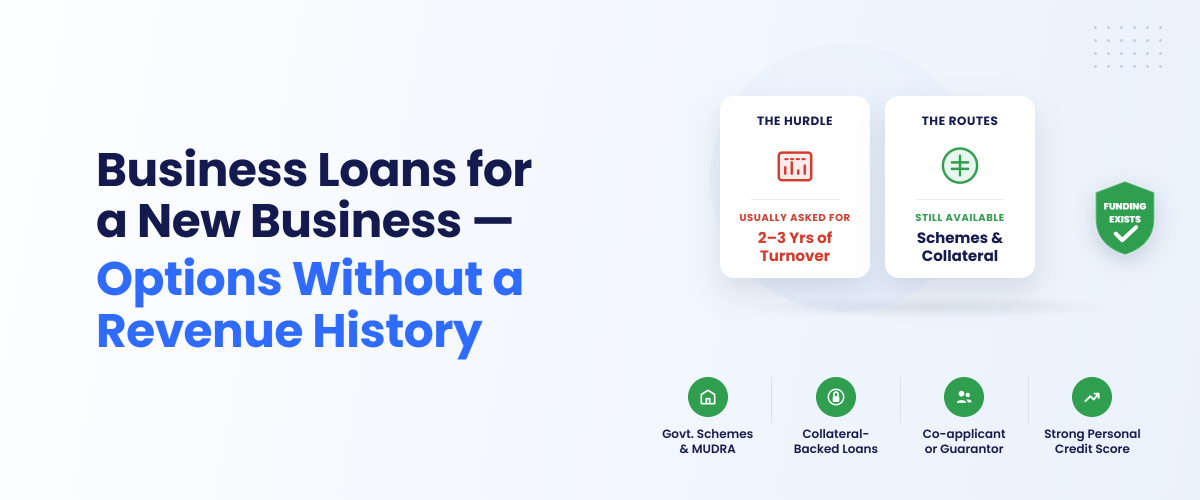
Starting a business is hard enough without lenders asking for three years of financial statements you simply don't have yet. If you're a new entrepreneur in India trying to fund your venture, you've probably noticed that most traditional business loan products seem designed for businesses that are already established.
The good news: you do have options. Let's look at what's realistically available for a new business without a strong revenue history, and how to improve your chances of getting funded.
Why Revenue History Matters to Lenders
Lenders assess business loans primarily on the ability to repay. For an established business, past revenue and cash flow are the clearest signals of that ability. A new business, by definition, doesn't have this track record, which is why lenders view it as higher risk and often adjust their requirements, loan amounts, or interest rates accordingly.
This doesn't mean funding is impossible. It means you need to look at the right kind of loan products and strengthen the other parts of your profile that lenders do consider.
What Lenders Look at Instead of Revenue History
When revenue history is limited, lenders often shift focus to other indicators of your ability to repay.
Funding Options for New Businesses Without Strong Revenue History
1. Personal Loan for Business Use
Many new entrepreneurs use a personal loan to fund early-stage business needs, since eligibility is based on personal income and CIBIL score rather than business revenue.
2. Government-Backed Schemes
India has several government-supported schemes designed specifically to help new and small businesses access credit without extensive revenue history. These typically involve lending through banks and NBFCs under government guarantee frameworks, which reduces the lender's risk.
3. Secured Business Loans (Loan Against Property or Assets)
If you or your business have an asset to pledge, property, gold, or fixed deposits, a secured loan can be an option even without a strong revenue history, since the collateral reduces the lender's risk.
4. NBFC-Specific New Business Loan Products
Some NBFCs offer loan products specifically designed for early-stage businesses, with more flexible documentation requirements than traditional banks, though often at a higher interest rate to offset the increased risk.
5. Loans Against Future Receivables (For Businesses With Some Initial Sales)
If your business has started generating some revenue, even if limited, certain lenders offer funding based on projected or existing receivables and transaction history (including digital payment or POS data), rather than requiring years of financial statements.
Comparison of Funding Options for New Businesses
| Funding Option | Collateral Needed | Based Primarily On | Typical Speed |
|---|---|---|---|
| Personal loan for business use | No | Personal income & CIBIL score | Fast |
| Government-backed schemes | Sometimes | Business plan & registration | Moderate |
| Secured business loan | Yes | Asset value | Moderate |
| NBFC new business loan products | Varies | Business plan, personal profile | Fast to moderate |
| Loans against receivables | No (asset-based) | Transaction/sales data | Fast, if data available |
Example: How a New Business Owner Might Approach Funding
Consider Rohit, who's launching a small D2C brand and needs ₹3,00,000 for initial inventory and marketing. His business has no revenue history yet, but he has a stable personal income from his previous job's savings, a CIBIL score of 740, and no major existing debt obligations.
Given his profile, a personal loan for business use is likely his most accessible option since approval depends on his personal financial profile rather than his (currently non-existent) business track record. As his business grows and starts generating consistent revenue and banking transaction history, he'll have more options, including business-specific loan products.
What Strengthens Your Application as a New Business Owner
Common Mistakes New Business Owners Make
Expert Tips for New Businesses Seeking Funding
Check Your Personal Loan Eligibility Now
Conclusion
Not having a revenue history doesn't shut the door on funding your new business, it just means choosing the right type of loan product for where you currently stand. Whether it's a personal loan, a government-backed scheme, or a secured option, understanding what lenders actually evaluate helps you approach funding with a realistic, well-prepared strategy. Check your eligibility and explore personal loan offers on IndiaLends.

Scan this QR Code


Latest Articles
Udyam Registration and Business Loans: Does MSME Registration Help?
03 Sep 2026
Seasonal Business Loan: Planning Funds Around Inventory & Revenue Cycles
03 Sep 2026
Why Do Two Lenders Offer Different Interest Rates to the Same Borrower?
03 Sep 2026
How to Compare Loan Offers Beyond the Interest Rate
03 Sep 2026
Bank vs NBFC Loan: How to Choose the Right Offer in 2026
03 Sep 2026
Relevant Articles
Udyam Registration and Business Loans: Does MSME Registration Help?
03 Sep 2026
Seasonal Business Loan: Planning Funds Around Inventory & Revenue Cycles
03 Sep 2026
How Bank Statements Influence Business Loan Approval
10 Aug 2026
How to use an EMI calculator for business loans?
25 Aug 2026
What are the requirements to get a business loan?
25 Aug 2026
FAQ’s
Yes, options exist such as personal loans for business use, government-backed schemes, and secured loans, though eligibility criteria and loan amounts will differ from those with established revenue.
A personal loan is often the most accessible unsecured option for new business owners, since it's based on personal income and CIBIL score rather than business revenue or collateral.
Yes, several government-backed schemes are designed to support new and small businesses by reducing lender risk, often making credit more accessible than purely commercial lending products.
Yes, for new businesses, lenders often rely heavily on the owner's personal CIBIL score and financial profile in the absence of established business credit history.
Yes, many new entrepreneurs use personal loans for early-stage business needs like working capital or initial setup costs, since approval is based on personal eligibility rather than business revenue.
 URL copied to clipboard successfully !
Download the IndiaLends App Now
Scan this QR code to download the app