Loans 

Credit Card
IndiaLends App is available in


Bank vs NBFC Loan: How to Choose the Right Offer in 2026
You've applied for a loan and received two offers, one from a well-known bank, one from an NBFC. The NBFC approved you faster and for a higher amount, but the interest rate is a little higher. The bank offer looks cheaper, but the paperwork is dragging on for days.
Which one should you pick?
This is one of the most common dilemmas Indian borrowers face today, and there's no one-size-fits-all answer. Understanding the real differences between a bank and NBFC loan will help you choose the offer that actually fits your situation, not just the one with the lowest headline rate.
Bank vs NBFC Loan: What's the Real Difference?
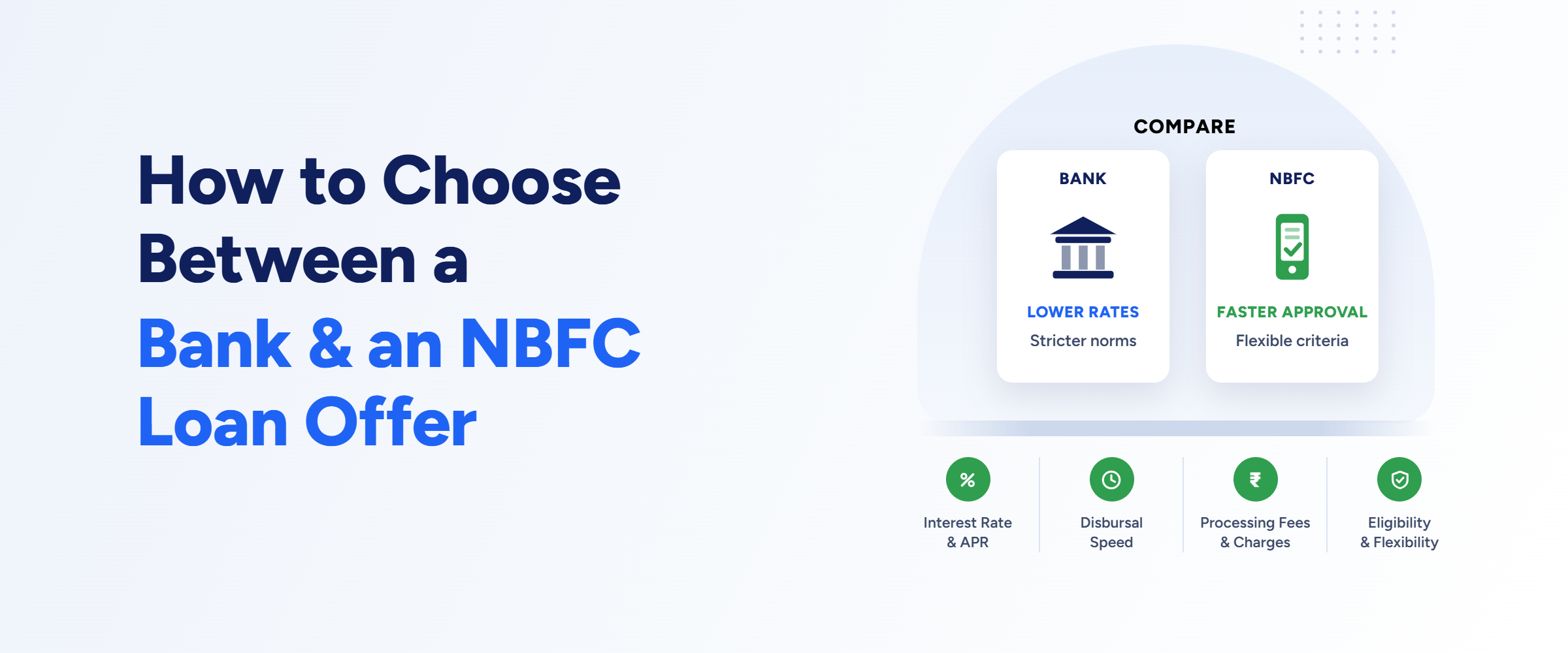
Banks are regulated deposit-taking institutions, while NBFCs (Non-Banking Financial Companies) are regulated by the RBI but don't accept public deposits in the same way. Both are legitimate, RBI-governed lenders, the difference lies in their approach to risk, speed, and eligibility.
1. Interest Rate Isn't the Only Cost
A lower interest rate looks attractive, but total loan cost includes processing fees, foreclosure charges, and any hidden charges. Always compare the full cost, not just the headline rate.
2. NBFC Interest Rates Reflect Risk-Based Pricing
NBFC interest rates are often 1-4% higher than bank rates for similar loan amounts. This isn't arbitrary, NBFCs typically serve borrowers with limited credit history, lower income documentation, or urgent funding needs, and price the additional risk accordingly.
3. Approval Speed Depends on Documentation Depth
Banks often require more extensive documentation and internal approvals, especially for larger loan amounts. NBFCs, particularly digital-first ones, use automated underwriting that can approve and disburse loans within 24-48 hours in many cases.
4. Eligibility Flexibility
If you're newly employed, self-employed with limited ITR history, or have a CIBIL score in the 650-700 range, NBFCs are often more willing to work with your profile than traditional banks.
Bank Loan vs NBFC Loan: Side-by-Side Comparison
| Factor | Bank Loan | NBFC Loan |
|---|---|---|
| Interest rate | Generally lower for strong profiles | Slightly higher, risk-based pricing |
| Approval speed | 3-7 working days typically | Often 24-48 hours, sometimes same day |
| Eligibility flexibility | Stricter income/CIBIL requirements | More flexible for thin-file or self-employed applicants |
| Documentation | Extensive | Often simplified, digital-first |
| Processing fee | Usually 0.5%-2% | Usually 1%-3% |
| Customer relationship | Long-term banking relationship may help | Purely transactional, often app-based |
| Best suited for | Strong CIBIL score, stable salaried income | Urgent needs, limited credit history, faster disbursal |
Detailed Breakdown: When to Choose a Bank
Choose a bank loan if:
Detailed Breakdown: When to Choose an NBFC
Choose an NBFC loan if:
Example: Same Borrower, Two Offers
Rahul's situation: Needs ₹4,00,000 for a medical emergency, CIBIL score 705, salaried with 2 years of work experience.
| Bank Offer | NBFC Offer | |
|---|---|---|
| Interest rate | 13.5% p.a. | 16% p.a. |
| Processing fee | 1% | 2% |
| Disbursal time | 5-6 working days | 24 hours |
| Documentation | Salary slips, bank statements, ITR, address proof | Salary slips, bank statements, PAN, Aadhaar |
Given the medical urgency, Rahul chose the NBFC offer despite the higher rate, the 5-day wait for the bank loan simply wasn't an option. In a non-urgent situation, the bank offer would have been the more cost-effective choice.
This example shows why loan approval speed sometimes outweighs a lower interest rate, depending on the situation.
Common Mistakes When Choosing Between a Bank and NBFC
Expert Tips for Choosing the Right Lender
Compare Personalised Loan Offers
Rather than guessing which lender suits you, compare real, personalised offers from banks and NBFCs side by side before you decide.
Compare Your Personal Loan Offers Now
Conclusion
There's no universal winner between a bank and an NBFC loan, the right choice depends on your CIBIL score, income documentation, urgency, and how much weight you place on interest rate versus speed and flexibility. The smartest approach is to compare personalised offers from both types of lenders side by side, rather than assuming one is always better than the other.

Scan this QR Code


Latest Articles
Merchant Cash Advance vs Business Loan: The Real Cost Comparison
30 Sep 2026
Business Loan Turnover Calculation: Why Cash Sales Don't Count
30 Sep 2026
Unsecured Business Loan vs LAP: The Cost and Speed Tradeoff
30 Sep 2026
Should I Prepay My Personal Loan? Bonus vs EMI Decision Guide
30 Sep 2026
RBI Cooling-Off Period on Personal Loans: What You Can Actually Undo
18 Sep 2026
Relevant Articles
Should I Prepay My Personal Loan? Bonus vs EMI Decision Guide
30 Sep 2026
RBI Cooling-Off Period on Personal Loans: What You Can Actually Undo
18 Sep 2026
Should You Take a Personal Loan During Your Notice Period?
18 Sep 2026
Why Do Two Lenders Offer Different Interest Rates to the Same Borrower?
03 Sep 2026
How to Compare Loan Offers Beyond the Interest Rate
03 Sep 2026
FAQ’s
Yes. NBFCs in India are regulated by the Reserve Bank of India, just like banks, though under a different regulatory framework. Reputed NBFCs are legitimate and safe lending options.
NBFCs often lend to borrowers with limited credit history, lower documentation, or urgent needs that banks may be hesitant to approve quickly. The slightly higher rate reflects this additional risk-based pricing.
NBFC loans, especially from digital-first lenders, are generally faster, with some approvals and disbursals completed within 24-48 hours. Bank loans typically take longer due to more extensive verification processes.
Often, yes. NBFCs tend to have more flexible eligibility criteria and may approve applicants with a CIBIL score in the 650–700 range that some banks might decline.
Not necessarily. It's important to also factor in processing fees, foreclosure charges, documentation requirements, and disbursal speed, the lowest rate doesn't always mean the lowest total cost or best fit for your situation.
 URL copied to clipboard successfully !
Download the IndiaLends App Now
Scan this QR code to download the app