Loans 

Credit Card
IndiaLends App is available in


Merchant Cash Advance vs Business Loan: The Real Cost Comparison
"No EMI, no paperwork, get funded in 24 hours", merchant cash advances are marketed as the easiest money a small business owner can get. And in a narrow sense, that's true: approval is fast, documentation is minimal, and there's no fixed monthly instalment hanging over your head.
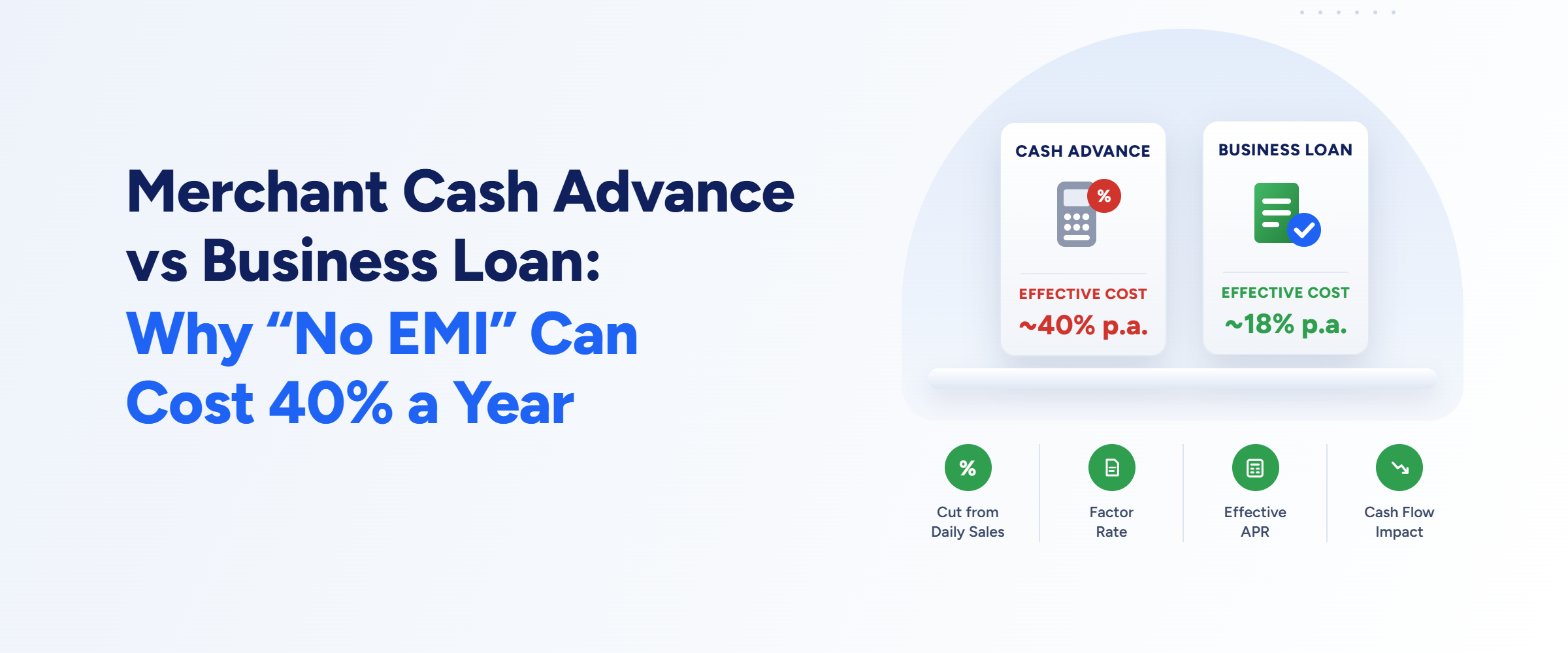
But "no EMI" doesn't mean "no cost." In fact, when you actually annualise the true cost of a typical merchant cash advance, it can easily work out to 35-50% a year or more, a figure that would shock most business owners if it were presented upfront as a simple interest rate. Here's exactly how this product works, and why the "no EMI" pitch can be misleading.
What Is a Merchant Cash Advance?
A Merchant Cash Advance (MCA) isn't technically a loan in the traditional sense, it's an advance against your future sales. A lender gives you a lump sum today, and in return, takes a fixed percentage of your daily card, UPI, or POS transactions until the advance (plus a fee) is fully recovered.
This structure is why MCAs are especially popular among businesses with steady digital transaction volume; restaurants, retail stores, and any merchant using a POS machine or accepting digital payments regularly.
| Feature | How It Works |
|---|---|
| Disbursal | Lump sum upfront, typically within 24–48 hours |
| Repayment mechanism | Automatic daily deduction, a fixed percentage of daily sales |
| Fixed monthly EMI | None, repayment fluctuates with your daily sales volume |
| Total repayment amount | Advance amount + a fixed "factor" fee, agreed upfront |
1. MCA for POS Merchants – Why It's So Widely Offered
MCAs have grown rapidly among POS merchants in India because the entire repayment mechanism is built directly into the payment infrastructure the merchant already uses. Since the lender (often working with the payment processor or POS provider) can see real-time transaction data, they can:
This is precisely why MCAs are heavily marketed to restaurants and kirana-style retail funding needs, these businesses often have strong daily transaction volume but may lack the extensive GST/ITR documentation a traditional lender would require.
2. Daily Deduction From Sales – How Repayment Actually Works
Understanding this mechanism is essential to understanding the true cost.
Instead of a fixed monthly EMI, the lender deducts a pre-agreed percentage of your daily sales, commonly in the range of 10–20%, though this varies by lender and agreement, directly from your daily settlement, until the total repayment amount is fully recovered.
Example:
| Detail | |
|---|---|
| Advance amount | ₹5,00,000 |
| Factor rate (illustrative) | 1.3 |
| Total repayment amount | ₹6,50,000 |
| Daily deduction percentage | 15% of daily sales |
If your daily sales are strong, you repay faster (and the effective annualised cost, paradoxically, can end up even higher, since you're paying the same total fee over a shorter period). If sales slow down, repayment stretches out longer but the total amount owed doesn't reduce, since it was fixed upfront as a flat fee, not a time-based interest calculation.
3. The True Cost of Merchant Cash Advance – Why It's Higher Than It Looks
This is the crux of the issue, and where the "no EMI" framing becomes genuinely misleading.
MCAs are priced using a "factor rate", a flat multiplier applied to the advance amount, rather than an annualised interest rate like a traditional loan. This makes direct comparison difficult unless you convert it properly.
Why the factor rate hides the real cost: a factor rate of 1.3 on a ₹5,00,000 advance means you repay ₹6,50,000 total, a flat ₹1,50,000 fee. If that repayment happens over, say, 5-6 months (which is common, given typical daily sales volumes), the effective annualised cost works out dramatically higher than the flat fee suggests.
| Repayment Period | Approximate Effective Annualised Cost |
|---|---|
| 12 months | Roughly in line with a moderately-priced unsecured business loan |
| 6 months | Substantially higher, can easily exceed 40-50% annualised |
| 3-4 months (fast repayment due to strong sales) | Can be even higher annualised, despite the same flat fee |
This is the core insight most merchants miss: a flat fee that seems reasonable in isolation (say, "just pay back 30% more") becomes an extremely expensive form of financing once you annualise it against a short, sales-dependent repayment period, precisely the kind of period MCAs are typically structured around.
MCA vs Business Loan: Side-by-Side Comparison
| Factor | Merchant Cash Advance | Traditional Business Loan |
|---|---|---|
| Cost structure | Flat factor rate on advance | Annualised interest rate on outstanding balance |
| Effective annualised cost | Often significantly higher (35%+ common) | Generally lower, especially for well-qualified borrowers |
| Repayment mechanism | Automatic daily % of sales | Fixed monthly EMI |
| Documentation required | Minimal, largely transaction history | More extensive, bank statements, GST, ITR |
| Approval speed | Very fast (24-48 hours common) | Days to a couple of weeks |
| Flexibility during slow sales periods | Repayment stretches automatically, but total amount owed stays fixed | EMI stays fixed regardless of sales, can strain cash flow in slow periods |
| Best suited for | Very short-term, urgent needs, limited documentation | Most standard business financing needs |
4. When MCA Is a Genuine Last Resort, and When It Isn't Entirely Unreasonable
It's important not to paint MCAs as universally bad, because they solve a real problem for a specific segment of merchants. But they should be approached with clear eyes about the cost.
MCA might be reasonable when:
MCA is usually the wrong choice when:
Example: Comparing Real Costs
Scenario: A restaurant owner needs ₹4,00,000 for kitchen equipment.
Option A: Merchant Cash Advance — Advance: ₹4,00,000, Factor rate: 1.25 → Total repayment: ₹5,00,000. Expected repayment period based on daily sales: ~5 months. Effective annualised cost: approximately 60% (illustrative, based on the flat ₹1,00,000 fee compressed into a 5-month repayment window).
Option B: Unsecured Business Loan — Loan: ₹4,00,000 at an illustrative 18% p.a., 12-month tenure. Approximate total interest paid over tenure: ~₹42,000. Effective annualised cost: 18%, as stated.
(Figures are illustrative and simplified; actual MCA and loan terms vary significantly by provider and merchant profile.)
The difference here is stark, and it's exactly why understanding the true annualised cost, not just the flat fee or "no EMI" pitch, matters enormously before choosing an MCA.
Common Mistakes Business Owners Make
Expert Tips Before Considering an MCA
Compare Real Business Loan Costs Before You Decide
Check your business loan eligibility on IndiaLends and compare transparent, annualised loan offers from multiple banks and NBFCs, before considering a costlier merchant cash advance.
Check Your Business Loan Eligibility Now
Conclusion
"No EMI" is a genuinely appealing pitch, but it shouldn't be mistaken for "low cost." Merchant cash advances can provide fast, accessible funding for businesses that might not qualify for traditional loans but the true annualised cost, once you do the math, is often dramatically higher than it first appears. Before choosing an MCA, always convert the factor rate into a real annualised percentage and compare it honestly against a traditional business loan, you may find you qualify for meaningfully cheaper financing than the "easy" option in front of you.
Related reading: Lenders Don't Count "Cash Sales": How They Rebuild Your Real Turnover, Unsecured Business Loan vs Loan Against Property, and Business Loan for Seasonal Businesses.

Scan this QR Code


Latest Articles
Pre-Approved Personal Loan Offers: How to Read the Real Rate
09 Oct 2026
Personal Loan After Credit Card Settlement: Is It Possible?
09 Oct 2026
Account Aggregator Personal Loans: What Lenders Read Beyond Your Salary Slip
08 Oct 2026
Salary Overdraft vs Personal Loan: Which One Should You Use?
08 Oct 2026
Loan Against Mutual Funds vs Personal Loan: Which Is Cheaper?
08 Oct 2026
Relevant Articles
Business Loan Turnover Calculation: Why Cash Sales Don't Count
30 Sep 2026
Unsecured Business Loan vs LAP: The Cost and Speed Tradeoff
30 Sep 2026
Udyam Registration and Business Loans: Does MSME Registration Help?
03 Sep 2026
Seasonal Business Loan: Planning Funds Around Inventory & Revenue Cycles
03 Sep 2026
How Bank Statements Influence Business Loan Approval
10 Aug 2026
FAQ’s
No. An MCA is an advance against future sales, repaid through automatic daily deductions from your transactions, priced using a flat factor rate, not an annualised interest rate like a traditional business loan.
Because MCAs use a flat factor rate applied over a relatively short, sales-dependent repayment period. When this flat fee is converted into an annualised percentage, it often works out significantly higher than a traditional loan's interest rate, commonly 35% or more.
They're particularly popular with POS-based merchants like restaurants and retail stores due to strong, trackable daily transaction volume, but they're offered to various businesses with consistent digital sales, not exclusively these categories.
It can be reasonable for short-term, urgent needs when you don't qualify for traditional business financing, or for a quick, self-liquidating opportunity, provided you've calculated and accepted the true annualised cost involved.
Convert the MCA's total fee (based on the factor rate) into an effective annualised percentage, based on your expected repayment period from daily sales, and compare this directly against a business loan's stated annual interest rate.
 URL copied to clipboard successfully !
Download the IndiaLends App Now
Scan this QR code to download the app