Loans 

Credit Card
IndiaLends App is available in


Business Loan Turnover Calculation: Why Cash Sales Don't Count
You tell the lender your shop does ₹15,00,000 a year in sales. Your bank statement, GST returns, and loan offer suggest something closer to ₹9,00,000. This gap is one of the most common and most frustrating surprises small business owners run into when applying for a business loan.
The reason isn't that lenders don't believe you. It's that "turnover" as you understand it and "turnover" as a lender calculates it for loan eligibility are often two very different numbers. Understanding exactly how lenders rebuild your real turnover can help you present a stronger application and set realistic expectations before you apply.
Why Lenders Don't Simply Take Your Word for It
Every business owner has an incentive to report their revenue as favourably as possible when applying for a loan. Lenders know this, which is why they don't rely on verbal claims or even self-reported figures alone. Instead, they reconstruct your turnover from verifiable, third-party data sources, primarily your bank statements and GST filings, because these are far harder to inflate or misrepresent.
This is the core of business loan turnover calculation: not what you say you earn, but what the data actually shows.
1. Current Account Credits vs GST Turnover
These are the two primary data sources lenders cross-reference, and they don't always match perfectly, which is exactly the point.
Current account credits refer to the total money flowing into your business's current account over a defined period (usually the last 12 months), as reflected in your bank statements.
GST turnover refers to the revenue you've formally declared in your GST returns, which is the officially recognised figure for tax purposes.
| Data Source | What It Reflects | Why Lenders Use It |
|---|---|---|
| Current account credits | Actual money that moved through your formal banking channel | Hard to fabricate; reflects real cash flow |
| GST returns | Officially declared revenue for tax purposes | Cross-verifiable with government records; a consistency check |
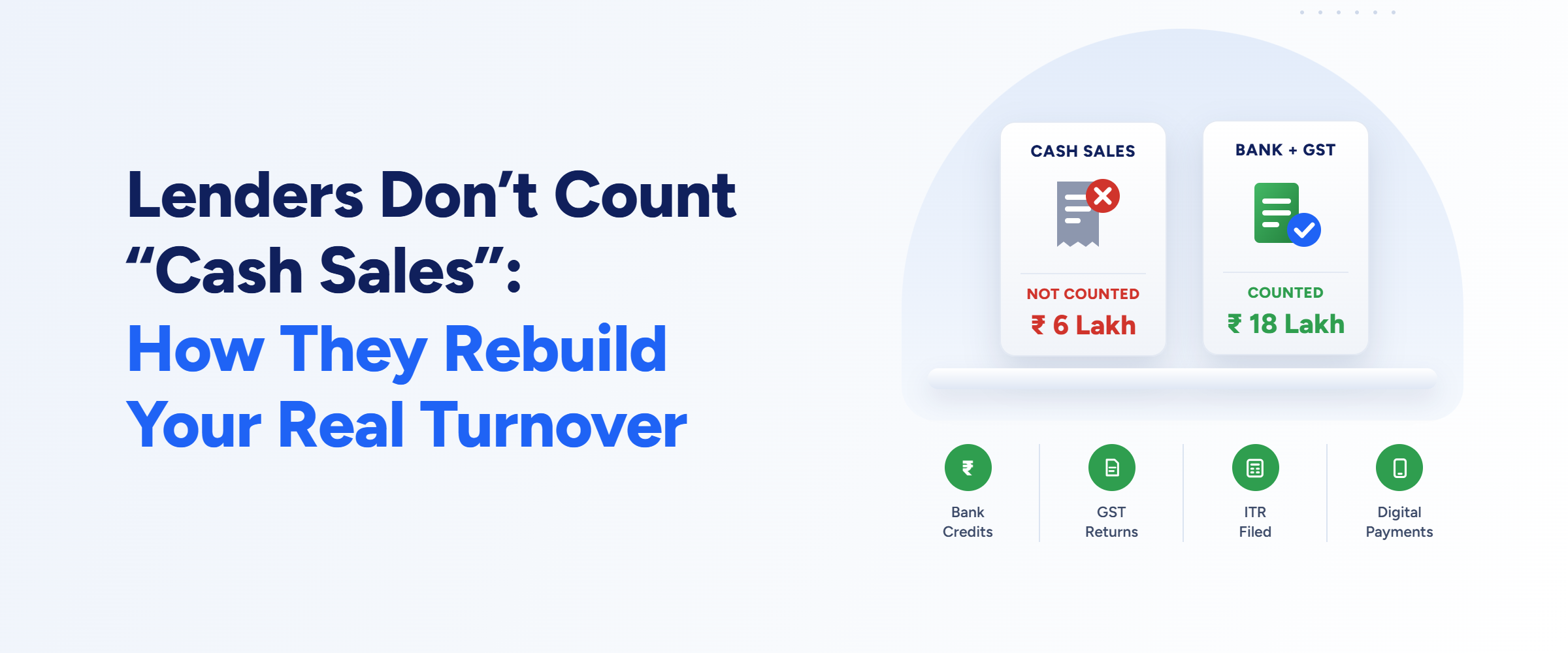
Why the mismatch happens: if a portion of your sales happens in cash and isn't deposited into your current account or isn't fully reflected in GST filings (whether due to informal practices, cash-heavy operations, or simple inconsistency in record-keeping), your bank credits and GST turnover can both undercount your actual business activity, and neither will match the figure you might quote from memory or your own internal records.
2. Cash Sales and MSME Loans – Why They Don't Count
This is the crux of the issue for a huge number of small businesses in India, many of which still operate with a meaningful cash component; kirana stores, small restaurants, local service providers.
Cash sales MSME loan eligibility challenges arise because:
The practical reality: if your cash sales aren't formally banked and reflected in your account credits (and ideally supported by consistent GST filings), they simply won't count toward your loan eligibility, no matter how real that revenue is to your actual business.
This is one of the most important, if sometimes unwelcome, truths in Indian MSME lending: your loan eligibility reflects your formal, bankable turnover, not your total economic activity.
3. How Bank Statement Analysis for Business Loans Actually Works
Lenders don't just eyeball your bank statement; they apply a structured analytical process to extract a reliable turnover estimate.
Typical steps in bank statement analysis:
4. Average Monthly Credits Lending – The Practical Formula
Most lenders build their working capital and business loan eligibility around a simplified, but consistent, formula based on average monthly credits.
A commonly used approach (illustrative, varies by lender): Eligible Loan Amount ≈ A multiple of Average Monthly Bank Credits (the specific multiple depends on the lender's policy, loan type, and your overall credit profile).
| Amount | |
|---|---|
| Average monthly current account credits (last 12 months) | ₹1,20,000 |
| Lender's eligibility multiple (illustrative) | 4-6x |
| Approximate eligible loan range | ₹4,80,000 – ₹7,20,000 |
This is why two businesses with the same self-reported annual turnover can receive very different loan offers, the one with cleaner, more consistent, fully banked credits will typically qualify for a meaningfully higher loan amount.
5. Inflated Turnover Red Flags
Lenders are also specifically trained to spot signs that a business may be attempting to present an inflated or misleading picture of its actual turnover. Common red flags include:
Triggering these flags doesn't automatically mean rejection, but it typically leads to additional scrutiny, requests for clarification, or a more conservative eligibility assessment, which can slow down your application and potentially reduce your offered loan amount.
Example: Two Businesses, Same Claimed Turnover, Different Outcomes
Business A: Ravi's Electronics Store — Ravi claims ₹18,00,000 annual turnover. His bank statements show average monthly credits of ₹1,45,000 (annualised: ~₹17,40,000), closely matching his GST returns. His figures are consistent, well-documented, and easily verified, resulting in a smooth loan approval process and an eligibility assessment close to his claimed turnover.
Business B: Meena's General Store — Meena also claims ₹18,00,000 annual turnover, largely cash based. Her bank statements show average monthly credits of only ₹60,000 (annualised: ~₹7,20,000), and her GST returns reflect a similarly modest figure. Despite her genuine belief that her shop does significantly more business, her loan eligibility is calculated based on the ₹7,20,000 figure the data supports, resulting in a considerably smaller loan offer than she expected.
The lesson here isn't that Meena's business is smaller than Ravi's, it may well not be. It's that only formally banked, verifiable turnover counts toward loan eligibility, regardless of a business's true economic scale.
Common Mistakes Business Owners Make
Expert Tips for Presenting Your Real Turnover Strongly
Get a Realistic Business Loan Assessment
Check your business loan eligibility on IndiaLends and understand exactly how your bank statement and GST data translate into your real loan eligibility, before you apply.
Check Your Business Loan Eligibility Now
Conclusion
The gap between what you believe your business earns and what a lender is willing to offer often comes down to one simple truth: lenders can only assess what's verifiable. Bank statement credits and GST returns form the backbone of business loan turnover calculation, and cash sales that never enter the formal banking system simply don't count, however real they are to your actual business. The most effective way to close this gap isn't to argue with a lender's assessment, it's to build a clean, consistent, fully banked transaction history well before you need to apply.
Related reading: Udyam Registration and Business Loans, Business Loan for Seasonal Businesses, and Unsecured Business Loan vs Loan Against Property.

Scan this QR Code


Latest Articles
Pre-Approved Personal Loan Offers: How to Read the Real Rate
09 Oct 2026
Personal Loan After Credit Card Settlement: Is It Possible?
09 Oct 2026
Account Aggregator Personal Loans: What Lenders Read Beyond Your Salary Slip
08 Oct 2026
Salary Overdraft vs Personal Loan: Which One Should You Use?
08 Oct 2026
Loan Against Mutual Funds vs Personal Loan: Which Is Cheaper?
08 Oct 2026
Relevant Articles
Merchant Cash Advance vs Business Loan: The Real Cost Comparison
30 Sep 2026
Unsecured Business Loan vs LAP: The Cost and Speed Tradeoff
30 Sep 2026
Udyam Registration and Business Loans: Does MSME Registration Help?
03 Sep 2026
Seasonal Business Loan: Planning Funds Around Inventory & Revenue Cycles
03 Sep 2026
How Bank Statements Influence Business Loan Approval
10 Aug 2026
FAQ’s
Lenders calculate eligibility based on verifiable data, primarily your bank statement credits and GST returns, not your self-reported total sales. If a portion of your revenue is in cash and not formally banked, it typically won't be reflected in your loan eligibility.
Generally, only cash sales that are consistently deposited into your formal business bank account are considered, since lenders need verifiable, traceable data. Cash that stays outside the banking system usually isn't factored into turnover calculations.
Lenders typically analyse your average monthly bank credits over the past 6-12 months, cross-reference this against your GST returns, and apply their own eligibility formula (often a multiple of average monthly credits) to determine your loan amount.
Large, irregular deposits, deposits immediately followed by matching withdrawals, sudden spikes in bank credits before applying, and significant mismatches between bank credits and GST-declared turnover can all raise scrutiny and potentially lower your loan offer.
Start depositing cash sales consistently into your business's formal bank account well before applying, keep personal and business transactions separate, and ensure your GST filings are reconciled with your banking pattern to build a clean, verifiable financial history.
 URL copied to clipboard successfully !
Download the IndiaLends App Now
Scan this QR code to download the app