Loans 

Credit Card
IndiaLends App is available in


RBI Cooling-Off Period on Personal Loans: What You Can Actually Undo
You applied for a personal loan through an app, got instant approval, and the money hit your account within minutes. Then, a day or two later, you reconsider, maybe you found a cheaper offer elsewhere, or you simply don't need the full amount anymore. Can you undo it?
Thanks to RBI's digital lending framework, the answer is often yes, through what's known as the cooling-off period (also called the look-up period). But there's a lot of confusion about exactly how long this window is, what it lets you cancel, and what it actually costs. Let's clear that up.
What Is the Cooling-Off Period?
The cooling-off period is a mandatory window, built into every digital loan contract from RBI-regulated lenders, during which you can exit the loan entirely by repaying the principal and a proportionate interest charge, without being hit with the penalties or exit charges that would normally apply to early loan closure.
Think of it as a short, structured "buyer's remorse" window specifically designed for digital lending, where loans are often approved and disbursed within minutes, sometimes before a borrower has had time to fully compare alternatives.
1. How Long Is the Cooling-Off Period, Really?
This is where a lot of outdated information circulates, so let's be precise.
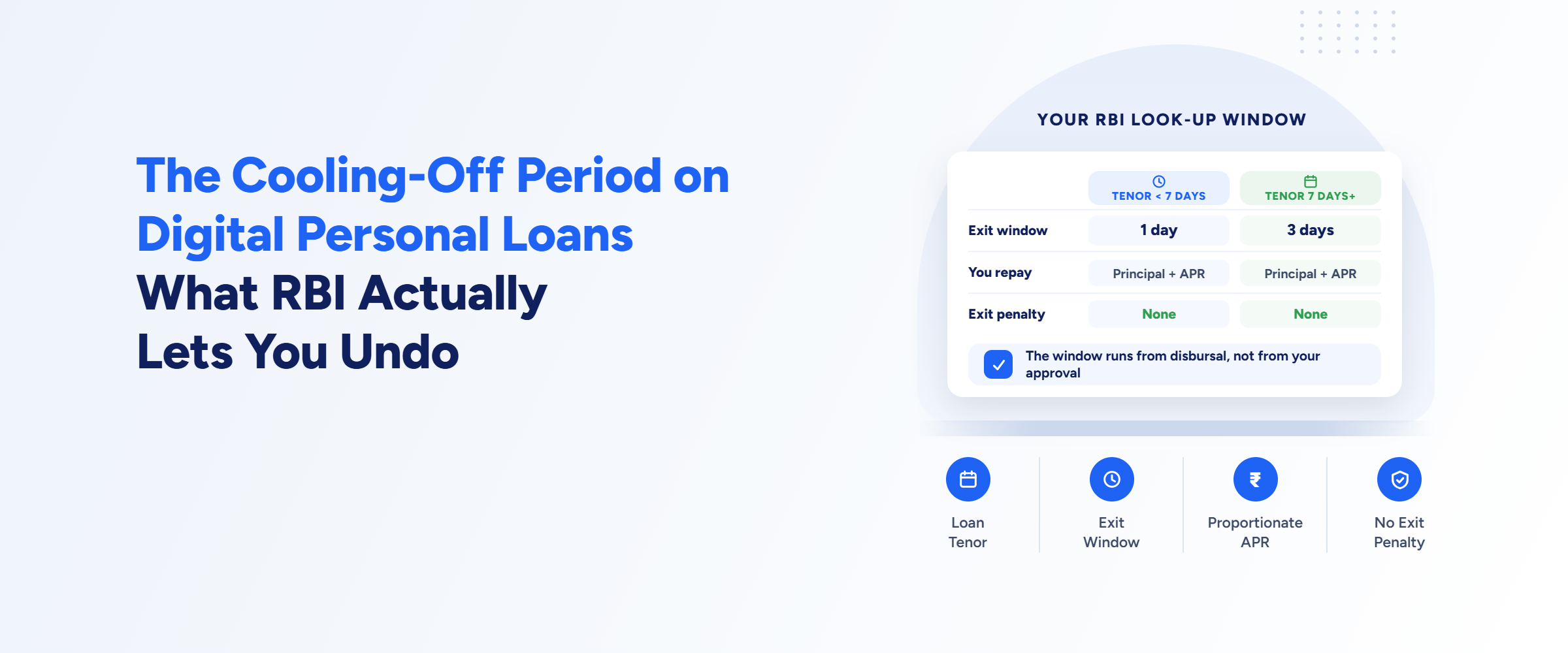
Under RBI's earlier digital lending guidelines, the commonly cited minimum cooling-off period was 3 days for loans with a tenure of more than 7 days, and 1 day for shorter-tenure loans. This "3-day" figure is still widely referenced in personal loan discussions and continues to be used as the actual disclosed period by many lenders.
However, under RBI's more recent, consolidated Digital Lending Directions, this requirement was revised: the minimum cooling-off period is now at least 1 day, with the exact duration determined by each lender's own Board-approved policy, meaning individual lenders can, and often still do, offer 3 days or more, but the regulatory floor itself has been set at a minimum of just 1 day.
| Period | Regulatory Position |
|---|---|
| Earlier guidance | Minimum 3 days for loans with tenure over 7 days; 1 day for shorter-tenure loans |
| Current Directions | Minimum 1 day for all digital loans, with exact duration set by the lender's Board policy |
Practical implication: Don't assume your specific loan automatically comes with a 3-day window. Always check your loan's Key Fact Statement (KFS), this document is required to explicitly disclose your loan's specific cooling-off period, since it can now legitimately vary by lender.
2. What You Can Actually Undo During This Period
This is the part that surprises many borrowers: the cooling-off period isn't free, it lets you exit the loan without penalty charges, but you're still required to repay what you've genuinely used.
Specifically, during the cooling-off period, you can exit your digital loan by paying the full principal amount disbursed to you, plus a proportionate interest charge, calculated only for the actual number of days the loan was outstanding (i.e., from disbursal date to the date you repay and exit).
What you don't have to pay, if you exit within this window: foreclosure or prepayment penalties that would normally apply to early loan closure, and any additional exit-specific charges beyond the proportionate interest already accrued.
| What Happens | During Cooling-Off Period | After Cooling-Off Period Ends |
|---|---|---|
| Repay principal | Required | Required |
| Pay proportionate interest for days elapsed | Required | Required (as part of ongoing EMI/interest schedule) |
| Foreclosure/prepayment penalty | Not applicable | May apply, depending on loan type (though floating-rate loans to individuals generally can't carry these either, under separate RBI rules) |
| Processing fee already paid | Lenders may retain a disclosed one-time processing fee | Not applicable, you're past the exit window |
3. Foreclosure Charges and the Cooling-Off Period
Here's an important nuance worth understanding clearly: the cooling-off period specifically waives penalties associated with early exit, it doesn't mean the loan was free of cost during those days.
Example: You take a personal loan of ₹1,50,000 with a 3-day cooling-off period disclosed in your KFS. On day 2, you decide to exit. You'll need to repay the full ₹1,50,000 principal, plus interest calculated for those 2 days the loan was outstanding, at your agreed rate, with no foreclosure penalty, since you're exiting within the disclosed cooling-off window.
If you'd waited until day 5 to exit (after the 3-day window closed, in this example), you'd potentially face your lender's standard foreclosure terms instead, which may or may not include a penalty, depending on whether your loan is a floating-rate loan for individual, non-business purposes (which generally cannot carry foreclosure charges under a separate RBI rule).
4. Digital Lending Guidelines India – The Bigger Picture
The cooling-off period is just one piece of a much broader regulatory framework RBI has built specifically for digital lending, aimed at protecting borrowers from mis-selling, opaque terms, and predatory practices that had become common with certain digital lending apps. Key related protections include:
Why this matters for you: these protections only apply when you're borrowing from an RBI-regulated entity (a bank or NBFC) or their properly registered lending partner. Always verify this before taking a digital loan, especially from a newer or lesser-known app.
NBFC Digital Loan Rules: Do They Apply Equally to Banks and NBFCs?
Yes. RBI's Digital Lending Directions apply uniformly to all Regulated Entities, this includes banks, NBFCs, and their associated Lending Service Providers offering digital loans. There's no separate, lighter framework for NBFCs specifically; the cooling-off period, KFS requirements, and direct disbursal rules apply equally, regardless of whether you're borrowing from a large bank's app or a smaller NBFC's digital lending platform.
Personal Loan Look-Up Period: How to Actually Exercise This Right
If you've decided to exit your loan within the cooling-off period, here's the general process:
Example: Two Borrowers Using the Cooling-Off Window
Case 1: Vikram, Exits Successfully — Vikram took a ₹2,00,000 personal loan through a digital lending app, disbursed on a Monday. His KFS disclosed a 3-day cooling-off period. On Wednesday, he found a better offer from another lender and decided to exit. He paid ₹2,00,000 principal plus 2 days' proportionate interest, with no foreclosure penalty, and received written closure confirmation the same day.
Case 2: Sneha, Misses the Window — Sneha took a similar loan with a cooling-off period disclosed as just 1 day, per her specific lender's policy. She decided on day 3 that she wanted to exit, only to realise her cooling-off window had already closed. She proceeded with her lender's standard foreclosure process instead, which, since her loan was a floating-rate personal loan, still didn't carry a foreclosure penalty under separate RBI rules, though she'd missed the specific "no-questions" simplicity of the cooling-off exit.
Both cases highlight the same lesson: always check your specific cooling-off period upfront, since it isn't a fixed, universal number anymore.
Common Mistakes Borrowers Make
Expert Tips for Using the Cooling-Off Period Wisely
Compare Transparent Personal Loan Offers
Check your personal loan eligibility on IndiaLends and compare offers from RBI-regulated banks and NBFCs with clear Key Fact Statements and transparent cooling-off terms before you commit.
Check Your Personal Loan Eligibility Now
Conclusion
RBI's cooling-off period is a genuinely useful safety net for digital personal loan borrowers, but it's often misunderstood as a free, no-cost cancellation window, it isn't. It waives the penalty for early exit, not the interest you've already accrued, and its exact duration can now vary by lender rather than being a fixed 3 days for everyone. The moment your loan is disbursed, check your Key Fact Statement for the specific window that applies to you and if you have second thoughts, act within that window rather than assuming you have more time than you actually do.
Related reading: Should You Take a Personal Loan During Your Notice Period?, How to Compare Loan Offers Beyond the Interest Rate, and Why Two Lenders Offer Different Rates to the Same Borrower.

Scan this QR Code


Latest Articles
Account Aggregator Personal Loans: What Lenders Read Beyond Your Salary Slip
08 Oct 2026
Salary Overdraft vs Personal Loan: Which One Should You Use?
08 Oct 2026
Loan Against Mutual Funds vs Personal Loan: Which Is Cheaper?
08 Oct 2026
Can I Take Two Personal Loans at the Same Time? Risks Explained
08 Oct 2026
Merchant Cash Advance vs Business Loan: The Real Cost Comparison
30 Sep 2026
Relevant Articles
Account Aggregator Personal Loans: What Lenders Read Beyond Your Salary Slip
08 Oct 2026
Salary Overdraft vs Personal Loan: Which One Should You Use?
08 Oct 2026
Loan Against Mutual Funds vs Personal Loan: Which Is Cheaper?
08 Oct 2026
Can I Take Two Personal Loans at the Same Time? Risks Explained
08 Oct 2026
Should I Prepay My Personal Loan? Bonus vs EMI Decision Guide
30 Sep 2026
FAQ’s
It's a mandatory window, disclosed in your loan's Key Fact Statement, during which you can exit a digital personal loan without foreclosure penalties by repaying the principal and proportionate interest for the days the loan was outstanding. Under current RBI Directions, the minimum is 1 day, though individual lenders may offer longer periods.
Not necessarily anymore. While 3 days was the earlier commonly cited minimum for loans over 7 days' tenure, RBI's current Digital Lending Directions set the minimum at just 1 day, with the exact duration determined by each lender's own policy and disclosed in the KFS.
Not entirely free, you're still required to repay the full principal and a proportionate interest charge for the days the loan was outstanding. What you avoid is the foreclosure or prepayment penalty that would otherwise apply to early exit.
Yes. RBI's Digital Lending Directions apply uniformly to all Regulated Entities, including both banks and NBFCs, along with their associated Lending Service Providers.
You'd proceed under the lender's standard foreclosure process instead. Depending on your loan type, a foreclosure penalty may or may not apply, floating-rate personal loans for individuals generally cannot carry such penalties under a separate RBI rule, but it's worth confirming with your specific lender.
 URL copied to clipboard successfully !
Download the IndiaLends App Now
Scan this QR code to download the app