Loans 

Credit Card
IndiaLends App is available in


Salary Overdraft vs Personal Loan: Which One Should You Use?
"I have an overdraft facility on my salary account, isn't that basically a personal loan?" This is one of the most common points of confusion among salaried professionals in India, and the honest answer is: not quite, and the difference matters a lot for your wallet.
Both products give you access to extra funds beyond your regular salary. But how they're structured, how interest is charged, and when each one actually makes financial sense are genuinely different. Let's clear up the confusion.
What Is a Salary Overdraft?
A salary overdraft (OD against salary account) is a credit facility linked directly to your existing salary account, allowing you to withdraw more money than your actual account balance, up to a pre-approved limit, without applying for a separate loan each time you need funds.
Many banks, including major players like HDFC and ICICI, offer this facility automatically or on request to salaried customers with a consistent salary credit history, often without requiring a fresh, lengthy loan application process.
| Feature | Salary Overdraft |
|---|---|
| Linked to | Your existing salary account |
| Access | Draw funds anytime up to the sanctioned limit |
| Repayment | Flexible, repay anytime, no fixed EMI mandated |
| Interest charged on | Only the amount and days actually utilised |
| Renewal | Typically reviewed and renewed periodically (often annually) |
1. How OD Against Salary Account Actually Works
Here's the mechanism, step by step:
This is fundamentally different from a personal loan, where a lump sum is disbursed once, and you repay it through fixed EMIs over a set tenure, regardless of whether you actually needed the full amount for the entire period.
2. Interest Charged Only on Usage – Why This Matters
This single structural difference is the core reason salary overdrafts can be significantly cheaper than personal loans for certain usage patterns.
Personal loan interest: calculated on the full disbursed amount from day one, for the entire tenure (reducing as you pay EMIs, but you're committed to the full amount and schedule upfront).
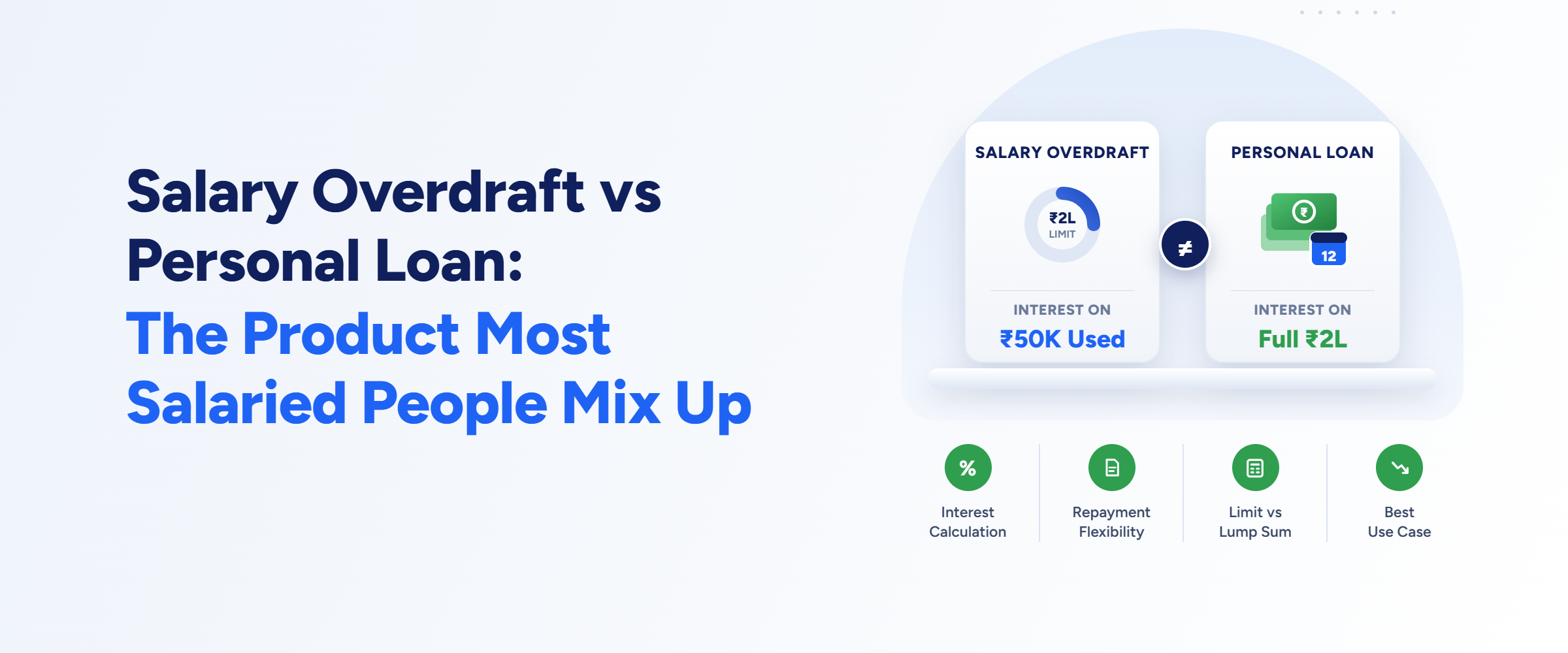
Salary overdraft interest: calculated only on the amount actually drawn, only for the days it remains outstanding. If you draw ₹1,00,000 for just 10 days and repay it, you pay interest for exactly those 10 days on that ₹1,00,000, nothing more.
Example:
| Scenario | Personal Loan | Salary Overdraft |
|---|---|---|
| You need ₹2,00,000 for 15 days only, then repay in full | Interest calculated on full tenure you originally committed to (e.g., 12 months), even if you prepay (subject to prepayment terms) | Interest calculated only for those 15 days on ₹2,00,000 |
This makes overdraft facilities particularly well-suited to short, unpredictable, or recurring cash flow gaps, rather than a large, one-time need with a clear, long repayment plan.
3. Flexi Personal Loan vs Overdraft – Aren't They the Same Thing?
This is genuinely where a lot of confusion comes from, because flexi personal loans are specifically designed to mimic the overdraft experience within a personal loan structure.
| Feature | Traditional Personal Loan | Flexi Personal Loan | Salary Overdraft |
|---|---|---|---|
| Disbursal | Full amount upfront | Sanctioned limit, draw as needed | Sanctioned limit, draw as needed |
| Interest calculation | On full amount for full tenure | Only on amount utilised | Only on amount utilised |
| Repayment flexibility | Fixed EMI | Interest-only EMI option, principal flexible | Fully flexible, no mandated EMI |
| Linked to salary account | No, separate loan account | No, separate loan account | Yes, part of existing salary account |
| Typical provider | Banks and NBFCs broadly | Banks and NBFCs offering this specific product | Primarily banks, tied to salary account relationship |
The key distinction: a flexi personal loan is a loan product engineered to behave like an overdraft (usage-based interest, flexible drawdown), while a salary overdraft is a banking facility directly attached to your existing salary account relationship. Functionally, for interest calculation purposes, they can feel quite similar, but eligibility, provider, and account structure differ.
4. HDFC, ICICI, and Salary OD – What to Expect
Major banks with large salaried customer bases, including HDFC Bank and ICICI Bank, commonly offer salary overdraft facilities as part of their broader relationship with salary account holders. While specific terms, limits, and eligibility criteria vary and change over time (so it's always worth checking current details directly with your bank), the general pattern typically includes:
Practical tip: if you're a salaried employee with an existing relationship with a bank offering this facility, it's worth directly asking whether you're eligible for a salary overdraft, it's often a more cost-efficient option than defaulting straight to a personal loan application, especially for smaller, short-term needs.
When Is Overdraft Cheaper Than an EMI Loan?
This is the practical question that matters most. Here's a framework:
| Your Situation | Better Fit |
|---|---|
| Short-term, unpredictable cash flow gaps (a few days to a couple of months) | Salary overdraft |
| Need funds repeatedly, in varying amounts, over time | Salary overdraft |
| Large, one-time expense with a clear, long repayment plan (12+ months) | Personal loan (or flexi personal loan) |
| Want the discipline of a fixed EMI to ensure structured repayment | Personal loan |
| Not sure exactly how much you'll need or for how long | Salary overdraft (pay only for what you use) |
| Need a larger amount than your bank's OD limit typically offers | Personal loan |
The core principle: overdraft facilities are cost-efficient specifically because of their usage-based interest structure, the shorter and more unpredictable your need, the more this advantage compounds in your favour. For a large, planned, long-tenure need, a traditional (or flexi) personal loan's structure is often more appropriate anyway.
Example: Two Borrowers, Two Products
Case 1: Salary Overdraft — Rahul has a ₹2,50,000 salary overdraft limit with his bank. Over the year, he draws ₹50,000 here, ₹80,000 there, always for short periods, repaying quickly whenever his salary or other income comes in. He never pays interest on the full limit, only on what he's actually used, for the exact days he's used it, keeping his overall interest cost quite low relative to the flexibility he's getting.
Case 2: Personal Loan — Sunita needs ₹5,00,000 for a home renovation, a large one-time expense she plans to repay steadily over 3 years. A personal loan's fixed EMI structure suits her well, she wants predictability in her monthly budget, and the overdraft's flexibility isn't particularly useful for a need she already knows the full scope and timeline of.
Both made the right choice for their specific usage pattern, the products simply aren't interchangeable in purpose, despite surface-level similarities.
Common Mistakes People Make
Expert Tips for Choosing the Right Product
Compare Personal Loan Options Alongside Your Bank's Overdraft
Check your personal loan eligibility on IndiaLends and compare offers from multiple banks and NBFCs, so you can weigh them against your salary account's overdraft facility and choose the genuinely cheaper option.
Check Your Personal Loan Eligibility Now
Conclusion
A salary overdraft and a personal loan solve different problems, even though they're often mentally lumped together as "extra credit from the bank." The overdraft's usage-based interest makes it genuinely cost-efficient for short-term, unpredictable needs, while a personal loan's fixed structure suits large, planned expenses better. Knowing which product actually fits your situation, rather than defaulting to whichever one you're more familiar with, can meaningfully reduce what you end up paying in interest.
Related reading: Personal Loan vs Loan Against Mutual Funds: Which Is Cheaper for 3–12 Months?, Two Personal Loans at Once: When Stacking Turns Into a Trap, Bonus in the Bank: Prepay the Personal Loan or Keep the EMI Running?, and Bank vs NBFC Loan: How to Choose the Right Offer.

Scan this QR Code


Latest Articles
Account Aggregator Personal Loans: What Lenders Read Beyond Your Salary Slip
08 Oct 2026
Loan Against Mutual Funds vs Personal Loan: Which Is Cheaper?
08 Oct 2026
Can I Take Two Personal Loans at the Same Time? Risks Explained
08 Oct 2026
Merchant Cash Advance vs Business Loan: The Real Cost Comparison
30 Sep 2026
Business Loan Turnover Calculation: Why Cash Sales Don't Count
30 Sep 2026
Relevant Articles
Account Aggregator Personal Loans: What Lenders Read Beyond Your Salary Slip
08 Oct 2026
Loan Against Mutual Funds vs Personal Loan: Which Is Cheaper?
08 Oct 2026
Can I Take Two Personal Loans at the Same Time? Risks Explained
08 Oct 2026
Should I Prepay My Personal Loan? Bonus vs EMI Decision Guide
30 Sep 2026
RBI Cooling-Off Period on Personal Loans: What You Can Actually Undo
18 Sep 2026
FAQ’s
A salary overdraft is a flexible credit facility linked to your existing salary account, where interest is charged only on the amount and days utilised. A personal loan is a separate loan product with a lump-sum disbursal and fixed EMI repayment over a set tenure.
It can be, particularly for short-term or unpredictable cash needs, since interest is charged only on what you actually use. For large, long-tenure needs, a personal loan's structure may be more cost-effective or appropriate overall.
Yes, major banks including HDFC and ICICI commonly offer overdraft facilities to eligible salary account holders, though specific terms and eligibility criteria vary and are worth confirming directly with the bank.
A flexi personal loan is a distinct loan product designed to offer overdraft-like flexibility, usage-based interest and flexible drawdown, but it's a separate loan account, not tied to your existing salary account like a true salary overdraft.
Choose a personal loan for large, one-time expenses with a clear, long repayment plan, where you want the predictability of a fixed EMI, or if your funding need exceeds your bank's overdraft limit.
 URL copied to clipboard successfully !
Download the IndiaLends App Now
Scan this QR code to download the app