Loans 

Credit Card
IndiaLends App is available in


Should I Prepay My Personal Loan? Bonus vs EMI Decision Guide
Your annual bonus just landed, and there's a running personal loan EMI quietly deducting from your account every month. The instinct for many people is simple: pay it off, feel lighter, move on. But is that actually the financially smarter move or just the emotionally satisfying one?
This is one of the most common money decisions Indian salaried professionals face, and the right answer depends on more than just "debt feels bad." Let's work through the real numbers.
The Core Question: Guaranteed Saving vs Uncertain Return
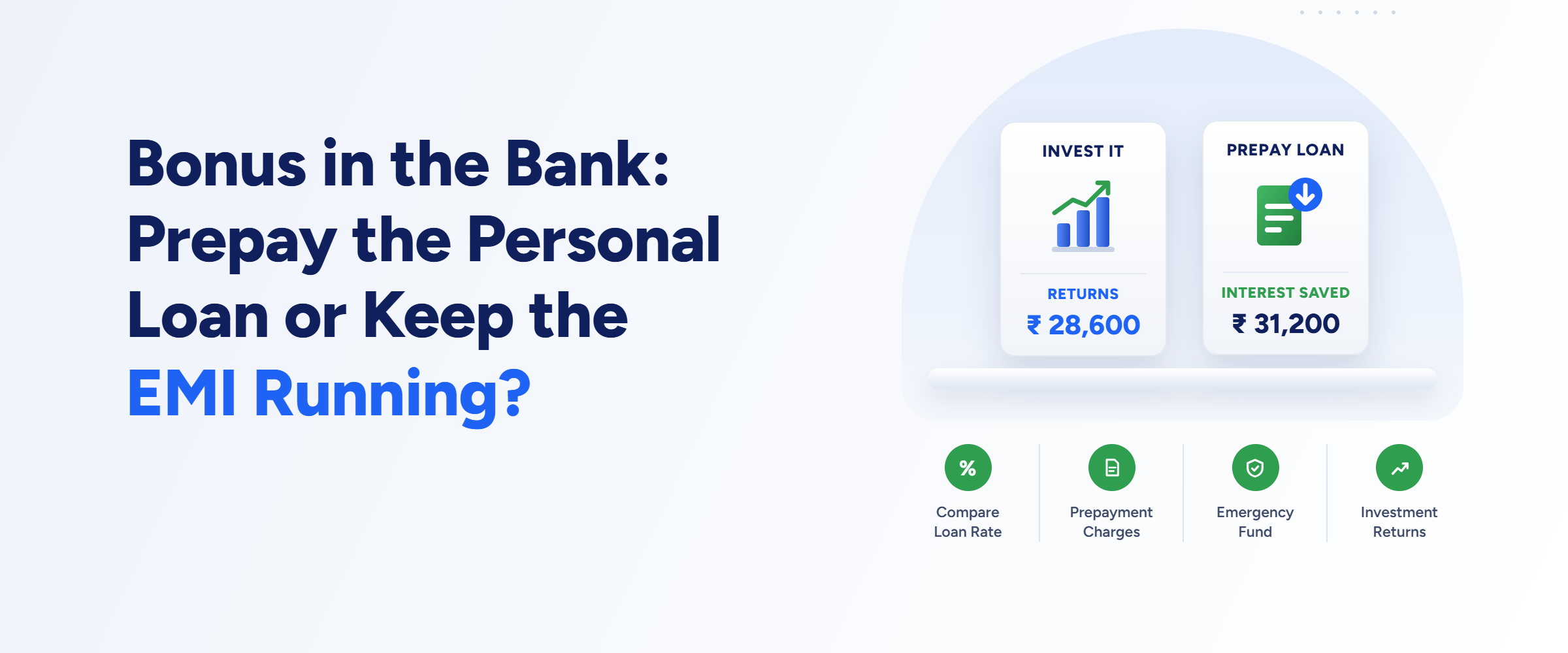
At its heart, this decision comes down to one comparison: the interest rate you're paying on your personal loan versus the return you could realistically earn if you invested that money instead.
If your personal loan interest rate is 13% and you're confident you can only earn 7-8% safely elsewhere, prepayment is mathematically the better move. If you have a longer investment horizon and higher risk tolerance, the calculation gets more nuanced.
1. How Reducing Balance Interest Works
Before deciding anything, it helps to understand exactly how your personal loan interest is calculated. Almost all personal loans in India use the reducing balance method, interest is charged only on your outstanding principal, which shrinks with every EMI you pay.
This has an important implication: the earlier in your loan tenure you prepay, the more interest you save, because a larger portion of your outstanding principal has more months left to accrue interest.
| When You Prepay | Relative Interest Savings |
|---|---|
| Early in the tenure (first 25%) | Highest savings, most principal, most remaining months |
| Midway through the tenure | Moderate savings |
| Near the end of the tenure | Lowest savings, most of the interest has already been paid in earlier EMIs |
This is why prepaying a loan you took 8 months ago saves you meaningfully more than prepaying the same outstanding amount on a loan that's 30 months into a 36-month tenure.
2. Personal Loan Part-Prepayment Charges
Many borrowers assume prepayment is always free. It often isn't, though the rules depend heavily on your specific loan type.
Key RBI rule: Floating-rate personal loans extended to individual borrowers for non-business purposes cannot carry prepayment or foreclosure penalties. This covers a large share of standard personal loans taken by salaried individuals.
However, this exemption doesn't apply universally:
| Loan Type | Prepayment Charges Likely? |
|---|---|
| Floating-rate personal loan, individual, non-business purpose | Generally no charges permitted |
| Fixed-rate personal loan | May carry prepayment charges, depending on lender |
| Loan taken for business purposes (even if personal loan product) | May carry prepayment charges |
| Loan to non-individual entities (proprietorship, etc.) | Prepayment charge exemption doesn't apply |
Always check your specific loan agreement. Even when charges do apply, they're typically a percentage of the prepaid amount (commonly 2-5%), and this cost needs to be factored into your prepay-vs-invest decision.
3. Personal Loan Foreclosure vs Continue – What Each Actually Means
Most lenders let you choose, after a part-prepayment, whether to reduce the tenure (keep EMI the same, finish earlier) or reduce the EMI (keep tenure the same, pay less monthly). If your goal is maximum interest savings, reducing the tenure is almost always the better choice, you get out of the interest-accruing period faster.
4. Surplus Money – Prepay or Invest?
This is the genuinely nuanced part of the decision. Let's compare it directly.
| Factor | Favours Prepayment | Favours Investing |
|---|---|---|
| Loan interest rate is high (13%+) | ✓ | |
| You have a low risk tolerance | ✓ | |
| You lack any other emergency fund | ✓ (build emergency fund first) | |
| You have a long investment horizon (5+ years) | ✓ | |
| Your loan is nearing its end anyway | ✓ (limited benefit either way) | |
| You already have high-interest debt elsewhere (credit card) | ✓ (clear that first) | |
| You have access to tax-advantaged, long-term investment options | ✓ |
A practical rule of thumb many financial planners use: if your loan's interest rate is meaningfully higher than the return you can confidently expect from a safe investment option, prepayment usually wins. If your loan rate is on the lower side and you have a genuinely long investment horizon, investing can make more sense, but only after you have a basic emergency fund in place.
5. Tax on Personal Loan Interest – Does It Change the Math?
Here's an important nuance many borrowers overlook: for a standard personal loan used for personal expenses (a wedding, travel, general consumption), the interest paid does not qualify for any income tax deduction under the Income Tax Act.
However, this changes if you can demonstrate the loan was used for a specific, tax-recognised purpose:
| Personal Loan Used For | Tax Treatment of Interest |
|---|---|
| General personal expenses | No deduction available |
| Home purchase/construction/renovation (with proof of usage) | May qualify under Section 24(b), subject to conditions |
| Business purposes (if you're self-employed/running a business) | May be claimed as a business expense, subject to conditions |
| Acquiring assets that generate taxable income | May be claimed against that income, subject to conditions |
Practical implication: if your personal loan genuinely qualifies for one of these exceptions, the effective cost of continuing the loan (after tax benefit) is lower than the stated interest rate, which can tip the calculation slightly toward continuing the loan rather than prepaying. For most standard personal loans, though, no such benefit applies, and the full stated interest rate is your real cost.
Worked Example: Comparing the Two Paths
Scenario: Ramesh has an outstanding personal loan of ₹4,00,000 at 13% p.a., with 24 months remaining on a 36-month tenure. He receives a bonus of ₹1,50,000.
Option A: Prepay ₹1,50,000
| Amount | |
|---|---|
| Principal reduced by | ₹1,50,000 |
| Approximate interest saved over remaining tenure | ~₹28,000–₹32,000 (illustrative, depends on exact schedule) |
| Prepayment charge (assuming floating-rate, individual, non-business, no charge applies) | ₹0 |
| Net benefit | ~₹28,000–₹32,000 saved |
Option B: Invest ₹1,50,000
| Amount | |
|---|---|
| Assumed conservative return over 24 months (~7% p.a., illustrative) | ~₹22,000 |
| Assumed moderate-risk return over 24 months (~11% p.a., illustrative, market-linked and not guaranteed) | ~₹35,000 |
(Figures are illustrative and simplified for comparison; actual outcomes depend on your loan's exact terms and market performance, which is never guaranteed.)
In Ramesh's case, prepayment offers a guaranteed outcome roughly comparable to a conservative investment, but investing carries the potential for a higher return if markets perform well, alongside the risk of underperforming if they don't. His personal choice would depend on how much he values certainty versus potential upside.
Common Mistakes Borrowers Make
Expert Tips for Making the Right Call
Compare Personal Loan Offers With Transparent Terms
Check your personal loan eligibility on IndiaLends and compare offers with clear prepayment terms upfront, so your next big financial decision is backed by full clarity from day one.
Check Your Personal Loan Eligibility Now
Conclusion
There's no single right answer to whether you should prepay your personal loan or keep the EMI running, it depends on your loan's interest rate, whether prepayment charges apply, your existing emergency fund, and your comfort with investment risk. What matters is running the actual numbers rather than relying on the emotional pull of being "debt-free" or the temptation of a higher potential return. A guaranteed saving from prepayment is worth comparing honestly against a realistic, risk-adjusted investment return, not an optimistic one.
Related reading: How to Compare Loan Offers Beyond the Interest Rate, The Cooling-Off Period on Digital Personal Loans, and Why Two Lenders Offer Different Rates to the Same Borrower.

Scan this QR Code


Latest Articles
Merchant Cash Advance vs Business Loan: The Real Cost Comparison
30 Sep 2026
Business Loan Turnover Calculation: Why Cash Sales Don't Count
30 Sep 2026
Unsecured Business Loan vs LAP: The Cost and Speed Tradeoff
30 Sep 2026
RBI Cooling-Off Period on Personal Loans: What You Can Actually Undo
18 Sep 2026
Should You Take a Personal Loan During Your Notice Period?
18 Sep 2026
Relevant Articles
RBI Cooling-Off Period on Personal Loans: What You Can Actually Undo
18 Sep 2026
Should You Take a Personal Loan During Your Notice Period?
18 Sep 2026
Why Do Two Lenders Offer Different Interest Rates to the Same Borrower?
03 Sep 2026
How to Compare Loan Offers Beyond the Interest Rate
03 Sep 2026
Bank vs NBFC Loan: How to Choose the Right Offer in 2026
03 Sep 2026
FAQ’s
It depends on your loan's interest rate, whether prepayment charges apply, and your risk appetite for investing instead. If your loan carries a high interest rate and no prepayment penalty, prepaying often provides a reliable, guaranteed saving.
It depends on the loan type. Floating-rate personal loans given to individuals for non-business purposes generally cannot carry prepayment or foreclosure charges under RBI rules. Fixed-rate loans or business-purpose loans may still carry charges, always check your specific agreement.
Generally, no, for standard personal use like weddings or travel. However, if the loan is demonstrably used for home purchase/renovation, business purposes, or acquiring an income-generating asset, the interest may qualify for a deduction under specific conditions.
Yes. Since personal loans use the reducing balance method, prepaying earlier, when a larger principal has more months left to accrue interest, results in significantly higher interest savings than prepaying the same amount later in the tenure.
It can be, if your loan's interest rate is relatively low and you have a long investment horizon with a reasonable risk appetite. However, investment returns aren't guaranteed, while prepayment offers a certain, risk-free saving equal to your loan's interest rate.
 URL copied to clipboard successfully !
Download the IndiaLends App Now
Scan this QR code to download the app