Loans 

Credit Card
IndiaLends App is available in


Why Do Two Lenders Offer Different Interest Rates to the Same Borrower?
Here's something that confuses a lot of first-time borrowers: you apply for a personal loan with the exact same income, same CIBIL score, and same documents at two different lenders and get two completely different interest rates.
One offers 11.5%. The other offers 15%. Same you, same month, wildly different pricing.
This isn't a glitch or unfair treatment. It's how loan pricing actually works in India, and understanding why can help you negotiate better and choose smarter.
The Short Answer: Every Lender Assesses Risk Differently
Interest rates aren't a fixed, universal number tied to a person, they're the lender's individual assessment of how risky it is to lend to you, combined with their own cost of funds, business priorities, and existing relationship with you (if any).
Two lenders can look at the exact same CIBIL score and profile and arrive at different risk conclusions, because their internal models, risk appetite, and portfolio needs are different.
1. Personalised Loan Interest Rate Is the Norm, Not the Exception
Gone are the days of one flat rate for everyone. Most lenders today use risk-based pricing, meaning your specific interest rate is calculated based on a combination of factors unique to you and to their internal criteria.
This is why the "starting from 10.5%" rate you see advertised is rarely what most applicants are actually offered, it's the best-case rate for the strongest possible applicant profile.
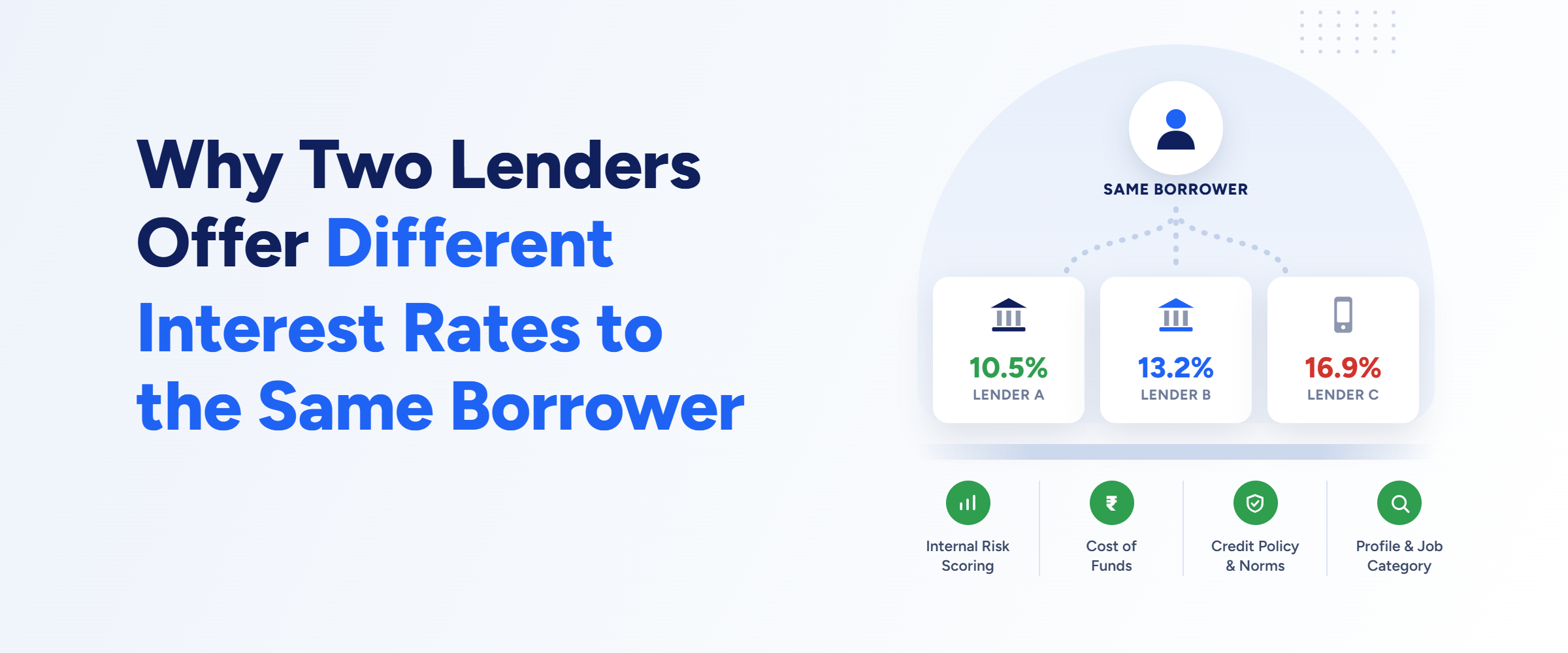
2. What Goes Into a Lender's Risk Assessment
| Factor | Why It Affects Your Rate |
|---|---|
| CIBIL score | Higher score signals lower default risk |
| Income stability | Salaried with long tenure vs frequent job changes |
| Existing debt obligations | Higher existing EMIs reduce repayment capacity |
| Employer category | Some lenders maintain lists of "preferred" employers with better rates |
| Banking relationship | Existing customers may get preferential pricing |
| Loan amount and tenure | Shorter tenures or smaller amounts can sometimes carry different pricing |
| City/location | Some lenders price differently based on geography and recovery risk |
No single factor decides your rate in isolation, lenders combine several of these into an internal risk score that determines your final offer.
3. Cost of Funds Differs by Lender
Banks typically borrow money (deposits) at a lower cost than NBFCs, who often raise funds through market borrowing or bank lines of credit at a relatively higher cost. This difference in cost of funds naturally trickles down into the interest rate each lender can profitably offer you.
This is part of why NBFC rates tend to run higher than bank rates for similar borrower profiles, even when both consider you low-risk.
4. Internal Policy and Business Priorities
Sometimes the difference isn't about you at all, it's about the lender's current priorities.
This is why the same applicant can get meaningfully different offers purely based on timing and which lender's current strategy they happen to fit into.
Example: Same Borrower, Three Lenders
Borrower profile: CIBIL score 745, salaried, ₹55,000/month income, 3 years at current job, requesting ₹4,00,000 personal loan for 3 years.
| Lender | Offered Rate | Why the Difference |
|---|---|---|
| Bank A (existing salary account) | 11.75% | Existing banking relationship, lower risk perception |
| Bank B (new relationship) | 13.25% | No prior relationship, standard risk-based pricing |
| NBFC C | 15.5% | Higher cost of funds, faster approval, more flexible documentation |
Same person, same month, same documents, a difference of nearly 4 percentage points simply due to lender risk assessment and relationship factors.
Credit Profile Loan Pricing: How Your Own Behaviour Shifts the Number
Your credit profile loan pricing isn't static either, it shifts over time based on your behaviour:
This means the rate you're offered today isn't fixed forever, improving these factors can genuinely get you a better rate on your next loan.
How to Use This Information to Your Advantage
Common Mistakes Borrowers Make
Expert Tips for Getting the Best Possible Rate
Compare Personalised Loan Offers Instantly
Check your loan eligibility on IndiaLends and see real, personalised interest rate offers from multiple banks and NBFCs side by side, with no impact on your CIBIL score.
Compare Your Personalised Loan Offers Now
Conclusion
The gap between interest rates offered by different lenders for the same borrower isn't random, it reflects each lender's unique risk assessment, cost of funds, and internal priorities at that moment. The smartest move isn't to accept the first offer you get, but to compare personalised rates across multiple lenders and understand what's driving the difference, so you can negotiate, improve your profile, or simply choose the better deal.
Related reading: How to Compare Loan Offers Beyond the Interest Rate and Bank vs NBFC Loan: How to Choose the Right Offer.

Scan this QR Code


Latest Articles
Merchant Cash Advance vs Business Loan: The Real Cost Comparison
30 Sep 2026
Business Loan Turnover Calculation: Why Cash Sales Don't Count
30 Sep 2026
Unsecured Business Loan vs LAP: The Cost and Speed Tradeoff
30 Sep 2026
Should I Prepay My Personal Loan? Bonus vs EMI Decision Guide
30 Sep 2026
RBI Cooling-Off Period on Personal Loans: What You Can Actually Undo
18 Sep 2026
Relevant Articles
Should I Prepay My Personal Loan? Bonus vs EMI Decision Guide
30 Sep 2026
RBI Cooling-Off Period on Personal Loans: What You Can Actually Undo
18 Sep 2026
Should You Take a Personal Loan During Your Notice Period?
18 Sep 2026
How to Compare Loan Offers Beyond the Interest Rate
03 Sep 2026
Bank vs NBFC Loan: How to Choose the Right Offer in 2026
03 Sep 2026
FAQ’s
Each lender uses its own risk assessment model, cost of funds, and internal policies to price loans. Even with the same CIBIL score and income, lenders can reach different risk conclusions about the same applicant.
Often, yes. Lenders with an existing relationship, like your salary account bank, have more visibility into your financial behaviour and may offer preferential pricing compared to a lender you're new to.
In many cases, yes, especially if you have a strong CIBIL score, low existing debt, or a competing offer from another lender. It's always worth asking, particularly with your existing banking relationship.
Direct applications to multiple lenders can trigger multiple hard inquiries, which may cause a small, temporary dip in your CIBIL score. Using a soft-check comparison platform avoids this while still letting you compare offers.
Improving your CIBIL score, reducing existing debt obligations, maintaining low credit utilisation, and comparing personalised offers across multiple lenders are the most effective ways to secure a better rate.
 URL copied to clipboard successfully !
Download the IndiaLends App Now
Scan this QR code to download the app