Loans 

Credit Card
IndiaLends App is available in


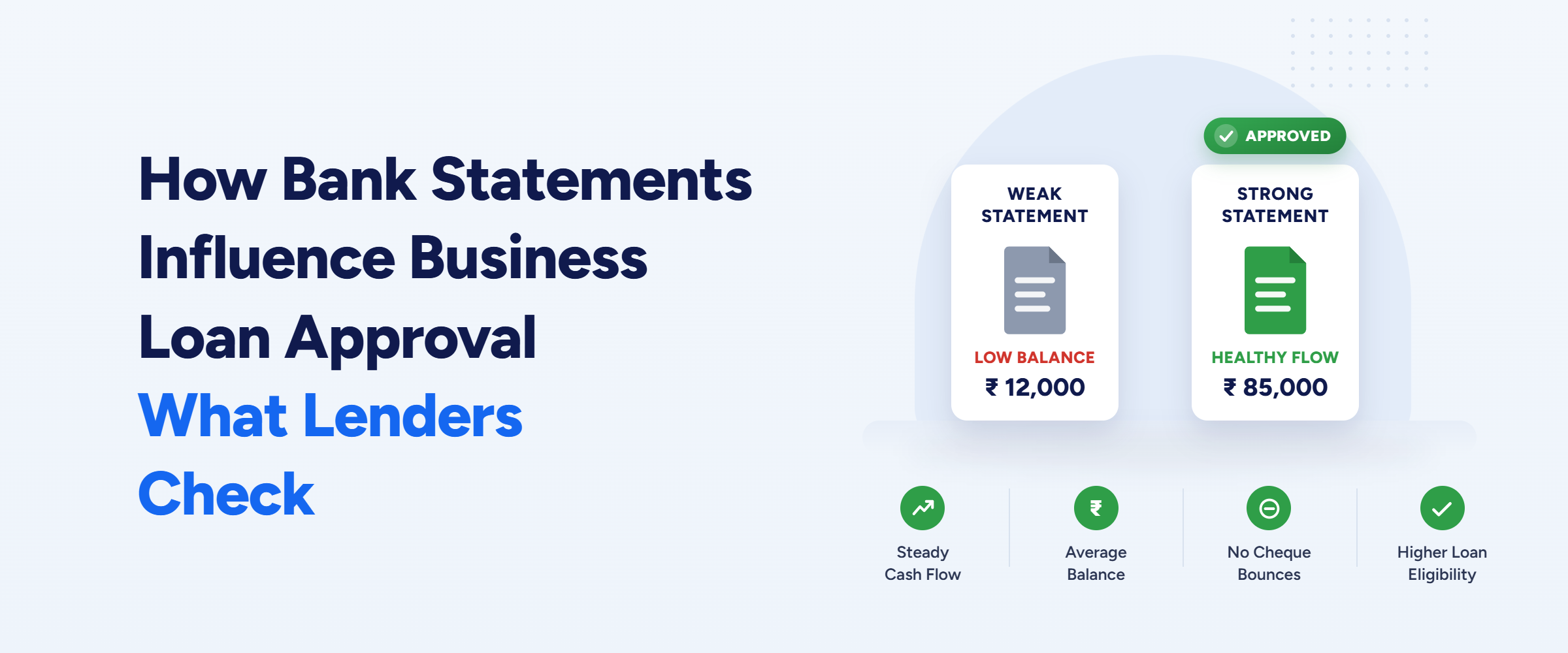
How Bank Statements Influence Business Loan Approval
When you apply for a business loan, most people focus on paperwork — GST returns, ITRs, business proof. But there's one document that quietly carries more weight than most applicants realise: the bank statement.
Lenders don't just glance at it. They study it, line by line, to understand how your business really behaves with money. If you're planning to apply for a business loan, understanding how your bank statement for business loan approval works can help you prepare better — and avoid unnecessary rejections.
What Role Does a Bank Statement Play in Loan Approval?
A bank statement is proof of how your business actually earns, spends, and manages money — not how it looks on paper. Lenders typically ask for 6 to 12 months of bank statements because it shows several key aspects of your financial behaviour.
In short, your bank statement acts as a cash flow assessment tool for the lender — more honest than any business plan you could write.
Core Concepts Lenders Look At
How Bank Statement Analysis Works: A Step-by-Step Breakdown
| Step | What the Lender Checks | Why It Matters |
|---|---|---|
| 1. Income consistency | Monthly credits over 6–12 months | Confirms real, repeatable business income |
| 2. Average balance | Daily/monthly average bank balance for loan eligibility | Indicates buffer capacity for EMI payments |
| 3. Expense pattern | Recurring debits, supplier payments, salaries | Shows genuine business activity |
| 4. Debt servicing | Existing loan EMIs or credit card payments | Used to calculate repayment capacity |
| 5. Irregularities | Bounced cheques, penalty charges, sudden withdrawals | Flags financial stress or risk |
| 6. Seasonal trends | Spikes or dips tied to business cycle | Helps lenders judge seasonal businesses fairly |
Average Bank Balance for Loan Approval: What's "Good Enough"?
There's no fixed number that works for every lender, but here's a general sense of how average balance is viewed.
| Average Monthly Balance | Lender's General View |
|---|---|
| Below ₹10,000 (irregular) | High risk; may lead to rejection or lower loan amount |
| ₹10,000 – ₹50,000 (stable) | Acceptable for small business loans |
| ₹50,000 – ₹2,00,000 | Comfortable; supports moderate loan amounts |
| Above ₹2,00,000 (consistent) | Strong profile; may support higher loan amounts and better interest rates |
These are indicative ranges. Actual eligibility depends on the lender — bank or NBFC — and the loan amount requested.
Worked Example: Two Small Business Owners
Example 1: Suresh, Kirana Store Owner, Pune
Suresh's bank statement shows daily cash deposits between ₹3,000–₹8,000, with an average monthly balance of around ₹45,000. His statement shows no bounced payments and one existing EMI of ₹4,000. This consistent pattern helped him get approved for a ₹5,00,000 business loan.
Example 2: Neha, Boutique Owner, Delhi
Neha's revenue is seasonal — high during festivals, low in other months. Her average balance swings between ₹15,000 and ₹1,20,000. Because her statement showed a clear seasonal pattern rather than random inconsistency, the lender still approved her loan, but with a slightly lower amount and a repayment structure that accounted for lean months.
The lesson: consistency matters, but lenders can also work with predictable seasonality — as long as it's clearly visible in the statement.
Common Mistakes That Hurt Business Loan Approval
Expert Tips to Strengthen Your Bank Statement Before Applying
Ready to Apply for a Business Loan?
IndiaLends helps you check your business loan approval eligibility across multiple banks and NBFCs based on your actual cash flow and financial profile — so you know where you stand before you apply.
Check Your Business Loan Eligibility Now
Conclusion
Your bank statement is more than a formality in a business loan application — it's the clearest evidence of how your business actually runs. Lenders read it to understand consistency, stability, and repayment capacity, often more than they rely on projections or paperwork. Keeping your account clean, consistent, and genuinely reflective of your business activity is one of the simplest ways to improve your chances of approval — and often, of getting a better loan amount too.

Scan this QR Code


Latest Articles
Pre-Approved Personal Loan Offers: How to Read the Real Rate
09 Oct 2026
Personal Loan After Credit Card Settlement: Is It Possible?
09 Oct 2026
Account Aggregator Personal Loans: What Lenders Read Beyond Your Salary Slip
08 Oct 2026
Salary Overdraft vs Personal Loan: Which One Should You Use?
08 Oct 2026
Loan Against Mutual Funds vs Personal Loan: Which Is Cheaper?
08 Oct 2026
Relevant Articles
Merchant Cash Advance vs Business Loan: The Real Cost Comparison
30 Sep 2026
Business Loan Turnover Calculation: Why Cash Sales Don't Count
30 Sep 2026
Unsecured Business Loan vs LAP: The Cost and Speed Tradeoff
30 Sep 2026
Udyam Registration and Business Loans: Does MSME Registration Help?
03 Sep 2026
Seasonal Business Loan: Planning Funds Around Inventory & Revenue Cycles
03 Sep 2026
FAQ’s
Most banks and NBFCs ask for 6 to 12 months of statements to assess income consistency and cash flow patterns.
There's no universal number, but a stable average monthly balance of ₹50,000 or more generally improves approval chances for moderate loan amounts. Lower balances aren't automatically disqualifying if the cash flow is consistent.
Yes, especially if your cash flow is regular and there are no bounced payments. Some NBFCs focus more on transaction consistency than absolute balance size.
Not always, but frequent bounces raise serious concerns. One or two isolated incidents with a clear explanation may still be considered.
Yes. It makes it harder for lenders to assess true business cash flow, which can lead to a lower loan amount or rejection. A dedicated business account is strongly recommended.
 URL copied to clipboard successfully !
Download the IndiaLends App Now
Scan this QR code to download the app