Credit Card 
IndiaLends App is available in


Credit Card vs Personal Loan in India: Which Is Cheaper for a 50,000 Emergency?
A sudden ₹50,000 expense has a way of showing up at the worst possible time, a medical bill, an urgent home repair, or a bill you simply didn't see coming. In that moment, most people reach for one of two options: swipe the credit card or apply for a quick personal loan.
Both get you the money fast. But they don't cost the same. Let's break down exactly which option works out cheaper for a ₹50,000 emergency, and when each one actually makes sense.
The Real Question: Cost, Not Just Convenience
When you're stressed about an emergency, it's tempting to just pick whichever option is fastest. But for a ₹50,000 borrowing need, the difference in cost between a credit card and a personal loan can be significant, especially if you can't repay it in a month or two.
The right choice depends on three things: how much you're borrowing, how long you'll take to repay it, and whether you can clear it within your credit card's interest-free period.
How Credit Card Borrowing Works for ₹50,000
There are two ways people typically use a credit card for an emergency like this.
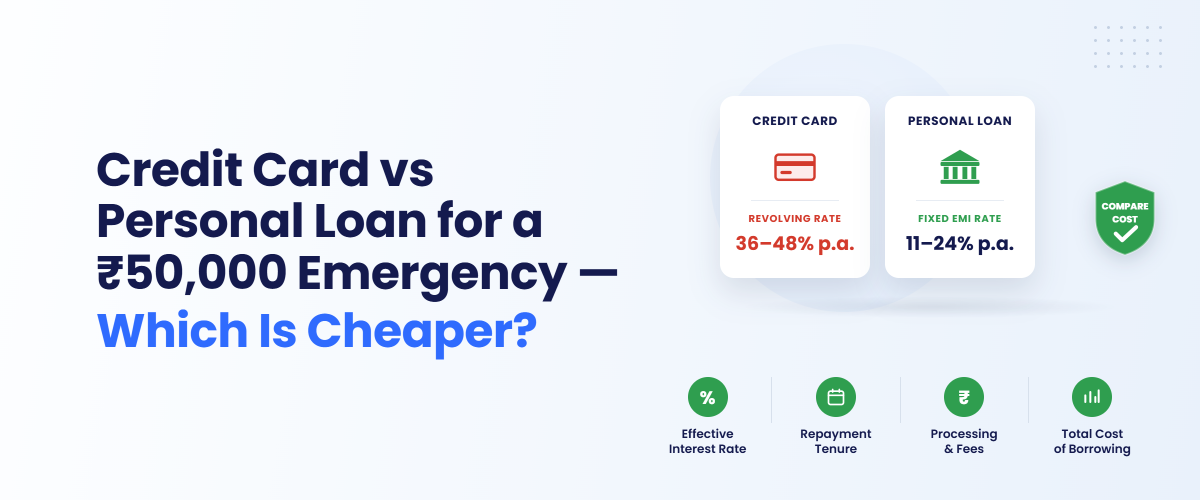
Both options are fast, often instant, since you're using an existing credit limit. But both typically carry a higher effective interest rate compared to a personal loan, especially revolving credit, which is one of the costliest ways to borrow.
How a Personal Loan Works for ₹50,000
A personal loan gives you the ₹50,000 as a lump sum, which you repay through fixed EMIs over a tenure you choose, typically 12 to 36 months for a smaller amount like this.
Credit Card vs Personal Loan: Side-by-Side Comparison
| Factor | Credit Card (Revolving/EMI) | Personal Loan |
|---|---|---|
| Speed of access | Instant, if limit available | A few hours to 1-2 days |
| Interest rate | Generally higher | Generally lower |
| Repayment structure | Minimum due or EMI conversion | Fixed EMI over fixed tenure |
| Best for | Very short repayment window (interest-free period) | Repayment over several months |
| Impact on credit utilization | Increases utilization ratio | No impact on card utilization |
| Documentation needed | None, if limit is available | Basic KYC and income proof |
When a Credit Card Is Actually the Cheaper Option
There's one scenario where a credit card beats a personal loan hands down: if you can repay the full ₹50,000 within your card's interest-free period (usually 20–50 days from the purchase, depending on your statement cycle).
In that case, you pay zero interest, making it cheaper than even the most competitive personal loan.
Example: Suppose Ananya spends ₹50,000 on her credit card for a medical bill on the 5th of the month, and her bill generates on the 25th with a due date of the 15th of the next month. If her salary comes in before that due date and she clears the full amount, she pays no interest at all.
When a Personal Loan Works Out Cheaper
If you know you'll need more than a month or two to repay the ₹50,000, a personal loan is almost always the more cost-effective route. Credit card interest on revolving balances is charged at a high monthly rate, which compounds and adds up quickly over a few months, while personal loan interest is calculated on a reducing balance over a longer, fixed tenure, usually working out to a lower total cost for the same repayment period.
Illustrative comparison for ₹50,000 repaid over 6 months:
| Repayment Method | Relative Interest Cost | Repayment Predictability |
|---|---|---|
| Credit card revolving balance | High | Low, minimum due can vary |
| Credit card EMI conversion | Moderate to high | Fixed EMI |
| Personal loan | Lower | Fixed EMI |
The exact numbers will depend on your card issuer's rate and the personal loan offer you qualify for, but the pattern holds consistently: the longer you need to repay, the more a personal loan tends to save you.
A Simple Decision Framework
Ask yourself these three questions:
Common Mistakes People Make in This Situation
Expert Tips for Handling a ₹50,000 Emergency
Check Your Personal Loan Eligibility Now
Conclusion
For a ₹50,000 emergency, there's no single "always right" answer, it comes down to how quickly you can repay. A credit card can be genuinely free if cleared within the interest-free period, but the moment repayment stretches beyond a month or two, a personal loan typically becomes the cheaper, more predictable choice. Check your eligibility and explore personal loan offers on IndiaLends.

Scan this QR Code


Latest Articles
Business Loan for New Business in India: What Options Exist Without Strong Revenue History
31 Jul 2026
Personal Loan EMI Calculator Guide – How to Calculate Your EMI
29 Jul 2026
Personal Loan Eligibility Criteria in India – Complete Guide
29 Jul 2026
Secured vs Unsecured Loans – Key Differences Explained
28 Jul 2026
12 Common Personal Loan Myths That Most Borrowers Believe
28 Jul 2026
Relevant Articles
FAQ’s
It depends on your repayment timeline. If you can repay within your credit card's interest-free period, the card is cheaper. If repayment will take longer, a personal loan usually works out more cost-effective.
It's the window between your purchase date and payment due date, typically 20 to 50 days, during which no interest is charged if you pay the full outstanding amount.
Yes, EMI conversion is usually cheaper than letting the balance revolve and paying only the minimum due, but it's still often costlier than a personal loan for the same repayment period.
Applying creates a hard inquiry, which may cause a small, temporary dip, but timely repayment can positively impact your score over time.
Yes, many lenders offer quick personal loans for smaller amounts, with digital verification often enabling disbursal within a day, depending on your documentation and eligibility.
 URL copied to clipboard successfully !
Download the IndiaLends App Now
Scan this QR code to download the app