Loans 

Credit Card
IndiaLends App is available in


Personal Loan for Medical Emergencies: How to Compare Speed, Cost, and Repayment Risk
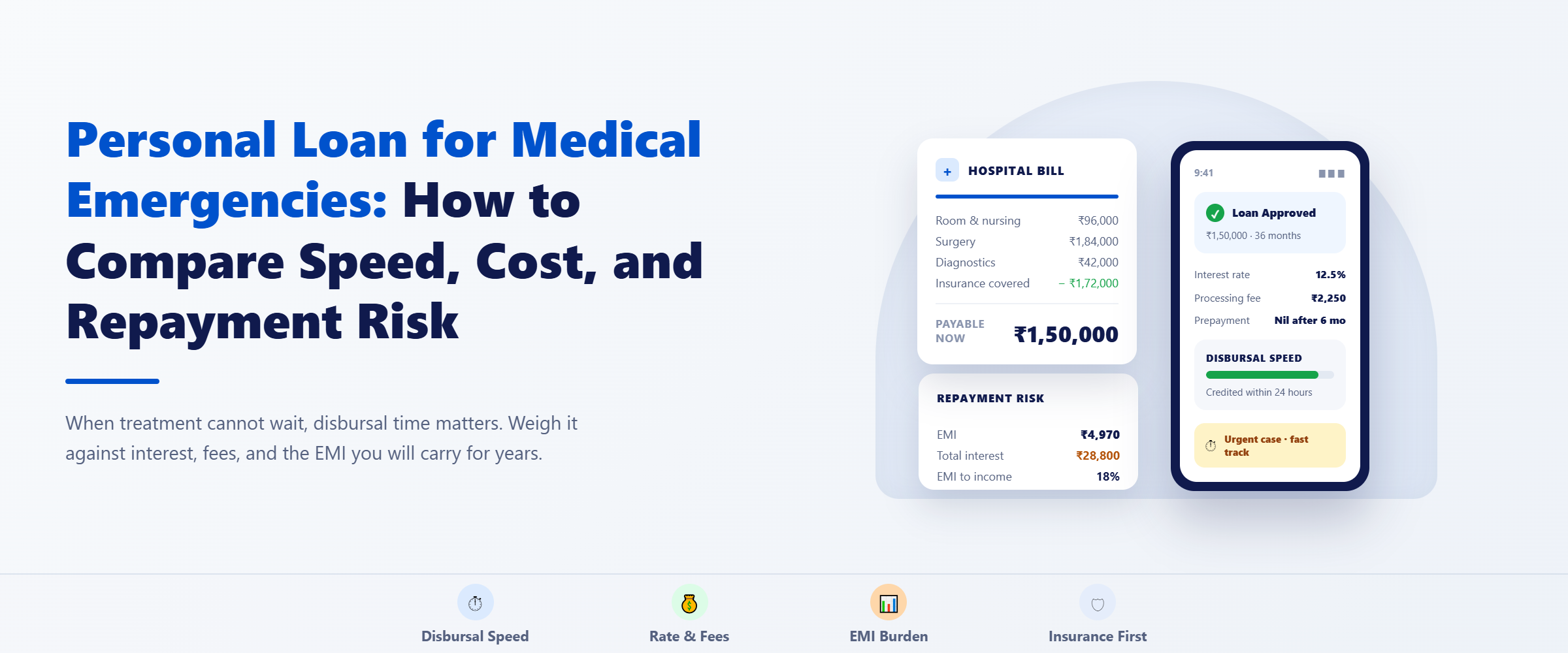
A hospital bill doesn't wait for you to compare interest rates. When a medical emergency hits, you need funds fast, sometimes within hours, not days.
In that pressure, it's tempting to accept the very first loan offer that comes your way. But a medical emergency personal loan taken in a rush can sometimes cost you far more than necessary or come with repayment terms that strain your finances long after the crisis has passed. This guide helps you quickly compare your options on the three things that matter most in a medical emergency: speed, cost, and repayment risk, so even under pressure, you can borrow smart.
What Counts as a "Medical Emergency Personal Loan"?
This isn't a distinct loan product with a special name at every lender, it typically refers to a regular personal loan or, in some cases, a specific instant medical loan product, used specifically to cover sudden medical expenses like:
Because personal loans are unsecured and don't require collateral, they're one of the fastest ways to access funds during a genuine medical crisis, provided you understand the trade-offs involved.
Core Concepts You Should Understand
Comparing Your Medical Emergency Financing Options
| Option | Typical Speed | Typical Cost | Repayment Risk Level |
|---|---|---|---|
| Pre-approved personal loan (existing bank/NBFC) | Fastest (minutes to a few hours) | Often competitive, based on existing relationship | Low, if EMI is realistic |
| Instant app-based NBFC loan | Very fast (same day) | Often higher interest rates | Can be higher if terms aren't checked carefully |
| Traditional bank personal loan (new applicant) | Slower (1-3 days) | Generally lower interest rates | Lower, due to standard underwriting |
| Credit card cash withdrawal/EMI conversion | Instant | Very high cost (cash withdrawal charges + high interest) | High; should be a last resort |
| Health insurance claim/cashless treatment | Immediate (if applicable) | No direct borrowing cost | None, but coverage may be limited |
Step-by-Step: How to Decide Quickly Under Pressure
Worked Example: Comparing Two Real Options Under Time Pressure
Scenario: Sunita needs ₹2,00,000 urgently for a family member's hospitalisation.
| Option | Interest Rate | Processing Time | Total Interest Cost (24-month tenure, illustrative) |
|---|---|---|---|
| Pre-approved offer from her salary account bank | 13% | Under 2 hours | Approximately ₹27,000 |
| Instant app-based NBFC loan | 19% | Under 30 minutes | Approximately ₹41,000 |
Sunita chose the pre-approved bank offer since the time difference (2 hours vs 30 minutes) was manageable given the situation, while the cost difference of roughly ₹14,000 was significant enough to matter for her family's finances.
The lesson: even in emergencies, a short comparison, when the extra time is genuinely affordable, can lead to meaningfully better outcomes.
Common Mistakes People Make During Medical Emergencies
Expert Tips for Borrowing Smart During a Medical Emergency
Need Funds for a Medical Emergency?
IndiaLends helps you quickly compare personal loan offers from multiple banks and NBFCs, so you can access funds fast without overpaying during an already stressful time.
Check Your Personal Loan Eligibility Now
Conclusion
A medical emergency demands speed, but that doesn't mean cost and repayment comfort should be ignored entirely. A brief comparison between available options, even one that takes just a few extra minutes, can meaningfully reduce what you end up paying, without significantly delaying the funds you need. Borrowing smart during a crisis isn't about slowing down unnecessarily; it's about making a quick, informed choice instead of an automatic one.

Scan this QR Code


Latest Articles
Personal Loan Top-Up vs Fresh Loan: Which Option Is Cheaper for Existing Borrowers?
26 Aug 2026
How Salary Account, Employer Category, and Job Tenure Affect Personal Loan Offers
25 Aug 2026
Personal Loan Disbursal Delayed After Approval: Common Reasons and What to Check
25 Aug 2026
Personal Loan for Freelancers and Gig Workers: Income Proof and Eligibility Requirements
24 Aug 2026
Personal Loan Repayment Through Auto-Debit: NACH, ECS, and Failed Mandate Charges Explained
24 Aug 2026
Relevant Articles
Personal Loan Top-Up vs Fresh Loan: Which Option Is Cheaper for Existing Borrowers?
26 Aug 2026
How Salary Account, Employer Category, and Job Tenure Affect Personal Loan Offers
25 Aug 2026
Personal Loan Disbursal Delayed After Approval: Common Reasons and What to Check
25 Aug 2026
Personal Loan for Freelancers and Gig Workers: Income Proof and Eligibility Requirements
24 Aug 2026
Personal Loan Repayment Through Auto-Debit: NACH, ECS, and Failed Mandate Charges Explained
24 Aug 2026
FAQ’s
Pre-approved personal loan offers from your salary account bank or an NBFC you've previously borrowed from are typically the fastest, often processed within a few hours or less.
Often, yes. Instant, app-based loan products tend to carry higher interest rates due to faster, less extensive underwriting, compared to traditional personal loans from banks.
Generally, this should be a last resort, since credit card cash withdrawals carry high withdrawal charges and interest rates, making them one of the costliest borrowing options available.
Yes. Checking your insurance coverage or the hospital's cashless treatment options first can significantly reduce how much you actually need to borrow.
Quickly check the interest rate, processing fee, EMI affordability, and prepayment charges, even under time pressure, since these directly affect your total repayment cost.
 URL copied to clipboard successfully !
Download the IndiaLends App Now
Scan this QR code to download the app