Loans 

Credit Card
IndiaLends App is available in


Personal Loan for Freelancers and Gig Workers: Income Proof and Eligibility Requirements
You run a successful freelance design business, or you drive for a ride-hailing app, or you take on gig projects across multiple platforms. Your income is real, sometimes even higher than a typical salaried employee's but the moment you apply for a personal loan, things suddenly feel harder.
No salary slip. No Form 16 in the traditional sense. No single, predictable monthly credit in your bank account. If you've ever wondered how to get a personal loan for freelancers or gig workers in India, the good news is that lenders have increasingly adapted to this reality. This guide walks you through exactly what's needed, and how to present your income in a way that works in your favour.
Why Is It Different for Freelancers and Gig Workers?
Traditional personal loan eligibility criteria were built around salaried employment, a fixed monthly salary credited on a specific date, along with salary slips and Form 16 as standard proof. Freelancers and gig workers don't fit this mould because:
This doesn't mean freelancers can't get approved, it means lenders assess income stability and consistency differently, using alternative documentation.
Core Concepts You Should Understand
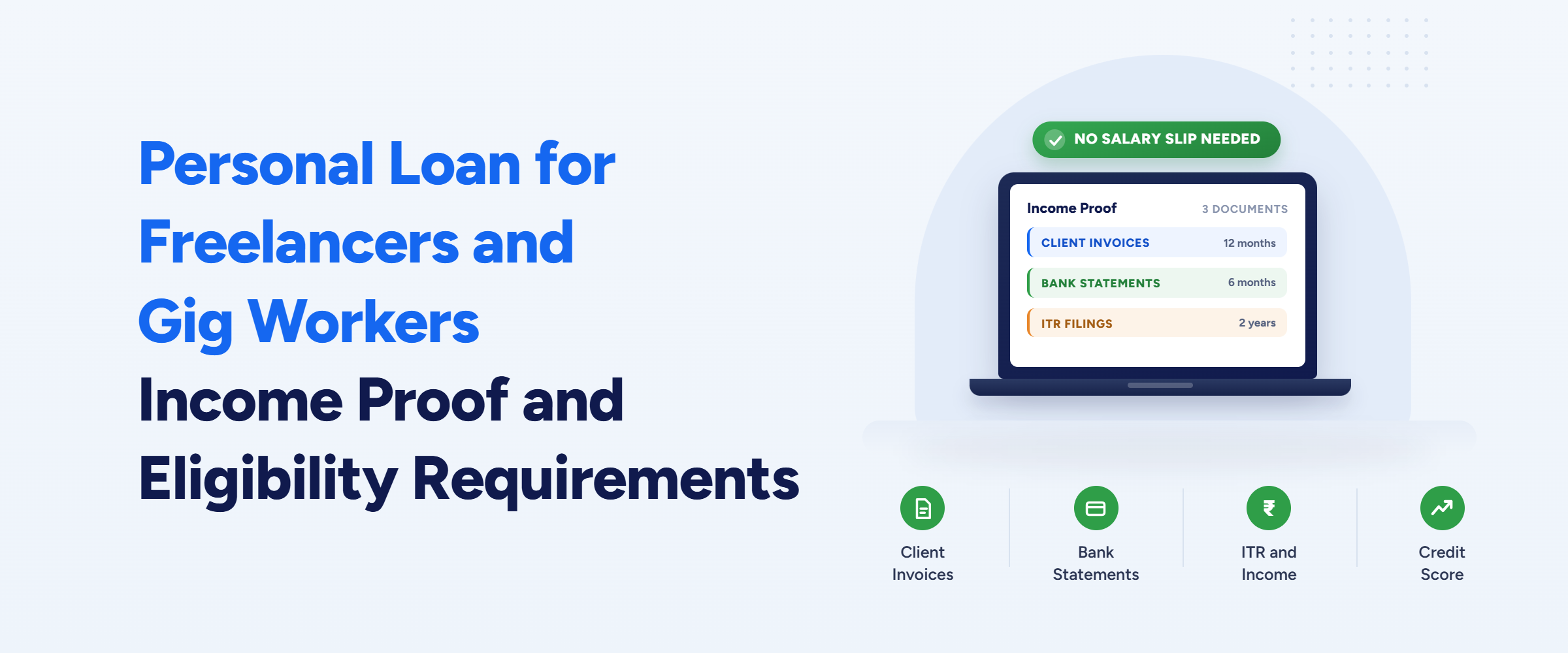
Income Proof Options for Freelancers and Gig Workers
| Document Type | What It Shows Lenders |
|---|---|
| Bank statements (6-12 months) | Consistency and average monthly income flow |
| Income Tax Returns (ITR), 2-3 years | Declared annual income and tax compliance |
| GST returns (if registered) | Business turnover and regularity, for freelancers with GST registration |
| Client invoices/contracts | Proof of ongoing work and expected future income |
| Platform income statements | For gig workers on apps like ride-hailing, delivery, or freelance marketplaces, showing payout history |
| Form 26AS | Tax deducted at source (TDS) details, if clients have deducted TDS on payments |
How Lenders Typically Evaluate Freelancer Loan Applications
Personal Loan Eligibility: Salaried vs Freelancer/Gig Worker
| Factor | Salaried Applicant | Freelancer/Gig Worker |
|---|---|---|
| Primary income proof | Salary slips, Form 16 | Bank statements, ITR, GST returns |
| Income assessment | Fixed monthly salary | Average income over 6-12 months |
| Employment proof | Employment/offer letter | Business registration, client contracts, platform statements |
| Approval speed | Generally faster, standardised | May take slightly longer due to additional verification |
| Interest rate | Often marginally lower for strong salaried profiles | Comparable, if income stability is well-documented |
| Best-fit lenders | Most banks and NBFCs | NBFCs and digital lenders often more flexible |
Worked Example: A Freelancer's Successful Loan Application
Example: Meghna, Freelance Content Writer, Mumbai
Meghna had been freelancing for 3 years, earning between ₹35,000 and ₹55,000 a month across multiple clients, with an average monthly income of around ₹45,000. She didn't have a salary slip, but she had 12 months of bank statements showing consistent monthly credits, 2 years of filed ITRs declaring her freelance income, and a CIBIL score of 750, built through a secured credit card and timely repayments.
She applied for a ₹3,00,000 personal loan with an NBFC that specifically evaluates freelance and gig income. Her application was approved within a few days, based on her documented income consistency and strong credit score, despite having no traditional salary slip.
Common Mistakes Freelancers and Gig Workers Make
Expert Tips to Improve Approval Chances
Ready to Explore Your Personal Loan Options?
IndiaLends helps freelancers and gig workers check their personal loan eligibility across multiple NBFCs and lenders, based on alternative income documentation, not just a traditional salary slip.
Check Your Personal Loan Eligibility Now
Conclusion
Not having a traditional salary slip doesn't mean freelancers and gig workers can't access personal loans in India. With the right documentation, consistent bank statements, filed ITRs, and a healthy CIBIL score, lenders can assess your income just as effectively as a salaried applicant's. The key is presenting your income clearly and consistently, so lenders see the same financial stability you already know exists in your work.

Scan this QR Code


Latest Articles
Pre-Approved Personal Loan Offers: How to Read the Real Rate
09 Oct 2026
Personal Loan After Credit Card Settlement: Is It Possible?
09 Oct 2026
Account Aggregator Personal Loans: What Lenders Read Beyond Your Salary Slip
08 Oct 2026
Salary Overdraft vs Personal Loan: Which One Should You Use?
08 Oct 2026
Loan Against Mutual Funds vs Personal Loan: Which Is Cheaper?
08 Oct 2026
Relevant Articles
Pre-Approved Personal Loan Offers: How to Read the Real Rate
09 Oct 2026
Personal Loan After Credit Card Settlement: Is It Possible?
09 Oct 2026
Account Aggregator Personal Loans: What Lenders Read Beyond Your Salary Slip
08 Oct 2026
Salary Overdraft vs Personal Loan: Which One Should You Use?
08 Oct 2026
Loan Against Mutual Funds vs Personal Loan: Which Is Cheaper?
08 Oct 2026
FAQ’s
Yes. Lenders assess freelancers using alternative income proof like bank statements, ITRs, and GST returns instead of salary slips, focusing on income consistency over the past 6-12 months.
Common documents include bank statements, income tax returns, platform income statements (for app-based gig work), and sometimes client contracts or invoices for freelance-based income.
It can, but lenders typically look at your average income over several months rather than month-to-month variation, so consistent overall earnings still support a strong application.
Yes, just as much as for salaried applicants. A strong CIBIL score significantly improves approval chances and can help secure better interest rates, regardless of employment type.
Not necessarily better, but many NBFCs and digital lenders have more flexible, tailored criteria for assessing freelance and gig income, which can make the approval process smoother.
 URL copied to clipboard successfully !
Download the IndiaLends App Now
Scan this QR code to download the app