Loans 

Credit Card
IndiaLends App is available in


Personal Loan Repayment Through Auto-Debit: NACH, ECS, and Failed Mandate Charges Explained
You take a personal loan, set up auto-debit, and assume the EMI will just quietly leave your account every month without a second thought.
Most of the time, it does. But then one month, it doesn't and suddenly you're staring at a bounce charge, a late payment fee, and a slightly panicked question: what exactly is a "NACH mandate," and why does it matter so much? Understanding how a NACH mandate for personal loan repayment actually works isn't just useful trivia, it directly affects your CIBIL score, your relationship with your lender, and your wallet. This guide breaks it all down clearly.
What Is a NACH Mandate, and Why Does Your Loan Need One?
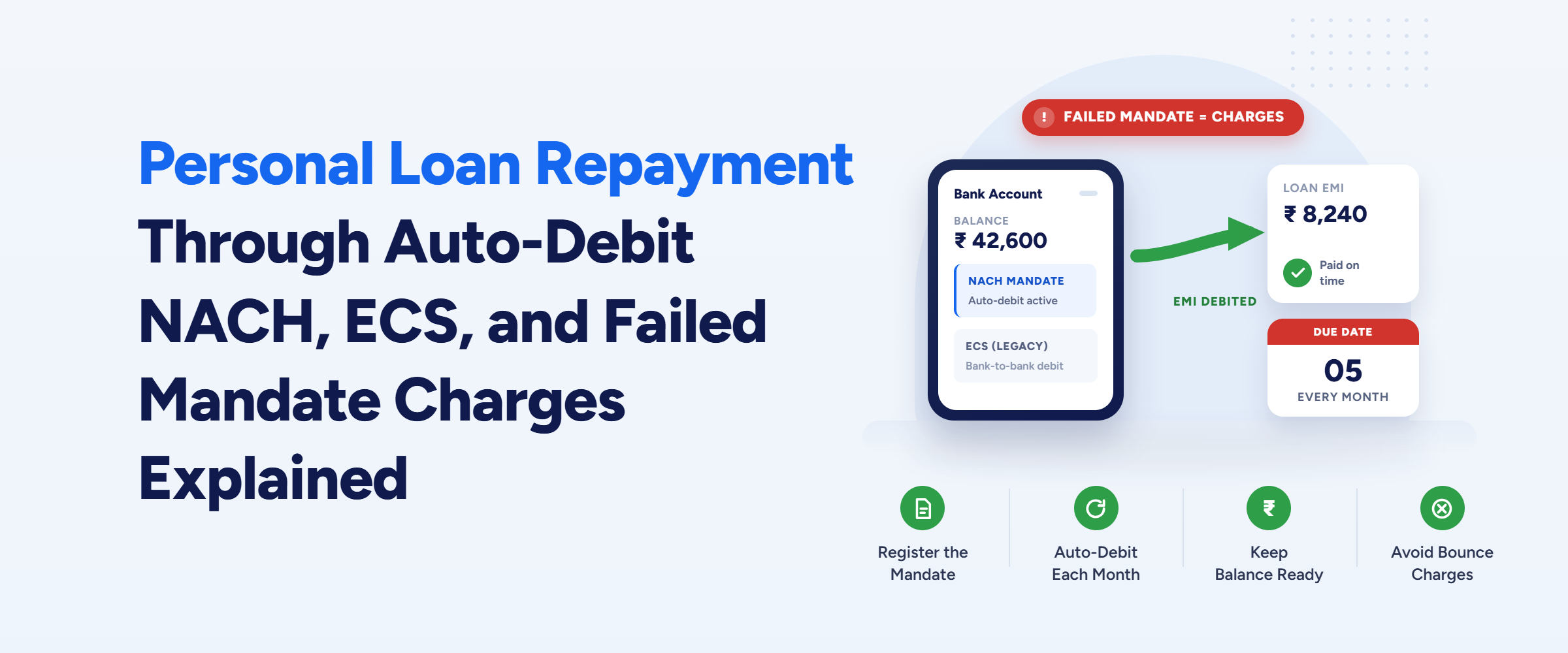
NACH stands for National Automated Clearing House, a centralised system run by NPCI (National Payments Corporation of India) that enables banks to process bulk, recurring payments like your loan EMIs automatically.
When you take a personal loan, your lender asks you to sign a NACH mandate, which is essentially a standing authorisation allowing them to automatically debit your bank account on a fixed date each month for your EMI amount. Without this mandate, you'd have to manually initiate the EMI payment every single month, which is inconvenient and increases the risk of missed payments.
Core Concepts You Should Understand
NACH vs ECS: Quick Comparison
| Aspect | ECS (Older System) | NACH (Current System) |
|---|---|---|
| Managed by | Regional clearing houses | NPCI (centralised, nationwide) |
| Processing speed | Slower, limited coverage | Faster, wider bank network coverage |
| Usage today | Largely phased out | Standard for most loan EMI auto-debits |
| Mandate registration | Physical form, bank-specific | Physical or digital (e-NACH), more banks supported |
How the EMI Auto-Debit Process Actually Works
What Happens When a NACH Mandate Fails? (Bounce Charges Explained)
When your EMI auto-debit fails, commonly called a "NACH bounce" or "ECS bounce", a few things happen in sequence:
| Consequence | Typical Details |
|---|---|
| Bounce charge from lender | Usually ₹300-₹750 per failed attempt, varies by lender |
| Bank-level penalty | Some banks also charge ₹150-₹500 separately for the failed debit attempt |
| Late payment fee | Often 1-2% of the overdue EMI amount, in addition to bounce charges |
| CIBIL score impact | A missed/delayed EMI gets reported to credit bureaus, which can lower your score |
| Additional interest | Overdue interest may accrue on the unpaid EMI until it's cleared |
Important: These charges can add up quickly. A single bounce due to a small balance shortfall can end up costing several hundred rupees in avoidable fees.
Worked Example: The Real Cost of a Missed NACH Debit
Example: Vikas, Sales Executive, Noida
Vikas had a personal loan EMI of ₹8,500 due on the 7th of the month. His salary was delayed by two days due to a payroll issue, and his account had only ₹6,000 on the debit date. The NACH mandate failed. Here's what it cost him:
Had he simply maintained a small buffer or paid manually two days late through net banking, he could have avoided most of this cost entirely.
Common Mistakes Borrowers Make
Expert Tips to Avoid NACH Bounce Charges
Planning to Take a Personal Loan?
IndiaLends helps you compare personal loan options from multiple banks and NBFCs, with clear terms on EMI dates, charges, and repayment methods, so you know exactly what to expect from day one.
Check Your Personal Loan Eligibility Now
Conclusion
A NACH mandate makes personal loan repayment convenient, but it also shifts the responsibility onto you to ensure sufficient funds are available on the due date. A single bounced EMI can quietly cost you several hundred rupees in charges and a dent in your credit score that takes time to recover from. A small buffer balance and a bit of proactive planning around your EMI date can save you from an entirely avoidable expense.

Scan this QR Code


Latest Articles
Personal Loan Top-Up vs Fresh Loan: Which Option Is Cheaper for Existing Borrowers?
26 Aug 2026
Personal Loan for Medical Emergencies: How to Compare Speed, Cost, and Repayment Risk
26 Aug 2026
How Salary Account, Employer Category, and Job Tenure Affect Personal Loan Offers
25 Aug 2026
Personal Loan Disbursal Delayed After Approval: Common Reasons and What to Check
25 Aug 2026
Personal Loan for Freelancers and Gig Workers: Income Proof and Eligibility Requirements
24 Aug 2026
Relevant Articles
Personal Loan Top-Up vs Fresh Loan: Which Option Is Cheaper for Existing Borrowers?
26 Aug 2026
Personal Loan for Medical Emergencies: How to Compare Speed, Cost, and Repayment Risk
26 Aug 2026
How Salary Account, Employer Category, and Job Tenure Affect Personal Loan Offers
25 Aug 2026
Personal Loan Disbursal Delayed After Approval: Common Reasons and What to Check
25 Aug 2026
Personal Loan for Freelancers and Gig Workers: Income Proof and Eligibility Requirements
24 Aug 2026
FAQ’s
A NACH mandate is a standing authorisation you give your bank, allowing your lender to automatically debit your EMI amount from your account each month, using the National Automated Clearing House system.
ECS was the older electronic clearing system, largely replaced by NACH, which is centralised, faster, and has wider bank coverage. Most lenders today use NACH for EMI auto-debit.
You're typically charged a bounce fee by the lender, sometimes an additional penalty by your bank, and a late payment fee. The missed payment may also be reported to credit bureaus, affecting your CIBIL score.
Bounce charges commonly range from ₹300 to ₹750 from the lender, with banks sometimes adding a separate penalty of ₹150 to ₹500 for the failed debit attempt.
In many cases, yes. You can request your lender to adjust the EMI due date, subject to their internal policy, so it better aligns with your salary credit date.
 URL copied to clipboard successfully !
Download the IndiaLends App Now
Scan this QR code to download the app