Loans 

Credit Card
IndiaLends App is available in


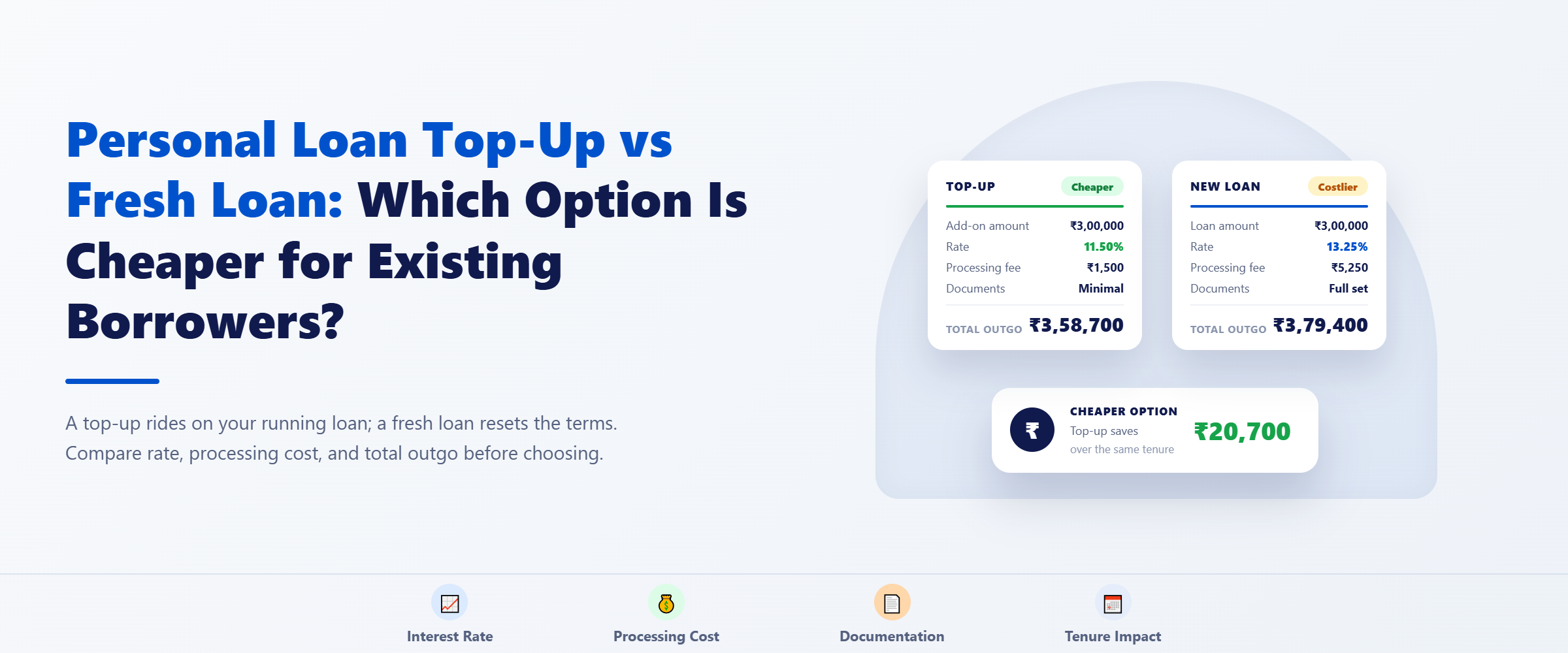
Personal Loan Top-Up vs Fresh Loan: Which Option Is Cheaper for Existing Borrowers?
You already have a personal loan running, and now you need more money, maybe for a wedding expense, a home renovation, or simply because costs have added up faster than expected.
Your lender offers you a top-up loan on your existing account. A quick search also shows you could apply for a completely new personal loan elsewhere. Both promise to get you the funds you need. But which one actually costs less? This guide compares personal loan top up vs new loan across cost, speed, and eligibility, so you can make a decision based on numbers, not convenience alone.
What Is a Personal Loan Top-Up, and How Is It Different from a New Loan?
A top-up personal loan is additional money you borrow on top of your existing, ongoing personal loan, from the same lender. Instead of closing your current loan and starting fresh, the lender simply increases your outstanding loan amount and adjusts your EMI or tenure accordingly.
A fresh/new personal loan, on the other hand, is a completely separate loan, either from your existing lender or a different one that runs independently of any loan you already have. The core difference: a top-up extends an existing relationship, while a new loan creates a new one.
Core Concepts You Should Understand
Personal Loan Top-Up vs New Loan: Side-by-Side Comparison
| Factor | Top-Up Loan | New/Fresh Loan |
|---|---|---|
| Documentation required | Minimal, since you're an existing customer | Full documentation, as a new applicant |
| Processing time | Usually faster (2-5 days) | Can take longer (5-10 days), depending on lender |
| Interest rate | Based on current rates; may differ from original loan | Based on current market rates and your present profile |
| Processing fee | Often reduced or waived | Full processing fee typically applies |
| EMI structure | Existing EMI adjusted, or tenure extended | Entirely new EMI schedule |
| Best suited for | Existing borrowers with a clean repayment record | Borrowers wanting a fresh start, better rate, or new lender |
| Impact on credit report | Reflected as a modification to the existing account | Appears as a new credit account/enquiry |
How to Actually Compare the Cost: A Step-by-Step Approach
Worked Example: Comparing the Real Cost
Scenario: Rahul has an existing personal loan with ₹2,00,000 outstanding at 13% interest and needs an additional ₹1,50,000.
| Option | Details | Approximate Total Interest Cost (Illustrative) |
|---|---|---|
| Top-up loan | ₹1,50,000 added at 15% interest, tenure extended by 12 months | ₹28,000-₹32,000 |
| New personal loan | ₹1,50,000 fresh loan at 13.5% interest (due to improved CIBIL score), separate 36-month tenure | ₹24,000-₹27,000 |
In this illustrative case, because Rahul's credit score had improved since his original loan, a new loan from a different lender offered a slightly better rate, making it marginally cheaper than the top-up, despite the extra documentation involved.
The key takeaway: the cheaper option isn't fixed, it depends on your current credit profile, the specific rates offered, and how the numbers work out in your specific case.
When a Top-Up Usually Makes Sense
When a Fresh Loan Usually Makes Sense
Common Mistakes Borrowers Make
Expert Tips for Making the Right Choice
Comparing Your Options?
IndiaLends helps you compare personal loan and top-up offers from multiple banks and NBFCs side by side, so you can choose the option that's genuinely cheaper for your situation.
Compare Personal Loan Offers Now
Conclusion
A personal loan top-up and a fresh personal loan can both get you the extra funds you need, but they aren't automatically interchangeable in terms of cost. The right choice depends on your current CIBIL score, the specific interest rate offered, applicable fees, and how the total cost compares once you run the numbers. Before deciding based on convenience alone, take a few minutes to compare the actual figures, it could save you a meaningful amount over your loan's tenure.

Scan this QR Code


Latest Articles
Personal Loan for Medical Emergencies: How to Compare Speed, Cost, and Repayment Risk
26 Aug 2026
How Salary Account, Employer Category, and Job Tenure Affect Personal Loan Offers
25 Aug 2026
Personal Loan Disbursal Delayed After Approval: Common Reasons and What to Check
25 Aug 2026
Personal Loan for Freelancers and Gig Workers: Income Proof and Eligibility Requirements
24 Aug 2026
Personal Loan Repayment Through Auto-Debit: NACH, ECS, and Failed Mandate Charges Explained
24 Aug 2026
Relevant Articles
Personal Loan for Medical Emergencies: How to Compare Speed, Cost, and Repayment Risk
26 Aug 2026
How Salary Account, Employer Category, and Job Tenure Affect Personal Loan Offers
25 Aug 2026
Personal Loan Disbursal Delayed After Approval: Common Reasons and What to Check
25 Aug 2026
Personal Loan for Freelancers and Gig Workers: Income Proof and Eligibility Requirements
24 Aug 2026
Personal Loan Repayment Through Auto-Debit: NACH, ECS, and Failed Mandate Charges Explained
24 Aug 2026
FAQ’s
Not always. While top-ups often have lower processing fees and faster approval, the interest rate may not always be better than what a new loan offers, especially if your CIBIL score has improved.
A top-up is usually reflected as a modification to your existing account, while a new loan appears as a separate credit account with its own enquiry, though both are factored into your overall credit profile.
Typically, no. Top-up loans are usually offered by the same lender managing your existing loan. If you want funds from a different lender, you'd generally need a fresh personal loan.
Top-ups usually require minimal documentation since you're an existing customer, often just updated income proof and address confirmation, compared to the full documentation needed for a new loan.
Not necessarily. A longer tenure lowers your EMI but increases the total interest paid overtime, so it's important to calculate the total cost before choosing tenure length.
 URL copied to clipboard successfully !
Download the IndiaLends App Now
Scan this QR code to download the app