Loans 

Credit Card
IndiaLends App is available in


Pre-Approved Personal Loan Offers: How to Read the Real Rate
"Congratulations! You're pre-approved for a ₹5,00,000 personal loan at just 10.5% interest." This SMS lands in millions of inboxes across India every day. It sounds like an exclusive, guaranteed deal, but by the time many borrowers reach the final loan agreement, the actual interest rate, fees, and terms often look quite different from that opening message.
Understanding exactly what "pre-approved" really means, and how to read past the headline number, can save you from an unpleasant surprise at the final step of your application.
What Does "Pre-Approved" Actually Mean?
This is the single most misunderstood term in the entire process, and clearing it up changes how you should read every such offer you receive.
Pre-approved, in its strictest and most accurate sense, means a lender has already assessed your eligibility, using your existing relationship data (like your bank account history, salary credits, or credit bureau information), and has determined you likely qualify for a loan, often with minimal additional documentation.
However, in practice, many offers labelled "pre-approved" are marketed more loosely than this strict definition suggests, which brings us to an important distinction.
1. Pre-Approved vs Pre-Qualified Loan – A Critical Difference
| Term | What It Actually Means | Reliability |
|---|---|---|
| Pre-qualified | A preliminary, often algorithm-based estimate of eligibility, based on limited data (sometimes just basic demographic or bureau-level information) | Lower, subject to change once full underwriting occurs |
| Pre-approved | A more thorough assessment, often based on your actual banking relationship or verified credit data, with fewer remaining conditions | Higher, but still not an unconditional guarantee |
The practical problem: many marketing messages use "pre-approved" language loosely, even when the underlying assessment is closer to a "pre-qualified" level of certainty. This means the specific rate and amount quoted in that initial SMS can still change, sometimes significantly, once you actually apply and go through complete verification.
What to do: treat any SMS or in-app "pre-approved" offer as a starting point for negotiation and verification, not a locked-in guarantee, until you've seen the final Key Fact Statement (KFS) with your actual, confirmed terms.
2. Risk-Based Pricing – Why Your Final Rate May Differ
Even genuinely well-assessed pre-approved offers are subject to risk-based pricing, meaning the final rate you're offered depends on a more complete risk assessment than what may have driven the initial marketing message.
Why the rate can shift between the SMS and the final offer:
This isn't necessarily deceptive on the lender's part, risk-based pricing is a standard, legitimate practice across the industry. The issue is that marketing messages often present the best possible rate prominently, without making clear that it's conditional on your specific, fully-verified profile.
3. Hidden Processing Fees on Personal Loans – What to Actually Check
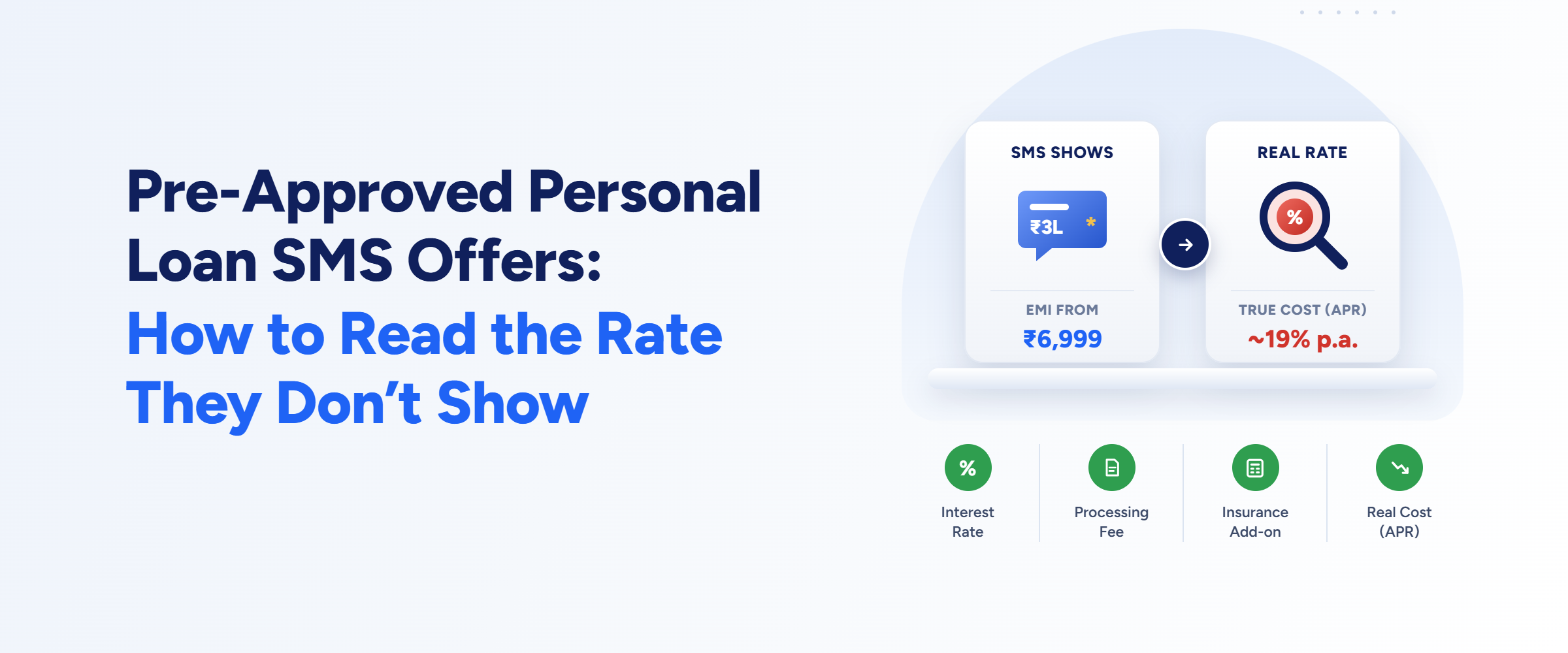
The headline interest rate is only one part of your real cost. Processing fees, in particular, are often mentioned in much smaller text (or not prominently at all) in the initial promotional message.
| What's Often Prominently Displayed | What's Often Less Visible |
|---|---|
| Headline interest rate (often the lowest possible rate) | Processing fee percentage |
| Loan amount you're "eligible" for | GST applicable on processing fee |
| Approximate EMI (sometimes calculated at the best-case rate) | Any additional charges (documentation, insurance bundling, etc.) |
Example of how this affects your real cost: an SMS advertises "10.5% interest, ₹5,00,000 pre-approved." When you actually proceed, you discover your final approved rate is 13.5% (based on your complete risk profile), plus a 2% processing fee plus GST, none of which was clearly presented in the original message.
Always ask for, and read, the complete fee breakdown, including processing fee, any documentation charges, and applicable taxes, before accepting any loan offer, regardless of how it was initially marketed.
4. In-App Loan Offer vs Actual ROI – Reading the Fine Print
This same pattern extends to in-app loan offers shown within banking or fintech apps, not just SMS messages. A prominently displayed "starting from X% ROI" figure inside an app is frequently the best-case rate, not necessarily your specific, confirmed rate.
What to check before assuming the displayed rate applies to you:
5. Is This "Bait and Switch"? Understanding the Regulatory Guardrails
The term "bait and switch" gets used loosely to describe this experience, but it's worth understanding what protections actually exist, so you know what to expect and what to push back on.
What RBI's framework requires:
What this means for you practically: while the marketing message itself may present an optimistic "starting from" rate, RBI's disclosure requirements ensure that by the time you're asked to actually commit to the loan, the complete, accurate terms must be transparently presented in the KFS. Your real protection lies in reading and understanding this KFS carefully, not in the SMS or app notification that first caught your attention.
A Practical Checklist Before Accepting Any Pre-Approved Offer
Example: Reading Between the Lines
The SMS: "You're Pre-Approved for ₹4,00,000 at 11% p.a.! Apply now, funds in 10 minutes."
What Rakesh actually found when he applied:
| What Was Advertised | What the KFS Actually Showed |
|---|---|
| 11% p.a. interest | 14.5% p.a. (his actual, risk-assessed rate) |
| Not mentioned prominently | 2.5% processing fee + 18% GST on the fee |
| ₹4,00,000 loan amount | Approved for ₹3,20,000 (based on his complete profile) |
Rakesh's actual APR, once fees were factored in, worked out meaningfully higher than the advertised 11%, a gap he only discovered by specifically requesting and reading the KFS before accepting, rather than proceeding based on the SMS alone.
This doesn't mean the offer was fraudulent, it means the initial marketing figure wasn't his final, confirmed rate, and only careful reading of the official disclosure revealed the real numbers.
Common Mistakes Borrowers Make
Expert Tips for Reading Pre-Approved Offers Correctly
Compare Verified Personal Loan Offers, Not Just Promotional Rates
Check your personal loan eligibility on IndiaLends and get transparent, personalised offers from multiple banks and NBFCs, with clear terms upfront, before you commit to anything.
Check Your Personal Loan Eligibility Now
Conclusion
A pre-approved personal loan offer is a genuine starting point, not a locked-in guarantee, the gap between the SMS you receive and the terms you actually sign can be meaningful, driven by risk-based pricing, processing fees, and the difference between preliminary and fully verified assessments. The single most reliable protection you have is the Key Fact Statement, mandated by RBI for every digital loan. Read it carefully, compare it against the advertised offer, and don't hesitate to check alternative lenders before committing.
Related reading: The Cooling-Off Period on Digital Personal Loans, Why Two Lenders Offer Different Rates to the Same Borrower, How to Compare Loan Offers Beyond the Interest Rate, What Lenders Now Read in Your Account Aggregator Data, and Can You Get a Personal Loan After a Credit Card Settlement?

Scan this QR Code


Latest Articles
Personal Loan After Credit Card Settlement: Is It Possible?
09 Oct 2026
Account Aggregator Personal Loans: What Lenders Read Beyond Your Salary Slip
08 Oct 2026
Salary Overdraft vs Personal Loan: Which One Should You Use?
08 Oct 2026
Loan Against Mutual Funds vs Personal Loan: Which Is Cheaper?
08 Oct 2026
Can I Take Two Personal Loans at the Same Time? Risks Explained
08 Oct 2026
Relevant Articles
Personal Loan After Credit Card Settlement: Is It Possible?
09 Oct 2026
Account Aggregator Personal Loans: What Lenders Read Beyond Your Salary Slip
08 Oct 2026
Salary Overdraft vs Personal Loan: Which One Should You Use?
08 Oct 2026
Loan Against Mutual Funds vs Personal Loan: Which Is Cheaper?
08 Oct 2026
Can I Take Two Personal Loans at the Same Time? Risks Explained
08 Oct 2026
FAQ’s
Not necessarily. Many "pre-approved" offers are based on preliminary data and are subject to change once complete underwriting occurs. Always verify your final, confirmed rate in the official Key Fact Statement before accepting.
Pre-qualified offers are typically based on limited, preliminary data and carry lower reliability, while pre-approved offers are generally based on a more complete assessment, though even these can still be subject to final verification and adjustment.
This usually happens due to risk-based pricing, the advertised rate is often the best-case rate for the strongest eligible applicants, while your final rate reflects your complete, verified credit and income profile at the time of full underwriting.
Request or locate the Key Fact Statement (KFS), which is mandated by RBI to disclose the actual Annual Percentage Rate (APR), including interest and all fees, giving you the true, complete cost of the loan.
Usually not. Processing fees, along with applicable GST, are typically charged separately from the headline interest rate and may not be prominently displayed in the initial promotional message.
 URL copied to clipboard successfully !
Download the IndiaLends App Now
Scan this QR code to download the app