Loans 

Credit Card
IndiaLends App is available in


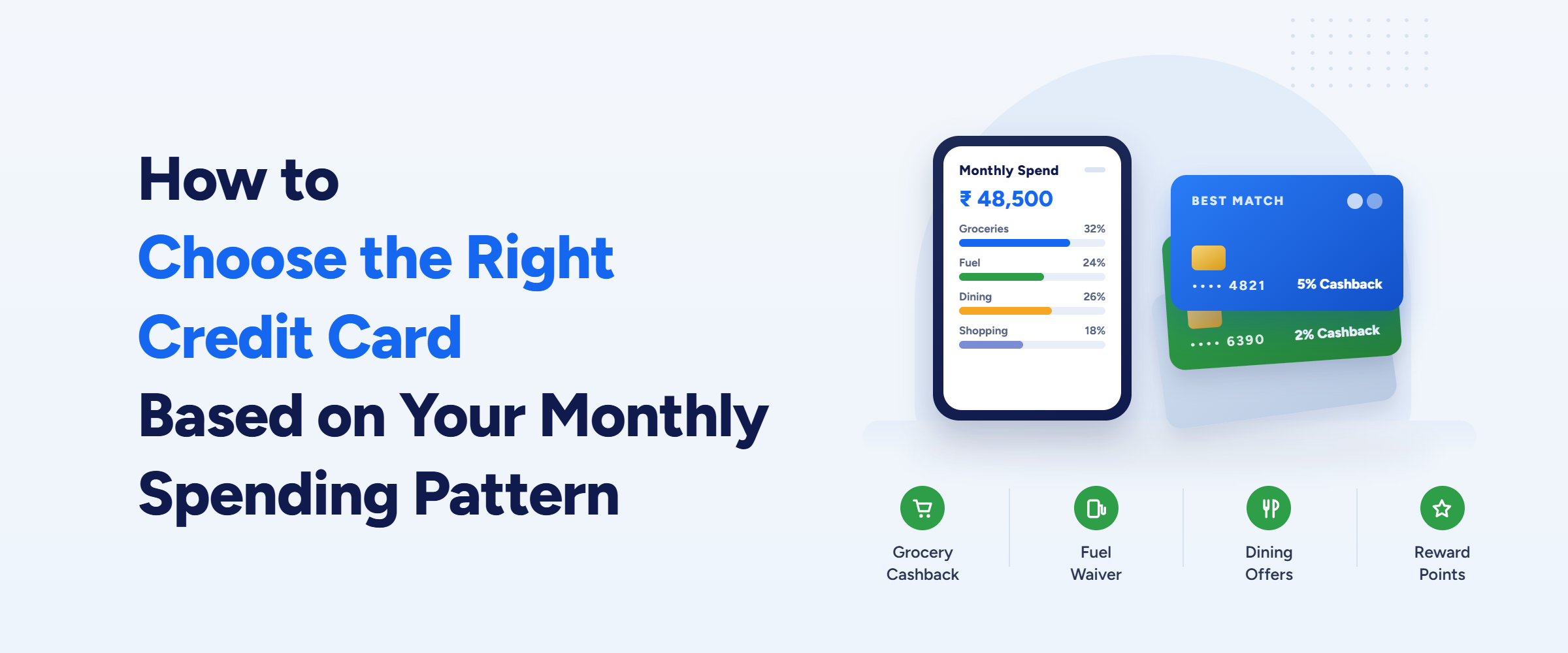
How to Choose the Right Credit Card Based on Your Monthly Spending Pattern
Picking a credit card shouldn't feel like buying a lottery ticket. Yet most people choose one because a bank representative called them, or a friend recommended it. Few actually stop to ask: "Does this card match how I spend money every month?"
If you want to choose the right credit card, the starting point isn't the card's brand or its shiny welcome offer. It's your own spending pattern, where your salary actually goes every month. This guide breaks that down in simple, practical terms, with real INR examples, so you can pick a card that saves you money instead of quietly costing you more.
What Does "Choosing the Right Credit Card" Really Mean?
A credit card is right for you when its rewards, fees, and features match your actual spending habits, not your aspirations. For example:
In short: the "best" card is not universal. It's personal.
Core Concepts You Should Understand First
Before comparing cards, it helps to understand a few basics.
How to Match a Credit Card to Your Spending Pattern
Here's a simple way to think about it: track where your last 2-3 months of spending actually went, then match that to a card category.
Step 1: Categorise Your Monthly Spending
| Spending Category | Typical Share of Monthly Budget |
|---|---|
| Groceries & daily essentials | 15-25% |
| Fuel & transport | 5-15% |
| Dining & food delivery | 5-15% |
| Online shopping | 10-20% |
| Bills & utilities | 10-15% |
| Travel (occasional) | Varies |
| EMIs & other loans | 15-30% |
Step 2: Identify Your Dominant Category
Whichever category takes the largest share of your spending should guide your card choice.
Step 3: Match to Card Type
| If You Spend Most On | Ideal Card Type | What to Look For |
|---|---|---|
| Groceries & utilities | Cashback card | High cashback rate on daily categories, low/no minimum spend |
| Fuel & travel by road | Fuel co-branded card | Fuel surcharge waiver, reward points on fuel |
| Online shopping | E-commerce co-branded card | Extra discounts on specific platforms, milestone benefits |
| Dining & entertainment | Lifestyle/rewards card | Dining discounts, movie ticket offers |
| Frequent flying | Travel/air miles card | Lounge access, air mile conversion, forex markup waiver |
| Low, mixed spending | Simple no-fee card | Zero or low annual fee, flat cashback, no complex categories |
Choosing a Credit Card Based on Salary
Your salary decides your loan eligibility and credit limit far more than your preferences do.
| Monthly Salary (Net) | Suggested Card Category | Typical Credit Limit Range |
|---|---|---|
| ₹20,000 - ₹35,000 | Entry-level/basic rewards card | ₹20,000 - ₹60,000 |
| ₹35,000 - ₹60,000 | Cashback or fuel co-branded card | ₹60,000 - ₹1,50,000 |
| ₹60,000 - ₹1,00,000 | Premium rewards or lifestyle card | ₹1,50,000 - ₹3,00,000 |
| ₹1,00,000+ | Travel/super-premium card | ₹3,00,000 and above |
Note: Actual limits depend on your CIBIL score, existing EMIs, and the bank's or NBFC's internal policy.
Worked Example: Two Indian Professionals, Two Different Cards
Example 1: Riya, 26, Marketing Executive, Mumbai
Riya earns ₹45,000 a month. Her biggest expenses are groceries (₹8,000), online shopping (₹6,000), and food delivery (₹5,000). A cashback card offering 3–5% back on these categories would save her roughly ₹500-₹900 every month, nearly ₹6,000-₹10,000 a year, more than covering any annual fee.
Example 2: Arjun, 32, IT Consultant, Bangalore
Arjun earns ₹1,10,000 a month and travels for work twice a month. A travel-focused card with lounge access and air mile rewards could save him thousands in flight upgrades and airport costs, something a basic cashback card simply can't offer him.
Same goal: save money; but two completely different right answers.
Common Mistakes People Make While Choosing a Credit Card
Expert Tips for Smarter Credit Card Selection
Take the Guesswork Out of It
Not sure which card fits your spending pattern? IndiaLends helps you compare credit cards from leading banks and NBFCs side by side, based on your income, credit profile, and spending habits so you can apply with confidence, not confusion.
Compare Credit Cards on IndiaLends
Conclusion
Choosing the right credit card isn't about picking the flashiest option, it's about picking the one that fits how you actually live and spend. Track your expenses, understand your salary bracket, compare fee structures honestly, and pick a card that rewards your real habits, not an imagined lifestyle. A well-matched credit card can quietly save you thousands of rupees a year. A poorly matched one can quietly cost you the same.

Scan this QR Code


Latest Articles
RBI Cooling-Off Period on Personal Loans: What You Can Actually Undo
18 Sep 2026
Should You Take a Personal Loan During Your Notice Period?
18 Sep 2026
Gold Loan for Business Working Capital: Cheaper Than a Business Loan?
11 Sep 2026
Gold Coin vs Jewellery Loan: What Lenders Will and Won't Accept
11 Sep 2026
Online Gold Loan vs NBFC Branch: Rate, Purity Test & Vault Safety
11 Sep 2026
Relevant Articles
How to Redeem Credit Card Reward Points Before They Expire
17 Aug 2026
Credit Card Minimum Due vs Total Due: The Real Cost of Paying Only the Minimum
17 Aug 2026
How to Dispute an Incorrect Credit Card Transaction in India
11 Aug 2026
Credit Card Closure vs Card Downgrade: Which Is Better for Your Credit History?
11 Aug 2026
Best Credit Cards for Cashback in India 2026
13 Jul 2026
FAQ’s
Match your credit limit expectations and card category to your net monthly income. As a rule of thumb, entry-level cards suit salaries under ₹35,000, while premium travel cards suit salaries above ₹1,00,000.
There's no single "best" card, it depends on where you spend the most. Cashback cards suit daily essentials, while co-branded fuel or e-commerce cards suit specific high-spend categories.
Yes, temporarily. Every application triggers a hard inquiry, which can lower your score slightly. Applying for too many cards in a short time can have a bigger impact.
Two to three well-matched cards are usually enough for most salaried individuals. More than that becomes hard to track and may hurt your credit utilisation ratio.
It's harder, but not impossible. Some NBFCs and banks offer secured credit cards (backed by a fixed deposit) for people with limited or low credit history.
 URL copied to clipboard successfully !
Download the IndiaLends App Now
Scan this QR code to download the app