Loans 

Credit Card
IndiaLends App is available in


Credit Card Minimum Due vs Total Due: The Real Cost of Paying Only the Minimum
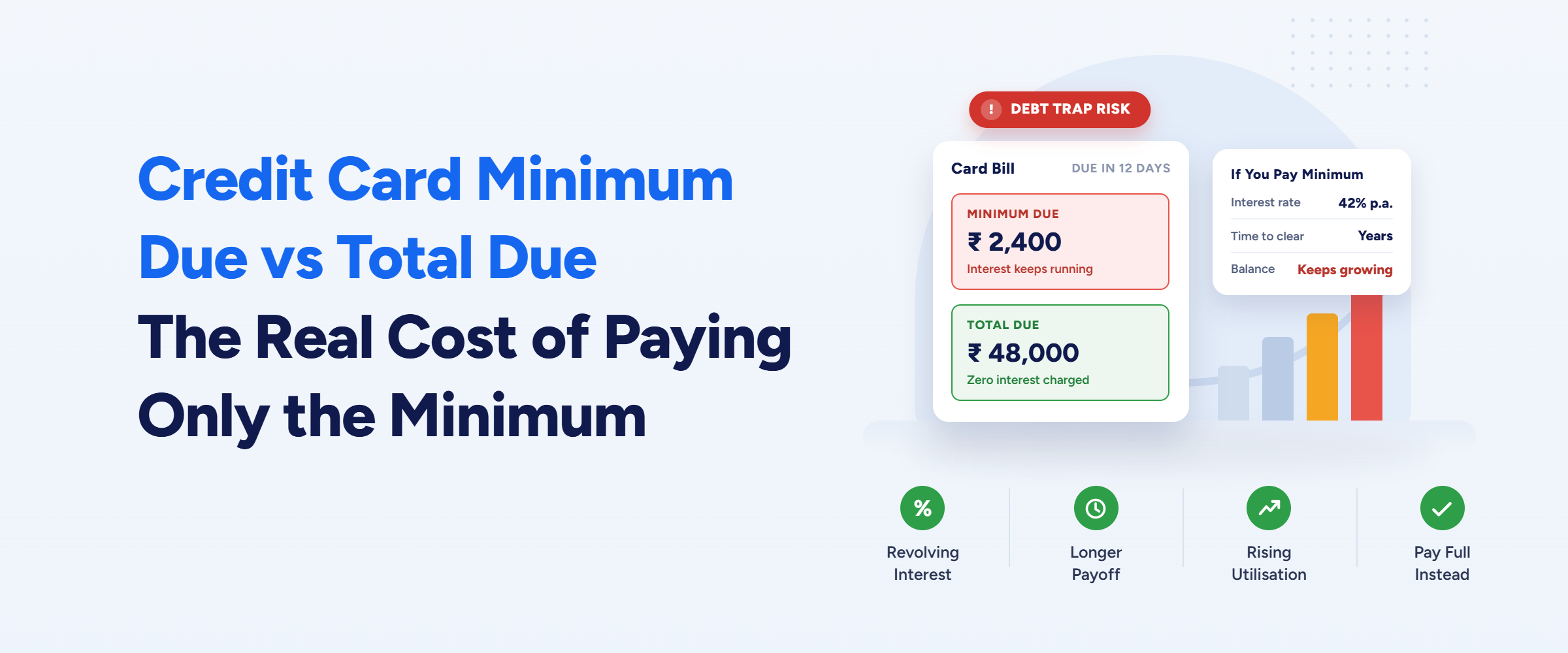
Your credit card bill lands, and there it is - two numbers. One small, one large. The "minimum amount due" looks so much easier to manage. Pay that, and technically, you're not "late." No penalty. No red flag. It feels like the safe choice.
But here's what most people don't realise until it's too late: paying only the minimum due is one of the most expensive habits in personal finance. Understanding credit card minimum due vs total due isn't just bank jargon, it directly affects how much interest you pay, how long you stay in debt, and even your CIBIL score over time. Let's break it down clearly.
What Is Minimum Due and Total Due on a Credit Card?
Total due is the entire amount you owe for that billing cycle, every purchase, EMI, fee, and previous balance combined.
Minimum amount due is a small fraction of that total, usually 5% of the total outstanding, plus any EMIs, fees, or overdue amounts that the bank asks you to pay to keep your account "in good standing" and avoid a late payment penalty.
Paying the minimum due keeps you technically compliant. But it does not mean your debt is cleared. The rest of the amount rolls over, and that's where the real cost begins.
Core Concepts You Need to Understand
Minimum Due vs Total Due: Side-by-Side Comparison
| Aspect | Minimum Due | Total Due |
|---|---|---|
| Amount | ~5% of outstanding + EMIs/fees | 100% of outstanding balance |
| Late payment penalty | Avoided | Avoided |
| Interest charged | Yes, on full outstanding | No, if paid in full and on time |
| Impact on CIBIL score | Neutral (if paid on time) | Positive (shows full repayment) |
| Debt carried forward | Yes | No |
| Interest-free period on new spends | Lost | Retained |
The Real Cost: A Worked Example
Let's say your total credit card bill is ₹50,000, and your minimum due is ₹2,500 (5%). If you pay only the minimum due, here's how the balance behaves over three months:
| Month | Outstanding Balance | Interest (approx. 3.5%/month) | New Minimum Due |
|---|---|---|---|
| Month 1 | ₹50,000 | ₹1,750 | ₹2,500 |
| Month 2 | ₹49,250 (after interest & partial payment) | ₹1,724 | ₹2,463 |
| Month 3 | ₹48,511 | ₹1,698 | ₹2,426 |
Even though you're "making payments" every month, your balance barely shrinks because interest keeps eating into it. If you also make new purchases, the balance can grow instead of reducing. In contrast: if you pay the full ₹50,000 total due, you owe ₹0 the next month, with zero interest charged.
Common Situations Where Minimum Due Feels Tempting (And Why It's Risky)
Common Mistakes People Make
Expert Tips to Avoid the Minimum Due Trap
Struggling With Credit Card Debt?
IndiaLends helps you compare personal loan options to consolidate high-interest credit card debt into a single, manageable EMI, often at a fraction of the interest rate.
Check Your Personal Loan Eligibility Now
Conclusion
Minimum due exists to protect your account status, not your wallet. Paying only the minimum feels manageable in the moment, but it quietly turns into one of the costliest financial habits, thanks to high interest rates and compounding balances. If you find yourself repeatedly paying only the minimum due, it's worth stepping back and looking at the full picture, including whether a personal loan at a lower interest rate could help you break the cycle faster.

Scan this QR Code


Latest Articles
RBI Cooling-Off Period on Personal Loans: What You Can Actually Undo
18 Sep 2026
Should You Take a Personal Loan During Your Notice Period?
18 Sep 2026
Gold Loan for Business Working Capital: Cheaper Than a Business Loan?
11 Sep 2026
Gold Coin vs Jewellery Loan: What Lenders Will and Won't Accept
11 Sep 2026
Online Gold Loan vs NBFC Branch: Rate, Purity Test & Vault Safety
11 Sep 2026
Relevant Articles
How to Redeem Credit Card Reward Points Before They Expire
17 Aug 2026
How to Dispute an Incorrect Credit Card Transaction in India
11 Aug 2026
Credit Card Closure vs Card Downgrade: Which Is Better for Your Credit History?
11 Aug 2026
How to Choose the Right Credit Card Based on Your Monthly Spending Pattern
10 Aug 2026
Best Credit Cards for Cashback in India 2026
13 Jul 2026
FAQ’s
Minimum due is a small portion (usually 5%) of your total outstanding that keeps your account penalty-free. Total due is the full amount owed, and paying it in full avoids all interest charges.
Paying the minimum due on time generally doesn't hurt your score directly, but the resulting high outstanding balance can increase your credit utilisation ratio, which can lower your score indirectly.
Credit card interest typically ranges from 2.5% to 3.5% per month (30-42% annually), charged on your full outstanding balance, not just the unpaid portion.
Yes, if done repeatedly. It leads to revolving credit card debt, where interest keeps compounding and the balance takes much longer to clear, often costing far more than the original purchase amount.
Pay as much as you can above the minimum due, avoid new spends on the card, and consider a personal loan to pay off the balance at a lower interest rate if the debt is significant.
 URL copied to clipboard successfully !
Download the IndiaLends App Now
Scan this QR code to download the app