Loans 

Credit Card
IndiaLends App is available in


How to Dispute an Incorrect Credit Card Transaction in India
You're scrolling through your credit card statement, and something feels off. A charge for ₹4,999 you don't remember making. A duplicate entry for a bill you paid only once. Or worse, a transaction from a store you've never even visited.
Your first reaction might be panic. It shouldn't be. Every bank and NBFC in India has a defined process to raise a credit card transaction dispute, and in most genuine cases, you get your money back. The key is knowing what to do and doing it quickly. This guide walks you through the entire process, in plain language, so you know exactly what steps to take the moment something looks wrong.
What Does "Disputing a Credit Card Transaction" Actually Mean?
A credit card dispute is a formal request you raise with your bank or NBFC asking them to investigate a transaction you believe is incorrect, unauthorised, or fraudulent. This could include:
Once you raise a dispute, the bank investigates and, in valid cases, reverses the charge, a process often called a chargeback.
Core Concepts You Should Know Before Raising a Dispute
| Reporting Time After Transaction | Your Liability |
|---|---|
| Within 3 working days | Zero liability |
| 4 to 7 working days | Limited liability (amount capped, varies by card type) |
| Beyond 7 working days | Liability decided as per bank's board-approved policy |
This is exactly why speed matters when you spot something wrong.
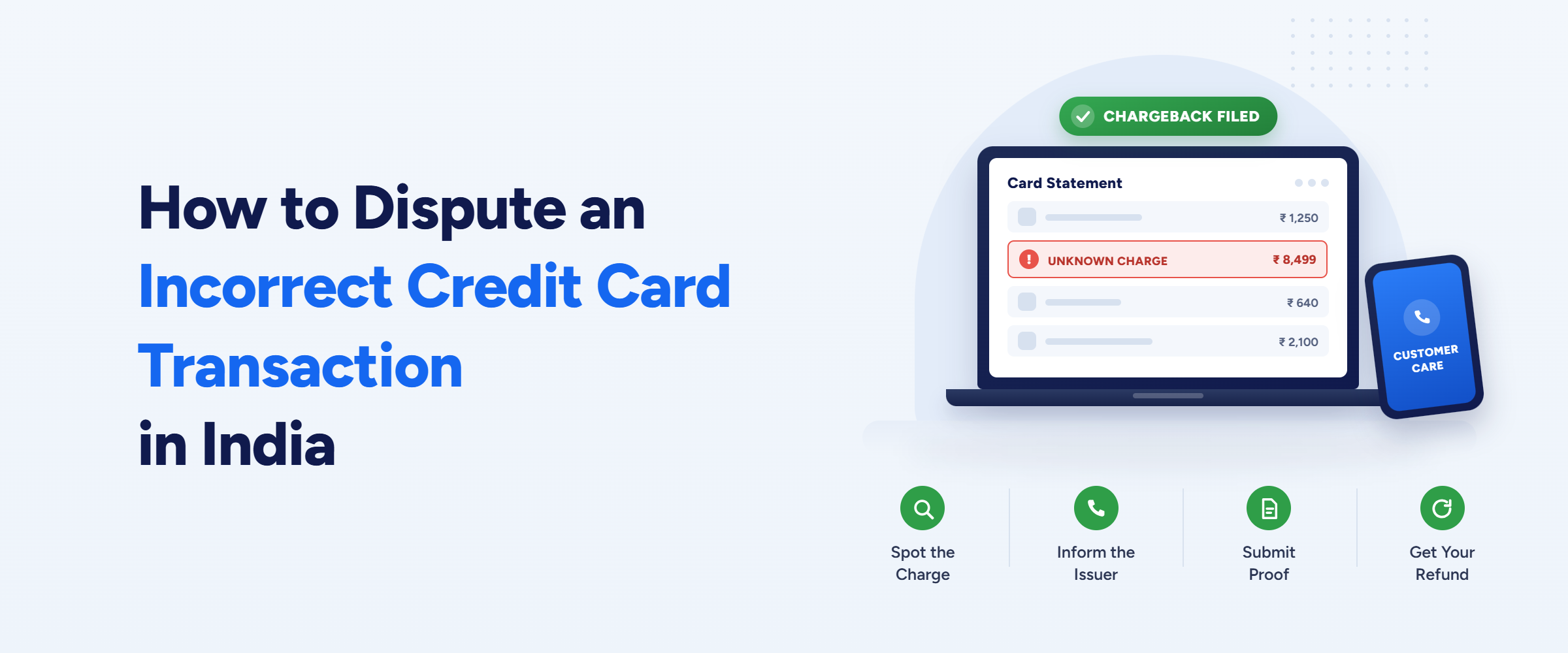
Step-by-Step: How to Raise a Credit Card Transaction Dispute in India
Dispute Process at a Glance
| Stage | What Happens | Typical Timeframe |
|---|---|---|
| Report the issue | You inform the bank and (if needed) block the card | Immediately |
| Dispute filed | Bank logs your complaint with a reference number | Same day |
| Investigation | Bank verifies with merchant/network (Visa, Mastercard, RuPay) | 7-45 days |
| Provisional credit | Amount may be credited temporarily during investigation | Within 10 working days (for eligible cases) |
| Final resolution | Amount reversed permanently, or dispute rejected with reason | After investigation closes |
Worked Example: Two Real-World Dispute Scenarios
Example 1: Priya, Delhi — Unauthorised Online Transaction
Priya noticed a ₹12,500 transaction from an online electronics store she'd never used. She immediately blocked her card through the bank's app and raised a dispute the same day. Since she reported it within 24 hours, she had zero liability under RBI rules, and the amount was credited back within 15 days after investigation.
Example 2: Rohan, Bangalore — Duplicate Billing
Rohan was charged ₹3,200 twice for the same hotel booking due to a payment gateway glitch. He raised a dispute with transaction screenshots and the hotel's confirmation email as proof. The duplicate charge was reversed within 10 days, since the evidence was clear.
Common Mistakes People Make While Disputing a Transaction
Expert Tips for a Smooth Dispute Resolution
Need Help Managing Your Credit Profile?
IndiaLends helps you track your credit health, understand how disputes and repayments affect your CIBIL score, and choose the right credit products with complete transparency.
Check Your Free CIBIL Score Now
Conclusion
Spotting a wrong or unauthorised charge on your credit card can be unsettling, but the process to fix it in India is well-defined and works in your favour when you act quickly. Report early, document everything, and follow up until you get a clear resolution. The faster you respond, the lower your liability — and the smoother your dispute journey.

Scan this QR Code


Latest Articles
RBI Cooling-Off Period on Personal Loans: What You Can Actually Undo
18 Sep 2026
Should You Take a Personal Loan During Your Notice Period?
18 Sep 2026
Gold Loan for Business Working Capital: Cheaper Than a Business Loan?
11 Sep 2026
Gold Coin vs Jewellery Loan: What Lenders Will and Won't Accept
11 Sep 2026
Online Gold Loan vs NBFC Branch: Rate, Purity Test & Vault Safety
11 Sep 2026
Relevant Articles
How to Redeem Credit Card Reward Points Before They Expire
17 Aug 2026
Credit Card Minimum Due vs Total Due: The Real Cost of Paying Only the Minimum
17 Aug 2026
Credit Card Closure vs Card Downgrade: Which Is Better for Your Credit History?
11 Aug 2026
How to Choose the Right Credit Card Based on Your Monthly Spending Pattern
10 Aug 2026
Best Credit Cards for Cashback in India 2026
13 Jul 2026
FAQ’s
Report the issue to your bank through its app, net banking, or helpline, provide transaction details and proof, and get a complaint reference number. The bank then investigates and resolves it, usually within 7 to 45 days.
For zero liability, you should ideally report within 3 working days of the transaction. Reporting between 4 to 7 days may lead to limited liability, as per RBI guidelines.
In genuine cases with valid proof, yes. Banks either issue a provisional credit during investigation or a full reversal once the dispute is resolved in your favour.
A refund is issued directly by the merchant. A chargeback is a bank-enforced reversal, used when the merchant doesn't cooperate or the transaction is proven unauthorised or fraudulent.
You can escalate to the bank's nodal grievance officer, and if still unresolved after 30 days, file a complaint with the RBI's Banking Ombudsman through the Integrated Ombudsman Scheme portal.
 URL copied to clipboard successfully !
Download the IndiaLends App Now
Scan this QR code to download the app