Loans 

Credit Card
IndiaLends App is available in


Credit Card Closure vs Card Downgrade: Which Is Better for Your Credit History?
You're paying an annual fee on a credit card you barely use. The obvious move feels like closing it and moving on.
But here's the catch: closing a credit card isn't always the safest decision for your credit history. In many cases, a simple downgrade does the job just as well without the side effects. If you're stuck deciding whether to close or downgrade credit card accounts you no longer need, this guide breaks down exactly how each option affects your CIBIL score, so you can choose with confidence.
What's the Difference Between Closing and Downgrading a Credit Card?
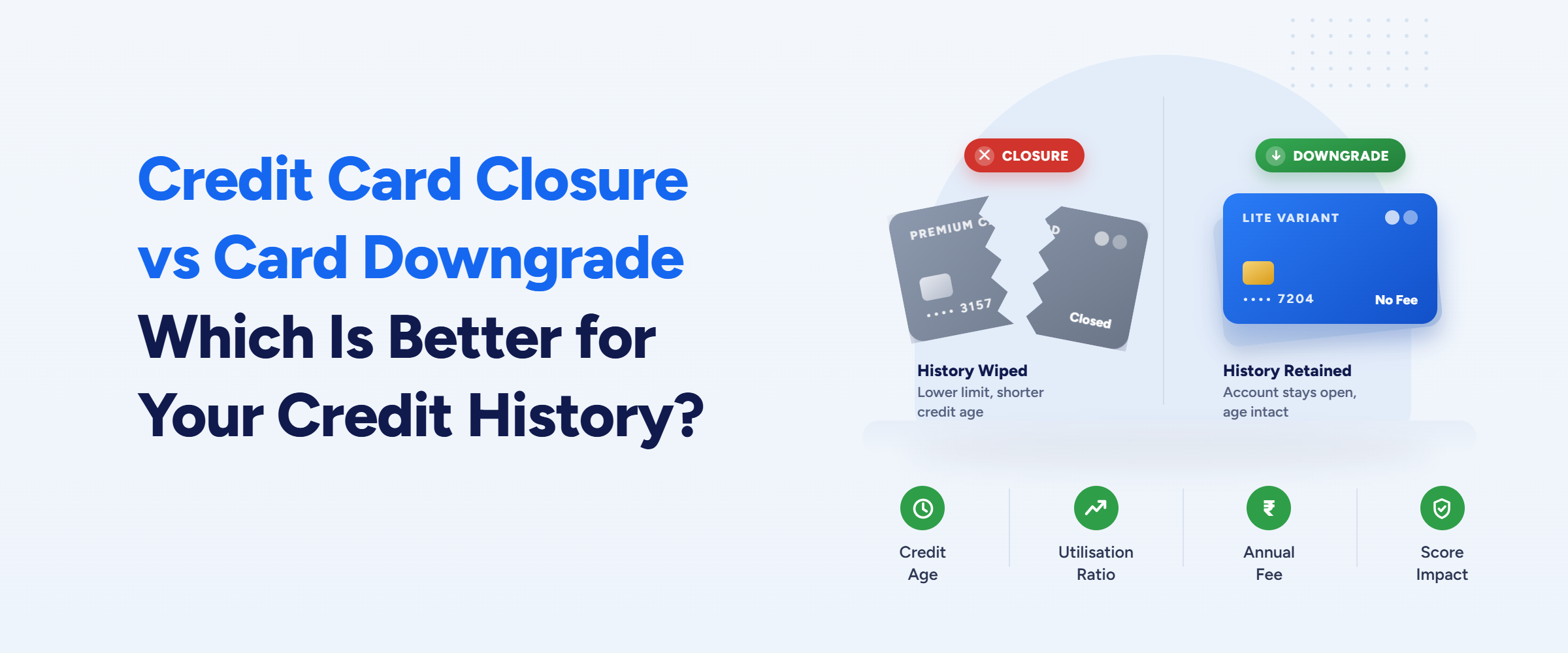
Credit card closure means permanently shutting down the card account. It stops existing, along with its credit limit and credit history tied to that account.
Credit card downgrade means switching your existing card to a lower-tier variant from the same bank, usually one with a lower or no annual fee while keeping the account, credit limit, and account age intact.
The core difference: closure ends the relationship completely, while downgrading simply changes the terms of an ongoing one.
Core Concepts That Affect Your Decision
Credit Card Closure Impact on CIBIL: What Really Happens
| Factor | Effect of Closing a Credit Card |
|---|---|
| Credit history length | May shorten average account age, especially if it's an old card |
| Credit utilisation ratio | Can increase, since total available limit drops |
| Credit mix | May reduce diversity if it's your only or last credit card |
| Payment history record | Stays on your credit report for years, even after closure |
| Immediate score impact | Usually small, but can be more noticeable for those with limited credit history |
The good news: the impact is rarely dramatic if you have other well-managed credit accounts. But for first-time borrowers or those with only one or two cards, it can matter more.
When Downgrading Makes More Sense Than Closing
| Situation | Better Choice | Why |
|---|---|---|
| Card is your oldest credit account | Downgrade | Preserves credit history length |
| You have very few other credit accounts | Downgrade | Maintains credit mix and available limit |
| You want to avoid the annual fee only | Downgrade | Solves the fee problem without closing the account |
| You've had disputes, unpaid dues, or fraud on the card | Closure (after resolving) | Downgrading won't fix an existing problem account |
| Bank doesn't offer any lower-tier variant | Closure | No downgrade option available |
| You genuinely don't need any card from that bank | Closure | No benefit to keeping an unused relationship open |
How to Downgrade a Credit Card Without Affecting Your Score
Here's the general process most Indian banks follow:
This route lets you cancel a credit card's expensive features without affecting your score, since the account itself stays open.
Worked Example: Two Cardholders, Two Different Choices
Example 1: Ananya, 29, First-Time Cardholder, Chennai
Ananya has only one credit card, issued 4 years ago, with an annual fee of ₹1,500. It's also her oldest credit account. Since closing it would shorten her credit history and remove her only credit account, she chose to downgrade to a no-fee variant instead, keeping her CIBIL profile stable while cutting costs.
Example 2: Vikram, 38, Multiple Cardholder, Hyderabad
Vikram has four credit cards. One card, taken 2 years ago, has a high annual fee and he rarely uses it. Since he has three other well-established cards, closing this one had minimal impact on his overall credit history and utilisation. He went ahead with closure.
Same question, two different right answers because their credit profiles were different.
Common Mistakes to Avoid
Expert Tips Before You Decide
Not Sure What's Right for Your Credit Profile?
IndiaLends helps you check your CIBIL score for free and understand exactly how decisions like card closure or downgrade could affect your credit health so you can decide with clarity, not guesswork.
Check Your Free CIBIL Score Now
Conclusion
Closing a credit card can feel like a quick fix, but it isn't always the safest one for your credit history. Downgrading often achieves the same goal, cutting unnecessary costs while protecting your credit history length, utilisation ratio, and credit mix. Before you decide, look at your full credit profile: how many cards you have, how old each one is, and how much of your credit limit you actually use. The right choice depends on your situation, not a one-size-fits-all rule.

Scan this QR Code


Latest Articles
RBI Cooling-Off Period on Personal Loans: What You Can Actually Undo
18 Sep 2026
Should You Take a Personal Loan During Your Notice Period?
18 Sep 2026
Gold Loan for Business Working Capital: Cheaper Than a Business Loan?
11 Sep 2026
Gold Coin vs Jewellery Loan: What Lenders Will and Won't Accept
11 Sep 2026
Online Gold Loan vs NBFC Branch: Rate, Purity Test & Vault Safety
11 Sep 2026
Relevant Articles
How to Redeem Credit Card Reward Points Before They Expire
17 Aug 2026
Credit Card Minimum Due vs Total Due: The Real Cost of Paying Only the Minimum
17 Aug 2026
How to Dispute an Incorrect Credit Card Transaction in India
11 Aug 2026
How to Choose the Right Credit Card Based on Your Monthly Spending Pattern
10 Aug 2026
Best Credit Cards for Cashback in India 2026
13 Jul 2026
FAQ’s
It can, especially if it's your oldest card or your only credit account. The impact varies from person to person, depending on your overall credit profile.
In most cases, yes, especially for your oldest or only card, since downgrading keeps your account history and credit limit intact while reducing costs like the annual fee.
Consider downgrading instead of closing, especially if it's an old account. If you must close it, do it only after clearing dues, redeeming rewards, and ensuring you have other active credit accounts.
Not necessarily. An old, unused card with no annual fee often helps your credit history length and utilisation ratio more by staying open than by being closed.
Sometimes the credit limit changes slightly with the new variant, but the account age and history usually remain unaffected, which is the main advantage over closure.
 URL copied to clipboard successfully !
Download the IndiaLends App Now
Scan this QR code to download the app