Loans 

Credit Card
IndiaLends App is available in


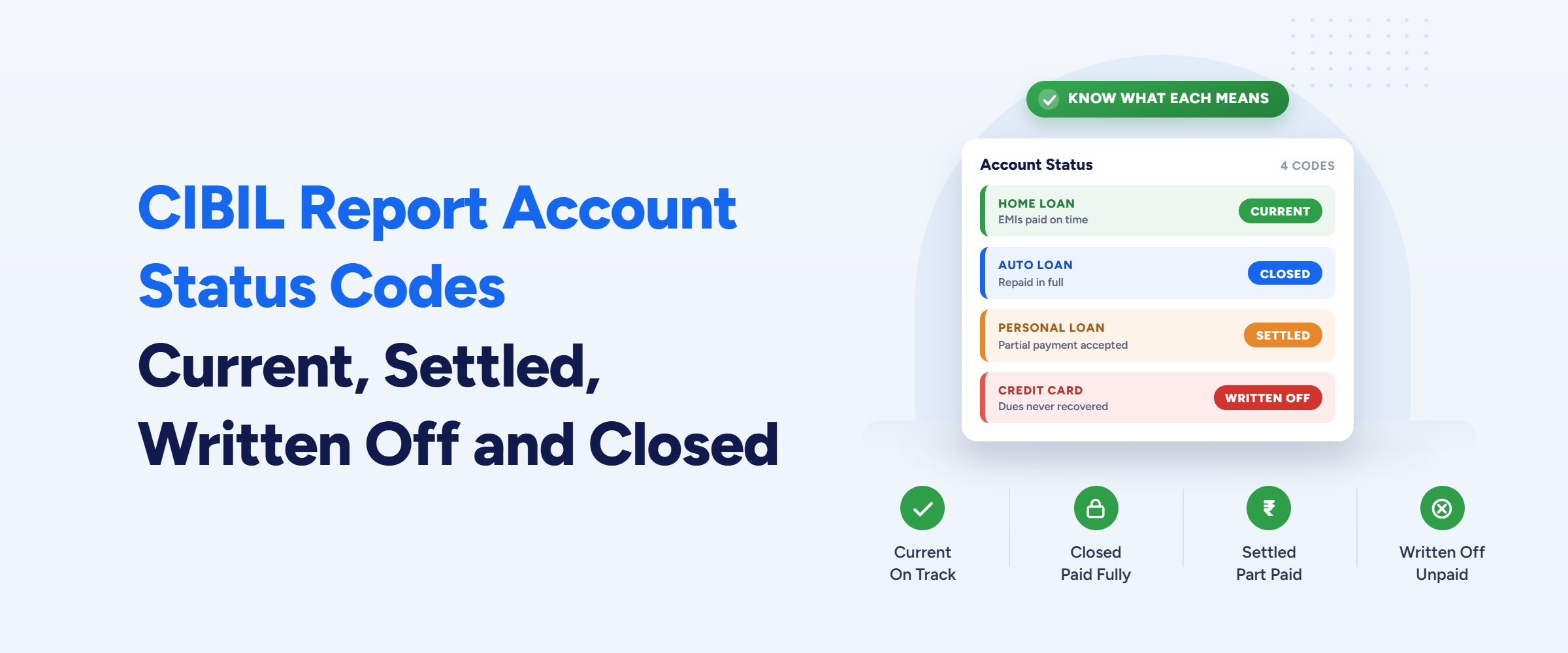
CIBIL Report Account Status Codes: Current, Settled, Written Off, and Closed
Scrolling through your CIBIL report, you spot a word next to one of your old loans: "Written Off." Your stomach drops a little. What does that even mean? Is it worse than "Settled"? Is "Closed" always good news?
These account status labels aren't just administrative details, they tell future lenders exactly how you handled your past debts, and each one carries a very different weight when it comes to your CIBIL score and loan eligibility. This guide breaks down every major CIBIL report account status in plain language, so you know exactly what you're looking at.
What Are Account Status Codes in a CIBIL Report?
Every loan or credit card listed in your CIBIL report has a status field that tells you (and any lender viewing your report) the current state of that account. This status is reported by the bank or NBFC every month and reflects things like:
Understanding these statuses helps you interpret your own credit history the same way a lender would.
Core Concepts You Should Understand First
The Four Key Account Statuses Explained
Quick Comparison: All Four Statuses Side by Side
| Status | What Happened | Credit Score Impact | Debt Legally Cleared? |
|---|---|---|---|
| Current | Loan is active, being repaid as agreed | Neutral to positive | Not applicable (ongoing) |
| Closed | Full amount repaid as per original terms | Positive | Yes |
| Settled | Reduced amount accepted as final payment | Significantly negative | Yes, but noted as settled |
| Written Off | Lender stopped pursuing recovery | Severely negative | Not necessarily; debt may still exist |
How Each Status Affects Your Future Loan Applications
| Status on Report | How Lenders Typically View It |
|---|---|
| Current (with good DPD) | Positive signal of active, responsible credit use |
| Closed | Strong positive signal; demonstrates full repayment history |
| Settled | Red flag; may lead to rejection or higher interest rates |
| Written Off | Very high-risk flag; often leads to straightforward rejection |
Worked Example: Comparing Two Borrowers
Example 1: Neha, Pune — "Closed" Status
Neha took a ₹2,00,000 personal loan and repaid it fully over 24 months with no missed payments. Her report shows "Closed" with a clean DPD history. When she applied for a new personal loan for ₹5,00,000, she was approved quickly at a competitive interest rate.
Example 2: Amit, Lucknow — "Written Off" Status
Amit stopped paying his credit card bill after a job loss, and after over a year of non-payment, the bank wrote off the debt. Two years later, when Amit applied for a personal loan, he faced rejection from multiple lenders, who cited the "Written Off" status as the primary reason, even though the debt itself was old.
The difference in outcomes here comes entirely down to how each account was resolved.
Common Mistakes People Make Regarding Account Status
Expert Tips for Managing Account Status Issues
Want to Understand Your Own Credit Report Better?
IndiaLends helps you check your CIBIL score and report for free, so you can see exactly how your accounts are being reported and take action on any issues before they affect your next loan application.
Check Your Free CIBIL Score Now
Conclusion
Not all account statuses on your CIBIL report are created equal. "Current" and "Closed" reflect responsible credit behaviour, while "Settled" and "Written Off" signal to future lenders that something went wrong along the way. Knowing the difference helps you understand exactly how lenders will view your credit history and gives you a clear reason to always aim for full repayment and a "Closed" status wherever possible.

Scan this QR Code


Latest Articles
How to Read a CIBIL Report Line by Line
20 Aug 2026
CIBIL Score After Loan Settlement: What Borrowers Should Know
18 Aug 2026
Why a Closed Loan Still Appears on Your Credit Report
18 Aug 2026
How to Redeem Credit Card Reward Points Before They Expire
17 Aug 2026
Credit Card Minimum Due vs Total Due: The Real Cost of Paying Only the Minimum
17 Aug 2026
Relevant Articles
How to Read a CIBIL Report Line by Line
20 Aug 2026
CIBIL Score After Loan Settlement: What Borrowers Should Know
18 Aug 2026
Why a Closed Loan Still Appears on Your Credit Report
18 Aug 2026
How to Improve Your Credit Score Fast in India
13 Jul 2026
Common CIBIL Score Myths That Most People Believe
14 May 2026
FAQ’s
"Settled" means the borrower paid a reduced amount, which the lender accepted as full and final payment instead of the complete outstanding balance. It negatively affects your credit score.
"Written Off" means the lender has stopped pursuing active recovery of the debt, typically after prolonged non-payment. It doesn't mean the debt is cancelled, you may still owe it legally.
Generally, yes. A "Closed" status means the loan was repaid in full as per the original agreement, which is viewed positively by future lenders.
In some cases, yes. If you repay the outstanding amount later, some lenders may agree to update the status, though this isn't guaranteed and depends on their internal policy.
"Written Off" typically has the most severe negative impact, followed closely by "Settled," since both indicate the original loan terms weren't fully honoured.
 URL copied to clipboard successfully !
Download the IndiaLends App Now
Scan this QR code to download the app