Loans 

Credit Card
IndiaLends App is available in


How to Read a CIBIL Report Line by Line
You finally download your CIBIL report. It opens up, and it's... a lot. Numbers, codes, tables, abbreviations you've never seen before.
Most people skim straight to the score at the top and ignore everything else. But that score is just a summary, the real story of your credit health is in the details below it. Learning how to read a CIBIL report properly helps you catch errors, understand why your score is what it is, and know exactly what lenders see when you apply for a personal loan or credit card. Let's go through it section by section, in plain language.
What Is a CIBIL Report, Exactly?
A CIBIL report is a detailed record of your credit history, maintained by TransUnion CIBIL, one of India's four credit bureaus. It's built from data that banks and NBFCs submit every month, your loans, credit cards, repayment history, and any defaults or settlements.
Lenders use this report (along with your CIBIL score) to decide:
Core Concepts Before You Start Reading
Section-by-Section Breakdown of Your CIBIL Report
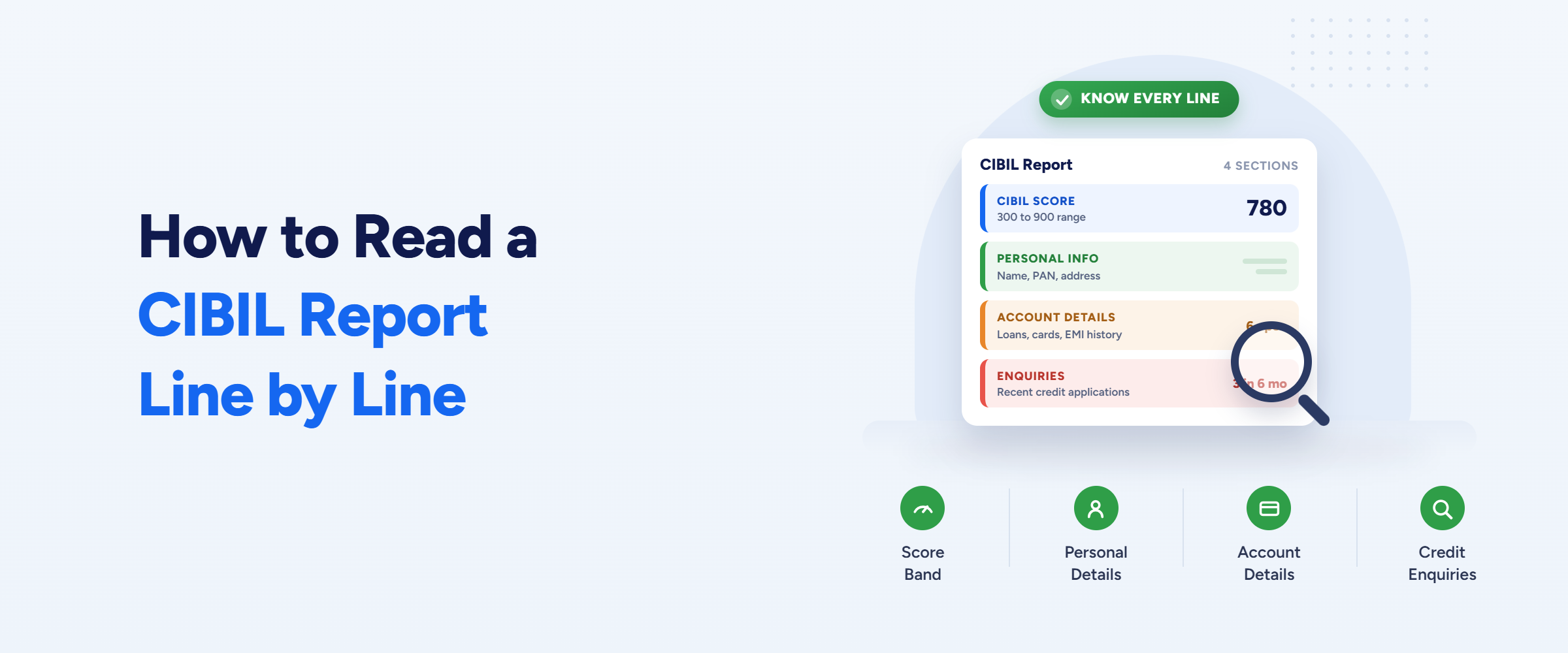
Section 1: CIBIL Score
This appears right at the top, a number between 300 and 900. The higher the number, the better your credit health.
| Score Range | What It Generally Indicates |
|---|---|
| 750-900 | Excellent credit health, strong loan eligibility |
| 650-749 | Good, but room for improvement |
| 550-649 | Below average; may face higher interest rates or rejections |
| Below 550 | Poor; loan approval becomes difficult |
Section 2: Personal Information
This includes your name, date of birth, PAN, address history, and phone numbers, as reported by different lenders over time. What to check here: Look for spelling errors, outdated addresses, or incorrect PAN details, these can sometimes cause mismatches during loan applications.
Section 3: Account Summary
This gives you a quick snapshot of the total number of accounts (active and closed), total outstanding balance across all accounts, number of accounts with overdue payments, and total high credit/sanctioned amount.
Section 4: Account Information (Detailed)
This is the most important section. For every loan or credit card, you'll see the following fields:
| Field | What It Means |
|---|---|
| Member Name | The bank or NBFC that issued the loan/card |
| Account Type | Personal loan, credit card, home loan, etc. |
| Account Status | Current, Closed, Settled, Written Off, etc. |
| Sanctioned Amount / Credit Limit | The original loan amount or credit card limit |
| Current Balance | What you still owe, if any |
| Overdue Amount | Any amount pending beyond the due date |
| DPD (Days Past Due) | Your monthly payment track record |
| Date Opened / Date Closed | When the account started and ended |
Section 5: Enquiry Information
This lists every instance where your credit report was accessed, usually because you applied for a loan or credit card. It shows the date, the lender's name, and the type of loan or product enquired about.
Worked Example: Reading a Sample Account Entry
Let's say your report shows this entry for a personal loan:
| Field | Sample Value |
|---|---|
| Member Name | XYZ Bank |
| Account Type | Personal Loan |
| Sanctioned Amount | ₹3,00,000 |
| Current Balance | ₹85,000 |
| Account Status | Current |
| DPD (last 6 months) | 000, 000, 000, 000, 030, 000 |
| Date Opened | 15-06-2023 |
Reading this: You took a ₹3,00,000 personal loan from XYZ Bank in June 2023. You still owe ₹85,000. Your payment history is mostly on time, except one month where you were 30 days late. The account is currently active ("Current" status). This single row tells a lender a complete story about your repayment discipline on this loan.
Common Mistakes People Make While Reading Their Report
Expert Tips for Reading Your CIBIL Report Effectively
Want to Check Your CIBIL Report for Free?
IndiaLends lets you check your CIBIL score and detailed credit report at no cost, so you can understand exactly where you stand before applying for your next loan or credit card.
Check Your Free CIBIL Score Now
Conclusion
Your CIBIL report is more than just a score, it's a detailed record of your financial behaviour that lenders study closely. Learning to read it section by section helps you catch errors early, understand what's driving your score, and walk into your next loan application with confidence, not confusion. Make it a habit to review your full report, not just the score, every few months.

Scan this QR Code


Latest Articles
CIBIL Report Account Status Codes: Current, Settled, Written Off, and Closed
20 Aug 2026
CIBIL Score After Loan Settlement: What Borrowers Should Know
18 Aug 2026
Why a Closed Loan Still Appears on Your Credit Report
18 Aug 2026
How to Redeem Credit Card Reward Points Before They Expire
17 Aug 2026
Credit Card Minimum Due vs Total Due: The Real Cost of Paying Only the Minimum
17 Aug 2026
Relevant Articles
CIBIL Report Account Status Codes: Current, Settled, Written Off, and Closed
20 Aug 2026
CIBIL Score After Loan Settlement: What Borrowers Should Know
18 Aug 2026
Why a Closed Loan Still Appears on Your Credit Report
18 Aug 2026
How to Improve Your Credit Score Fast in India
13 Jul 2026
Common CIBIL Score Myths That Most People Believe
14 May 2026
FAQ’s
Start with your score, then review personal information for accuracy, check the account summary for an overview, go through detailed account information for each loan or card, and finally check the enquiry section for recent credit checks.
DPD stands for "Days Past Due." It shows how many days late a payment was for each month, with "000" indicating an on-time payment.
Check your personal information for accuracy first, since errors here can cause issues during loan applications, then move to your account details and payment history.
Closed loans remain on your report for years as part of your credit history, since they contribute to your overall repayment track record, even after being paid off.
An enquiry is recorded every time your credit report is accessed, usually because you or a lender checked it for a loan or credit card application. Too many enquiries in a short time can slightly affect your score.
 URL copied to clipboard successfully !
Download the IndiaLends App Now
Scan this QR code to download the app