Loans 

Credit Card
IndiaLends App is available in


CIBIL Score After Loan Settlement: What Borrowers Should Know
Life doesn't always go as planned. A job loss, a medical emergency, or a sudden financial setback can make it impossible to pay your loan EMIs as agreed. In such situations, some borrowers negotiate a loan settlement with their bank or NBFC, paying a reduced amount to close the debt. It can feel like relief in the moment.
But here's what many borrowers don't fully understand until later: loan settlement impact on CIBIL is real, and it's often more damaging than a regular loan closure. This guide explains exactly what happens to your credit score after a settlement, how long it stays on your report, and what you can do to recover.
What Does "Loan Settlement" Actually Mean?
A loan settlement happens when a borrower is unable to repay the full outstanding amount, and the lender agrees to accept a lower amount as full and final payment, closing the account.
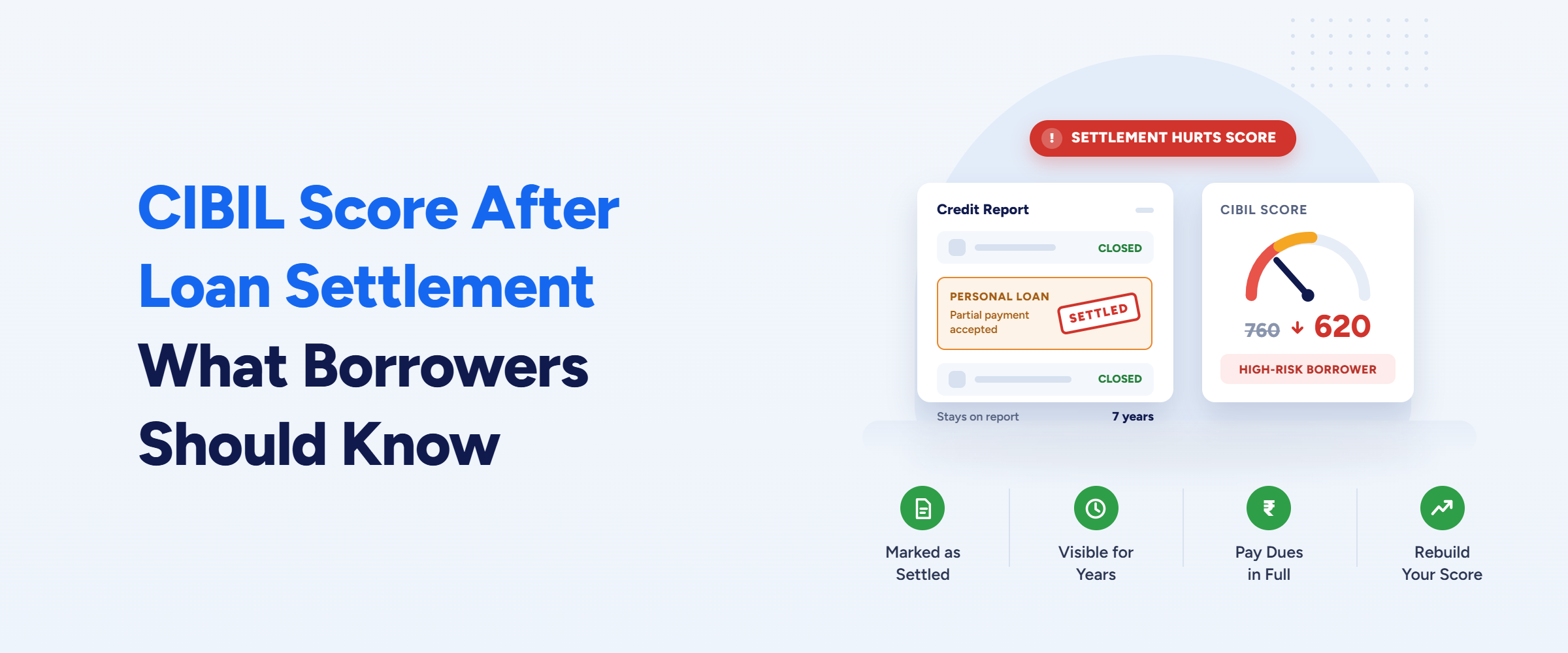
This is different from a regular loan closure, where you repay the entire outstanding amount as originally agreed. Once a settlement is done, the lender reports the account status to credit bureaus as "Settled" instead of "Closed" and this distinction matters enormously for your credit profile.
Core Concepts You Should Understand
Loan Settlement vs Loan Closure: Key Differences
| Aspect | Loan Closure | Loan Settlement |
|---|---|---|
| Amount paid | Full outstanding amount | Reduced/negotiated amount |
| Credit report status | "Closed" | "Settled" |
| Impact on CIBIL score | Neutral to positive | Significantly negative |
| Duration on credit report | Reflects as a positive closed account | Remains visible for up to 7 years |
| Future loan eligibility | Generally unaffected | Often affected; may need explanation |
| Perception by future lenders | Responsible repayment | Partial default / higher risk |
How Much Does a Settlement Affect Your CIBIL Score?
There's no fixed number that applies to everyone, since your score depends on your overall credit profile. But here's a general sense of the impact.
| Credit Profile Before Settlement | Typical Score Impact |
|---|---|
| Strong score (750+) with clean history | Can drop by 75-100+ points |
| Moderate score (650-750) | Can drop by 50-75 points |
| Already weak score (below 650) | Smaller absolute drop, but recovery becomes harder |
These are indicative ranges. Actual impact depends on the lender's reporting, your overall credit mix, and other active accounts.
Worked Example: Understanding the Real Impact
Example: Sanjay, Marketing Manager, Chennai
Sanjay had a personal loan of ₹4,00,000. After losing his job for a few months, he couldn't keep up with EMIs and negotiated a settlement with his NBFC, paying ₹3,10,000 as full and final settlement.
His CIBIL score, which was 760 before the financial trouble began, dropped to around 640 after the settlement was reported. Nearly two years later, despite maintaining perfect repayment on his credit card and a new small personal loan, his score had only recovered to about 700 because the "Settled" remark continued to weigh on his report.
This illustrates why settlement should generally be considered a last resort, not a convenient shortcut.
How to Improve Your Score After a Settlement
Common Mistakes Borrowers Make
Expert Tips for Borrowers Considering Settlement
Not Sure What Settlement Means for Your Credit Health?
IndiaLends helps you check your CIBIL score for free and understand exactly where you stand, so you can make informed decisions before and after a loan settlement.
Check Your Free CIBIL Score Now
Conclusion
A loan settlement can offer real relief during a genuine financial crisis, but it comes at a cost that isn't always obvious upfront, a "Settled" remark that can shape how future lenders view you for years. If you're considering settlement, explore every alternative first, and if you do go ahead, understand clearly what it means for your credit journey. Recovery is possible, but it takes patience, discipline, and consistent, responsible credit behaviour.

Scan this QR Code


Latest Articles
How to Read a CIBIL Report Line by Line
20 Aug 2026
CIBIL Report Account Status Codes: Current, Settled, Written Off, and Closed
20 Aug 2026
Why a Closed Loan Still Appears on Your Credit Report
18 Aug 2026
How to Redeem Credit Card Reward Points Before They Expire
17 Aug 2026
Credit Card Minimum Due vs Total Due: The Real Cost of Paying Only the Minimum
17 Aug 2026
Relevant Articles
How to Read a CIBIL Report Line by Line
20 Aug 2026
CIBIL Report Account Status Codes: Current, Settled, Written Off, and Closed
20 Aug 2026
Why a Closed Loan Still Appears on Your Credit Report
18 Aug 2026
How to Improve Your Credit Score Fast in India
13 Jul 2026
Common CIBIL Score Myths That Most People Believe
14 May 2026
FAQ’s
Yes, significantly. A settled loan is reported as "Settled" rather than "Closed," which signals partial default to future lenders and typically causes a noticeable drop in your CIBIL score.
The "Settled" remark can remain visible on your credit report for up to 7 years, although its impact on your score gradually reduces over time with responsible credit behaviour.
No. Loan closure means you repaid the full amount owed. Loan settlement means you paid a reduced, negotiated amount, and this distinction is clearly reflected in your credit report.
Yes, though it takes time, typically 18 to 36 months of consistent, on-time repayment on other credit accounts, along with low credit utilisation, can help your score recover gradually.
In some cases, if you later pay the remaining waived amount, the lender may agree to update the status to "Closed," but this isn't guaranteed and depends on the lender's policy.
 URL copied to clipboard successfully !
Download the IndiaLends App Now
Scan this QR code to download the app