Loans 

Credit Card
IndiaLends App is available in


Gold Loan Auction Process in India: Timeline, Notice & Borrower Rights
Missing a gold loan payment is stressful and the fear of losing family jewellery to auction can make that stress worse. But here's what most borrowers don't realise: auction is the last step in a long, regulated process, not an immediate consequence of a missed payment.
The Reserve Bank of India has built in multiple checkpoints, notice requirements, and borrower protections before any pledged gold can actually be auctioned. Understanding this timeline can help you act at the right moment and in many cases, reclaim your jewellery even after a default.
What Happens When a Gold Loan Default Occurs
A gold loan default doesn't mean instant seizure of your jewellery. It triggers a structured recovery process that lenders, banks and NBFCs alike, are required to follow under RBI's regulatory framework.
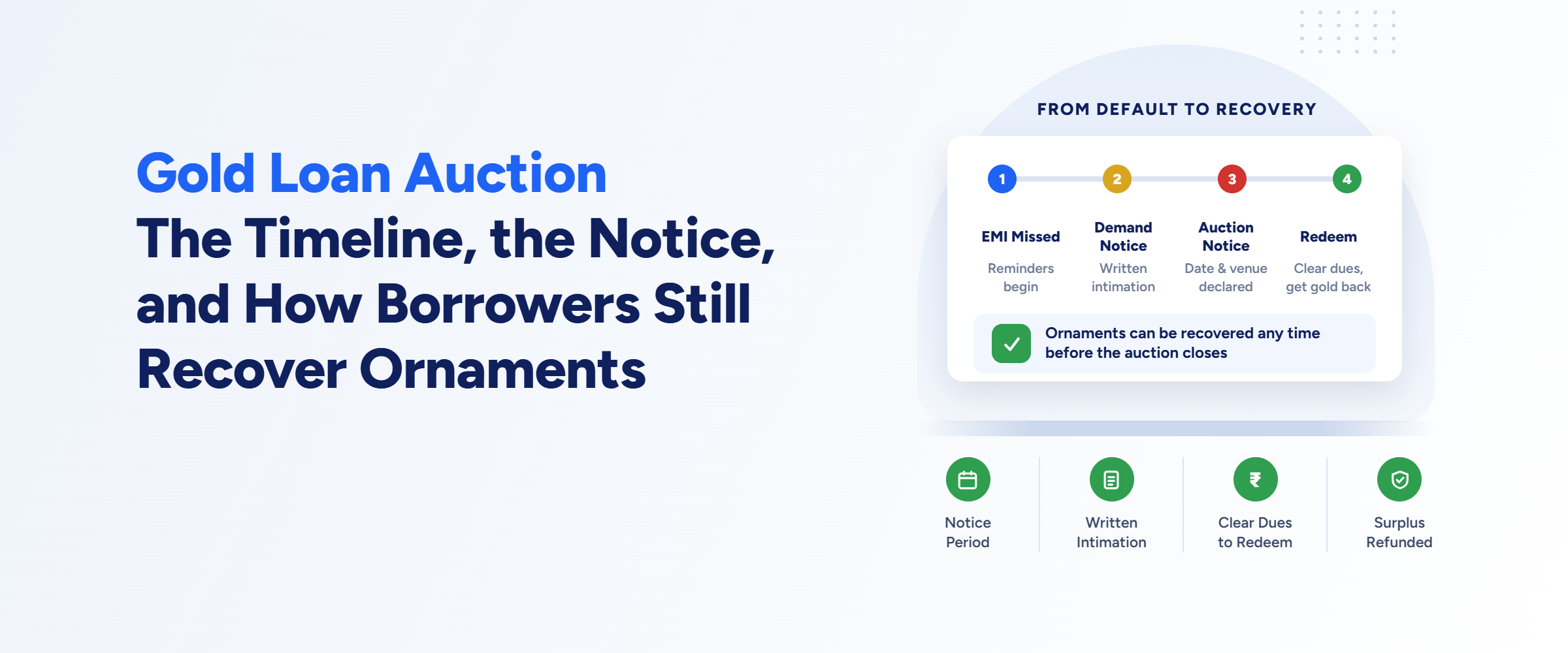
Here's the general sequence:
The gap between step 1 and step 5 is usually measured in weeks to months, not days, giving you real opportunities to intervene.
1. The Notice Period Before Auction
RBI mandates that borrowers receive advance written notice before any auction can take place, giving them a genuine window to repay dues or negotiate before losing their pledged jewellery.
Key points about the notice:
If you receive an auction notice, this is not the final stage of losing your jewellery, it's actually your last clear opportunity to act.
2. How the Reserve Price Is Set
Lenders can't auction your gold at any arbitrary low price to quickly recover dues. RBI's framework requires the reserve price to be based on a fair, market-linked gold valuation, commonly benchmarked at around 90% of recent average market value, which may be reduced somewhat (for instance, to around 85%) only if an initial auction attempt fails to attract adequate bids.
This protects borrowers from lenders undervaluing pledged gold just to recover the loan quickly and pocket a larger "loss" against the borrower's equity in the jewellery.
3. NBFC Gold Loan Seizure Rules Are the Same as Banks
A common misconception is that NBFCs operate under looser rules than banks when it comes to gold loan recovery. In reality, NBFC gold loan seizure rules follow the same RBI-mandated framework as banks:
The specific processing timelines or internal escalation steps may differ slightly by lender, but the core borrower protections apply uniformly across regulated banks and NBFCs.
Reclaim Jewellery Before Auction: What You Can Actually Do
Even after receiving a formal auction notice, you typically still have options:
| Option | What It Involves |
|---|---|
| Full repayment | Pay the entire outstanding amount (principal + interest + charges) to close the loan and reclaim jewellery |
| Partial repayment + renewal | Some lenders allow partial payment combined with renewing/restructuring the remaining loan, subject to their policy |
| Request extension | Contacting the lender directly to explain your situation, many lenders prefer recovery over auction, since auctions involve additional cost and effort for them too |
| Transfer/balance transfer | In some cases, transferring the outstanding gold loan to another lender at better terms, then repaying and reclaiming jewellery |
The single most important action: don't ignore communications from your lender. Lenders generally have no interest in going through the auction process if you're willing to engage and resolve the dues, auctions are administratively costly and time-consuming for them too.
4. Auction Surplus Refund
If your pledged jewellery sells at auction for more than your outstanding dues (principal, interest, and applicable charges), you are legally entitled to the surplus amount.
Under RBI's framework, lenders are required to refund this surplus to the borrower within a defined timeframe after the auction concludes, commonly within about 7 working days.
Example: Your outstanding dues at the time of auction are ₹1,80,000. The jewellery sells at auction for ₹2,10,000. You are entitled to receive the ₹30,000 surplus back, and the lender cannot simply retain it.
If a lender fails to refund a genuine surplus, this is a valid ground for a formal complaint through the lender's grievance redressal mechanism or the RBI Ombudsman scheme.
Example: A Borrower Who Reclaimed Jewellery After Default
Case: Vikram's gold loan
Vikram took a gold loan of ₹3,00,000 against jewellery valued at ₹4,00,000 (net value). Due to a temporary job loss, he missed three consecutive monthly payments. The lender sent SMS and call reminders, followed by a formal written demand notice after the second missed payment.
By the time Vikram received the advance auction notice, nearly two months after his first missed payment, he had found new employment. He contacted the lender, explained his situation, and arranged to clear the overdue interest and a portion of the principal, while requesting a short extension for the remaining balance. The lender agreed, the auction was called off, and Vikram fully repaid and reclaimed his jewellery within the extended period.
This is a common outcome, auction is rarely the lender's preferred first choice, and proactive communication often resolves the situation before it reaches that stage.
Gold Loan Auction Process India: Timeline Summary
| Stage | Typical Timing | Borrower Action Available |
|---|---|---|
| Missed payment | Day 1 of default | Pay overdue amount immediately to avoid escalation |
| Reminder communications | Days 1-30 | Respond and clear dues, or discuss options with lender |
| Formal demand notice | Typically after continued non-payment | Contact lender to negotiate repayment or extension |
| Advance auction notice | Weeks to a few months after default, per lender policy | Full repayment, partial repayment, or negotiated extension |
| Public auction | After notice period lapses without resolution | Can attend auction; surplus (if any) is refundable |
| Post-auction | Within a defined period after sale | Claim surplus refund if sale proceeds exceed dues |
(Exact timelines can vary by lender and loan type, always refer to your specific loan agreement, which is required to clearly state the applicable auction procedure and notice period.)
Common Mistakes Borrowers Make
Expert Tips If You're Facing a Potential Default
Need a Gold Loan You Can Manage Comfortably?
Check your gold loan eligibility on IndiaLends and compare offers from multiple lenders with transparent terms, so you can borrow confidently and repay on a schedule that actually works for you.
Check Your Gold Loan Eligibility Now
Conclusion
A missed gold loan payment is stressful, but it's far from an immediate loss of your jewellery. RBI's regulatory framework builds in reminders, formal notices, a fair reserve pricing mechanism, and a genuine window to repay or negotiate before any auction takes place, and even after an auction, you're entitled to any surplus proceeds. The best protection isn't just knowing these rules, it's acting early, communicating with your lender, and never letting a missed payment go unaddressed.
Related reading: Gold Loan LTV Explained: Why You Never Get 100% of the Jeweller's Quote, Gold Loan vs Selling Gold: What to Do When You Need Money in 48 Hours, and Why Making Charges, Stones, and Kundan Work Don't Count in a Gold Loan.

Scan this QR Code


Latest Articles
Can You Pledge Your Mother's or Wife's Gold for a Loan? Rules Explained
09 Sep 2026
Bullet Repayment vs EMI Gold Loan: Which Fits a 6-Month Cash Crunch?
09 Sep 2026
Why Making Charges, Stones & Kundan Work Don't Count in a Gold Loan
08 Sep 2026
Gold Loan vs Selling Gold: What to Do When You Need Money in 48 Hours
08 Sep 2026
Gold Loan LTV Explained: Why You Never Get 100% of the Jeweller's Quote
08 Sep 2026
Relevant Articles
Can You Pledge Your Mother's or Wife's Gold for a Loan? Rules Explained
09 Sep 2026
Bullet Repayment vs EMI Gold Loan: Which Fits a 6-Month Cash Crunch?
09 Sep 2026
Why Making Charges, Stones & Kundan Work Don't Count in a Gold Loan
08 Sep 2026
Gold Loan vs Selling Gold: What to Do When You Need Money in 48 Hours
08 Sep 2026
Gold Loan LTV Explained: Why You Never Get 100% of the Jeweller's Quote
08 Sep 2026
FAQ’s
There's no single fixed number across all lenders, but RBI requires a formal advance auction notice giving borrowers a meaningful window, commonly in the range of 15 to 30 days, in addition to the time already elapsed since the missed payment and earlier reminder communications.
Yes, in most cases. An auction notice is not the final step, you typically still have the opportunity to repay the outstanding dues in full or negotiate a partial payment and extension with the lender, before the auction actually takes place.
No. NBFCs are required to follow the same RBI-mandated framework as banks for gold loan recovery, including advance notice requirements, fair reserve pricing, and surplus refund obligations.
You are entitled to receive the surplus amount, the difference between the sale proceeds and your outstanding dues, refunded by the lender, typically within a defined period after the auction concludes.
Contact your lender proactively to explain your situation. Many lenders prefer to work out a partial payment or extension rather than proceed toward auction, which is a more time-consuming and costly process for them as well.
 URL copied to clipboard successfully !
Download the IndiaLends App Now
Scan this QR code to download the app