Loans 

Credit Card
IndiaLends App is available in


Bullet Repayment vs EMI Gold Loan: Which Fits a 6-Month Cash Crunch?
You need ₹3,00,000 urgently, and you've decided a gold loan is the right way to get it. But then the lender asks a question that catches many first-time borrowers off guard: "Would you like bullet repayment or EMI?"
If you've never taken a gold loan before, this choice might feel like a minor formality. It isn't. Choosing the wrong repayment structure for your specific situation can mean paying more interest than necessary, or worse, straining your monthly cash flow when you can least afford it.
Let's break down both options clearly, so you can pick the one that actually fits a short-term cash crunch, not just the one that sounds simpler.
What Bullet Repayment and EMI Actually Mean
Bullet Repayment
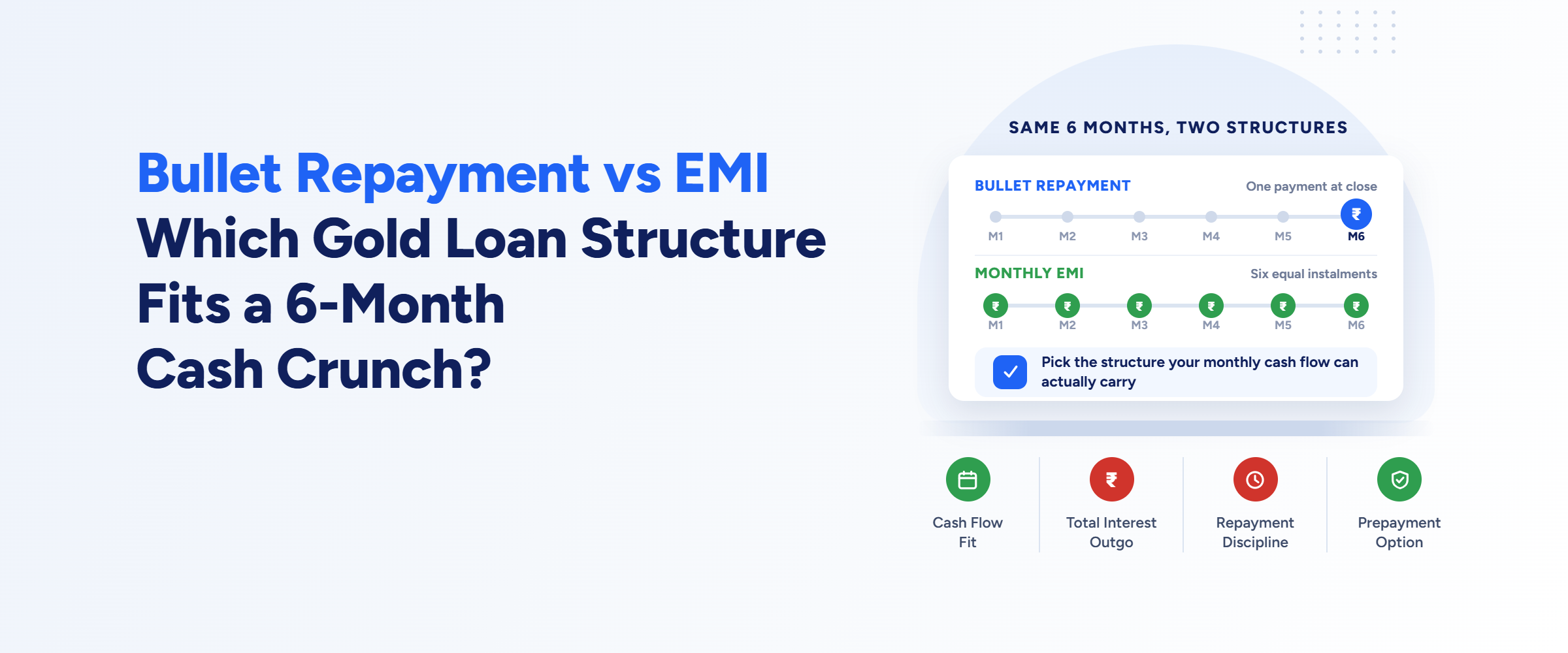
In a bullet repayment gold loan, you don't pay anything monthly. The entire principal and all accumulated interest are paid together in a single lump sum at the end of the loan tenure. This is sometimes called an interest-only gold loan in casual usage, though technically even the interest is deferred to maturity, not paid periodically.
EMI-Based Repayment
In a monthly EMI gold loan, you repay a fixed amount every month, a combination of principal and interest, spread evenly across the loan tenure, similar to how a personal loan or home loan EMI works.
| Feature | Bullet Repayment | EMI-Based Repayment |
|---|---|---|
| Monthly outgo | None during tenure | Fixed monthly payment |
| When principal is repaid | Fully at maturity | Gradually, spread across tenure |
| When interest is paid | Fully at maturity (accumulated) | Monthly, along with principal |
| Cash flow pressure | Concentrated at the end | Spread evenly throughout |
| Credit score impact | Limited, since there's no repayment history until closure | Builds regular repayment history if paid on time |
1. Why Bullet Repayment Feels Like "Pay Later"
Bullet repayment is often described as a pay later gold loan because you genuinely don't owe anything monthly, the entire burden sits at the far end of the tenure. This makes it attractive if:
However, "pay later" doesn't mean "pay less." Interest still accrues every single day of the tenure, you're simply not paying it as you go. By the time you reach maturity, the total amount due can feel like a bigger number than expected, purely because months of accumulated interest arrive all at once.
2. Important RBI Rule on Bullet Repayment Tenure
Under RBI's regulatory framework for gold loans, bullet repayment loans for consumption purposes are capped at a maximum tenure of 12 months. After this period, if you haven't repaid, you'd typically need to apply for a renewal, provided your account is in good standing and the loan-to-value (LTV) ratio remains within permitted limits at that point.
An important technical detail: for bullet repayment loans, lenders are required to calculate the LTV ratio based on the total repayment due at maturity (principal plus all accrued interest), not just the amount originally disbursed. This means the effective loan-to-value cushion narrows as interest accumulates over the tenure, which is worth keeping in mind if you're pledging gold close to the maximum eligible LTV.
3. How EMI Loans Support Cash Flow Discipline
An EMI-based gold loan works differently, every month, you chip away at both principal and interest, similar to structured loans you may already be familiar with. This has two practical advantages:
Total Interest: Bullet vs EMI – A Worked Example
Let's compare the actual numbers for a 6-month gold loan of ₹3,00,000 at an illustrative interest rate of 12% per annum.
Bullet Repayment (6 months)
| Component | Calculation | Amount |
|---|---|---|
| Principal | – | ₹3,00,000 |
| Interest (accrued over 6 months at 12% p.a.) | ₹3,00,000 × 12% × 6/12 | ₹18,000 |
| Total amount due at maturity | Principal + Interest | ₹3,18,000 |
EMI-Based Repayment (6 months)
| Component | Calculation | Approx. Amount |
|---|---|---|
| Approximate monthly EMI | Standard amortising formula | ~₹51,650/month |
| Total paid over 6 months | 6 × ₹51,650 | ~₹3,09,900 |
| Approximate total interest paid | Total paid − Principal | ~₹9,900 |
(Figures are illustrative and simplified for comparison; exact EMI and interest depend on the lender's calculation method and any processing charges. Always check the lender's amortisation schedule for precise numbers.)
Why EMI often costs less in total interest: Because you're paying down the principal every month, interest is calculated on a progressively smaller outstanding balance. In bullet repayment, the full principal continues to accrue interest for the entire tenure, since nothing is paid down until the end.
When Bullet Repayment Makes Sense for a 6-Month Crunch
When EMI Makes More Sense for a 6-Month Crunch
Farm Income Gold Loan Repayment: A Special Case
For agricultural borrowers, farm income gold loan repayment is often structured differently from typical consumption loans, since farm income is inherently seasonal, arriving in lump sums after harvest rather than as steady monthly income.
For this reason, bullet repayment (or repayment schedules aligned to harvest cycles) is a common and practical fit for farmers, since it matches the loan's due date to when cash actually becomes available. Note that loans against gold specifically for agricultural/crop purposes may be governed by separate norms distinct from standard consumption gold loans, always confirm with your lender which category your loan falls under, since terms can differ.
Example: Two Borrowers, Two Choices
Case 1: Rohit (Bullet Repayment) — Rohit needs ₹3,00,000 for 6 months to bridge a temporary cash gap before an annual bonus arrives. His monthly expenses already stretch his salary thin, so committing to an EMI isn't realistic. He opts for bullet repayment, knowing his bonus will comfortably cover the ₹3,18,000 due at maturity.
Case 2: Anjali (EMI) — Anjali needs the same ₹3,00,000 for 6 months but has no specific lump-sum inflow expected. She has steady monthly income and prefers predictable, smaller payments. She opts for EMI, paying roughly ₹51,650/month, and ends up paying meaningfully less total interest than the bullet option, while also building a clean repayment record.
Same loan amount, same tenure, same lender, but the right choice depended entirely on their individual cash flow pattern.
Common Mistakes Borrowers Make
Expert Tips for Choosing the Right Structure
Choose the Right Gold Loan Structure for Your Needs
Check your gold loan eligibility on IndiaLends and compare bullet repayment and EMI options across multiple lenders, with transparent total-cost calculations before you decide.
Check Your Gold Loan Eligibility Now
Conclusion
Neither bullet repayment nor EMI is universally "better", the right choice depends entirely on when your cash actually becomes available and how much total interest you're comfortable paying. Bullet repayment offers breathing room today at the cost of a larger lump sum tomorrow, while EMI spreads the burden evenly and typically costs less overall. Before choosing, calculate the real total amount due under each structure, not just the monthly outgo, so your gold loan actually fits your 6-month reality, not just your immediate convenience.
Related reading: Gold Loan LTV Explained: Why You Never Get 100% of the Jeweller's Quote and Gold Loan Auction Process in India: Timeline, Notice & Borrower Rights.

Scan this QR Code


Latest Articles
Pre-Approved Personal Loan Offers: How to Read the Real Rate
09 Oct 2026
Personal Loan After Credit Card Settlement: Is It Possible?
09 Oct 2026
Account Aggregator Personal Loans: What Lenders Read Beyond Your Salary Slip
08 Oct 2026
Salary Overdraft vs Personal Loan: Which One Should You Use?
08 Oct 2026
Loan Against Mutual Funds vs Personal Loan: Which Is Cheaper?
08 Oct 2026
Relevant Articles
Gold Loan for Business Working Capital: Cheaper Than a Business Loan?
11 Sep 2026
Gold Coin vs Jewellery Loan: What Lenders Will and Won't Accept
11 Sep 2026
Online Gold Loan vs NBFC Branch: Rate, Purity Test & Vault Safety
11 Sep 2026
Gold Loan When Gold Prices Fall: Margin Calls & Top-Up Rules Explained
11 Sep 2026
Can You Pledge Your Mother's or Wife's Gold for a Loan? Rules Explained
09 Sep 2026
FAQ’s
In bullet repayment, you pay the entire principal and accumulated interest in one lump sum at the end of the tenure. In an EMI-based gold loan, you repay a fixed monthly amount covering both principal and interest throughout the tenure.
EMI-based repayment generally results in lower total interest paid, since the outstanding principal reduces every month, whereas bullet repayment loans accrue interest on the full principal for the entire tenure.
Yes. Under current RBI rules, bullet repayment gold loans for consumption purposes are capped at a maximum tenure of 12 months, after which renewal (subject to account standing and LTV compliance) may be required.
Loans against gold for agricultural or crop-related purposes may follow separate repayment norms aligned to harvest cycles, distinct from standard consumption gold loans. It's best to confirm the applicable category and terms directly with your lender.
It depends on your cash flow. If you have a confirmed lump-sum inflow expected around 6 months, bullet repayment can work well. If your income is steady and monthly, EMI usually results in lower total interest and a more disciplined repayment path.
 URL copied to clipboard successfully !
Download the IndiaLends App Now
Scan this QR code to download the app