Loans 

Credit Card
IndiaLends App is available in


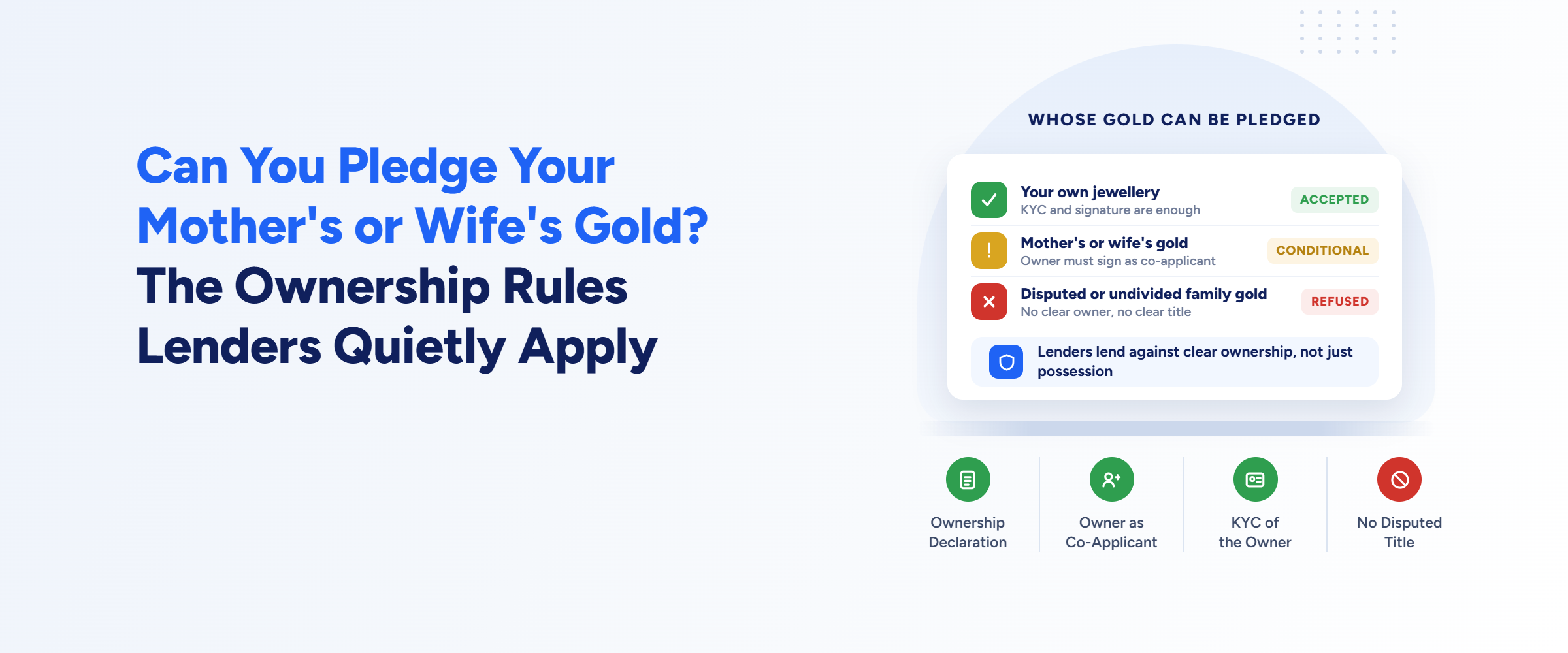
Can You Pledge Your Mother's or Wife's Gold for a Loan? Rules Explained
In most Indian households, gold isn't neatly divided by "who owns what." Your mother's wedding jewellery, your wife's gift sets, jewellery passed down from a grandmother, it often sits together, worn interchangeably, with no one thinking about legal ownership until a loan application forces the question.
That question comes up more often than you'd expect: can you actually pledge jewellery that technically belongs to your mother, wife, or another family member?
The short answer is yes, in most cases, but lenders apply specific ownership and documentation rules that many first-time borrowers aren't aware of until they're standing at the counter. Here's exactly how it works.
Why Ownership Matters for a Gold Loan
A gold loan is a secured loan, the lender holds your jewellery as collateral, with a legal obligation to return the exact same items once you repay. Because of this, lenders need reasonable assurance that:
This is why ownership isn't just a formality, it protects both the lender and the family from future disputes.
1. The Loan Applicant Must Generally Be Present and Identified
Regardless of whose jewellery is being pledged, the loan applicant, the person whose name the loan is sanctioned under, must provide their own KYC documents (ID and address proof) and must typically be physically present during the gold valuation process. This isn't optional; RBI's framework requires the borrower to be present when the gold is assessed and valued, precisely to prevent disputes later about what was actually pledged.
2. Most Lenders Don't Insist on Purchase Receipts
Here's something that surprises many borrowers: most lenders, especially NBFCs, don't require formal proof of purchase (like an original jewellery bill) to accept gold as collateral. This is precisely why pledging family jewellery, inherited pieces, wedding gifts, or gold bought years or decades ago without a preserved receipt, is generally accepted in practice.
Instead, lenders typically rely on:
Family jewellery gold loan applications are extremely common in India precisely because of this practical, declaration-based approach, very few families retain original purchase bills for jewellery bought decades ago or received as gifts.
3. Pledging Gold That Belongs to Someone Else: The Third-Party Route
If the gold genuinely belongs to your mother or wife, but you (not them) want to be the loan applicant, lenders typically require one of these approaches:
Option A: The Gold Owner Applies as the Borrower
The simplest route, if your mother or wife is willing and able to visit the branch, they apply as the primary borrower themselves, since they're both the owner and the applicant. This avoids any need for additional authorisation documentation.
Option B: Power of Attorney (PoA) Arrangement
If the actual owner cannot visit the branch (due to age, health, or being an NRI), a notarised Power of Attorney can authorise you to pledge the gold and sign the loan agreement on their behalf. In this arrangement, both the gold owner (principal) and the authorised representative typically need to submit their respective KYC documents. This route is commonly used for senior citizens, NRIs, or family members who are physically unable to visit.
Option C: Joint or Co-Applicant Structure
Some lenders allow the gold owner and the person seeking the loan to apply jointly, with both parties' documentation on record, this can simplify matters when both are available and willing to be part of the application.
| Scenario | Typical Requirement |
|---|---|
| Owner applies as sole borrower | Owner's own KYC documents; owner present for valuation |
| Someone else pledges on owner's behalf | Notarised Power of Attorney + KYC of both parties |
| Joint application | KYC of both applicant and co-applicant/owner |
Important: Exact requirements vary meaningfully by lender, always confirm the specific process with your chosen bank or NBFC before assuming any of the above routes will be accepted without question.
Inherited Gold Loan Documents: What You'll Typically Need
Inherited gold loan documents requirements are generally lighter than you might expect, precisely because most lenders don't demand formal ownership proof for gold jewellery:
| Situation | Typical Documentation |
|---|---|
| Inherited from a deceased parent/relative | Self-declaration of ownership; in some cases supporting documents like a will or legal heir certificate, if requested by the lender |
| Gifted at marriage or as a family tradition | Self-declaration; no formal gift deed usually required for jewellery specifically |
| No original purchase receipt available | Generally acceptable, lenders rely on physical valuation and borrower declaration, not historical proof of purchase |
If a family dispute exists over the jewellery's ownership (for instance, among siblings after a parent's passing), it's strongly advisable to resolve this before pledging, since the loan applicant is effectively representing sole or rightful custodial claim to the gold at the time of pledge.
Joint Family Gold Pledge: A Common Indian Scenario
In many Indian households, especially joint families, gold is collectively "family gold" rather than clearly assigned to one individual. When this jewellery needs to be pledged:
While lenders generally won't investigate family ownership disputes themselves, it's in the borrower's own interest to have internal family clarity before pledging jointly-considered assets.
ID Proof for the Gold Owner vs the Loan Applicant
It's worth clearly separating two things that often get confused:
If you're pledging your mother's jewellery and she's comfortable applying herself, this entire question becomes simple, she's both the owner and the applicant, and only her documents are needed.
Example: Three Common Family Scenarios
Scenario 1: Son pledges mother's jewellery, mother applies herself — Rajesh's mother has gold jewellery she's willing to pledge for his business need. She visits the branch herself, submits her own Aadhaar and PAN, and applies as the sole borrower. Rajesh isn't part of the loan application at all, his mother receives and is responsible for the loan.
Scenario 2: NRI mother, son pledges via Power of Attorney — Priya's mother lives abroad and cannot visit an Indian branch. Priya arranges a notarised Power of Attorney authorising her to pledge her mother's jewellery and sign the agreement. Both Priya's and her mother's KYC documents are submitted, and the lender processes the loan under this arrangement.
Scenario 3: Wife's jewellery, no receipts available — Arjun's wife has jewellery from their wedding, with no purchase receipts retained. She applies as the borrower herself, declares ownership as part of the standard pledge agreement, and the lender proceeds with valuation based on physical assessment of purity and weight, without asking for any historical proof of purchase.
Common Mistakes Families Make
Expert Tips for Pledging Family Jewellery
Ready to Pledge Family Jewellery for a Gold Loan?
Check your gold loan eligibility on IndiaLends and compare lenders with clear, transparent documentation requirements, so you know exactly what's needed before you visit a branch.
Check Your Gold Loan Eligibility Now
Conclusion
Pledging a mother's, wife's, or other family member's gold for a loan is common practice in India and generally straightforward, but it does come with specific ownership and documentation considerations that are easy to overlook until you're at the branch counter. The simplest path is always having the actual owner apply themselves; when that's not possible, a properly arranged Power of Attorney keeps the process smooth and compliant. A little planning and an honest family conversation where jewellery is jointly considered goes a long way in avoiding delays or disputes later.
Related reading: Gold Loan LTV Explained: Why You Never Get 100% of the Jeweller's Quote, Why Making Charges, Stones, and Kundan Work Don't Count in a Gold Loan, and Bullet Repayment vs EMI Gold Loan.

Scan this QR Code


Latest Articles
Pre-Approved Personal Loan Offers: How to Read the Real Rate
09 Oct 2026
Personal Loan After Credit Card Settlement: Is It Possible?
09 Oct 2026
Account Aggregator Personal Loans: What Lenders Read Beyond Your Salary Slip
08 Oct 2026
Salary Overdraft vs Personal Loan: Which One Should You Use?
08 Oct 2026
Loan Against Mutual Funds vs Personal Loan: Which Is Cheaper?
08 Oct 2026
Relevant Articles
Gold Loan for Business Working Capital: Cheaper Than a Business Loan?
11 Sep 2026
Gold Coin vs Jewellery Loan: What Lenders Will and Won't Accept
11 Sep 2026
Online Gold Loan vs NBFC Branch: Rate, Purity Test & Vault Safety
11 Sep 2026
Gold Loan When Gold Prices Fall: Margin Calls & Top-Up Rules Explained
11 Sep 2026
Bullet Repayment vs EMI Gold Loan: Which Fits a 6-Month Cash Crunch?
09 Sep 2026
FAQ’s
Yes, generally. The simplest way is for the actual owner to apply as the borrower themselves. If they can't visit the branch, a notarised Power of Attorney can authorise you to pledge the gold and sign the agreement on their behalf.
Usually not. Most lenders, particularly NBFCs, rely on the borrower's declaration of ownership and their own physical valuation of the gold, rather than requiring historical purchase receipts.
Typically, a notarised Power of Attorney authorising you to pledge on their behalf, along with KYC documents (ID and address proof) of both the gold owner and the authorised representative.
In practice, one family member can pledge jewellery considered joint family property, but it's advisable to have internal family agreement first to avoid disputes, since the lender typically doesn't investigate ownership disputes independently.
Yes. Under current RBI guidelines, the borrower is required to be physically present during the gold valuation process, regardless of whose jewellery is being pledged.
 URL copied to clipboard successfully !
Download the IndiaLends App Now
Scan this QR code to download the app