Loans 

Credit Card
IndiaLends App is available in


Why Making Charges, Stones & Kundan Work Don't Count in a Gold Loan
If you've ever pledged an intricately designed piece of jewellery, say, a Kundan necklace or a diamond-studded gold set, you may have been surprised at how modest the loan amount turned out to be, especially compared to what you originally paid for it.
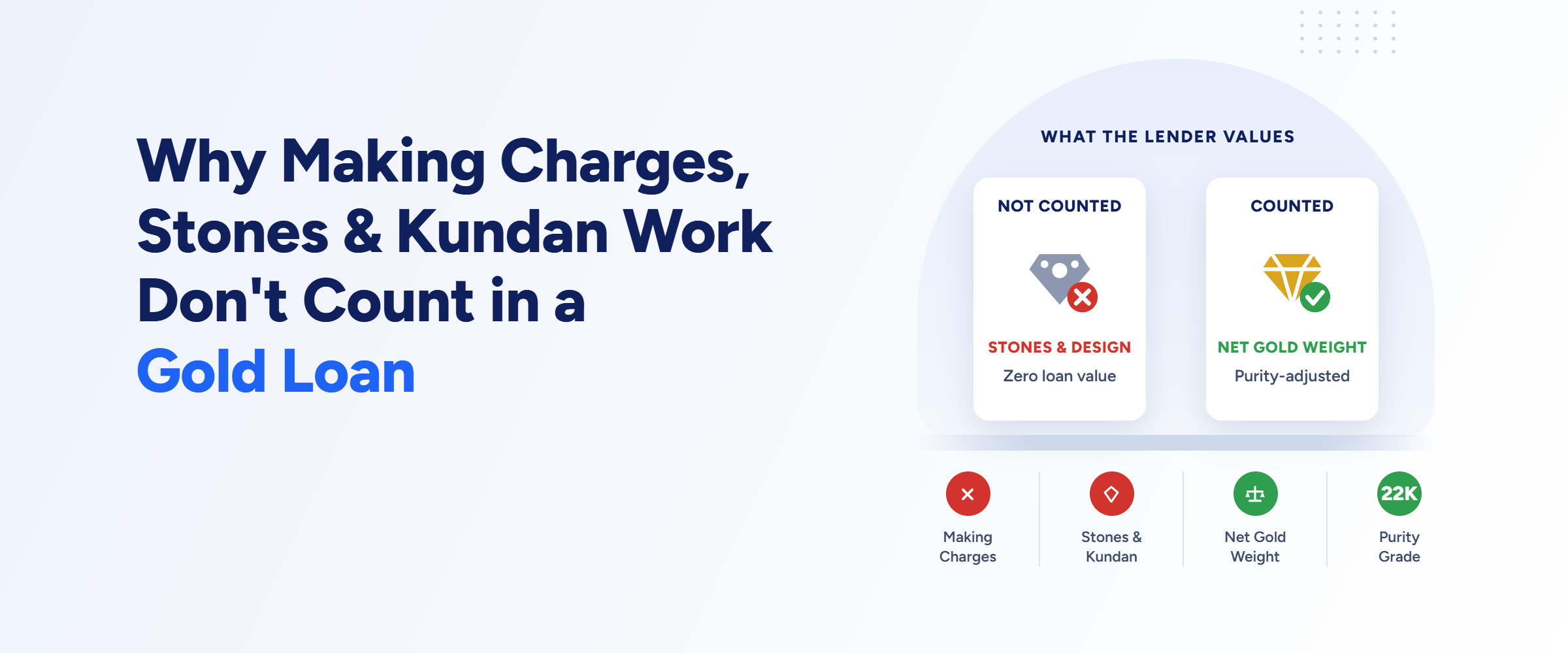
The reason is simple, even if it feels unfair at first: a gold loan values gold, not craftsmanship. The stones, the Kundan work, the intricate design, the GST you paid at purchase, none of that factors into your loan valuation. Only the actual gold content does.
Let's break down exactly how this works, so you know what to expect before you pledge.
The Core Principle: You're Borrowing Against Gold, Not Art
When you buy jewellery, you're paying for gold plus craftsmanship, the artistry, the design complexity, the setting of stones, and the brand or jeweller's premium. A gold loan strips all of that away and looks only at one thing: the actual weight and purity of gold content in the piece.
This is why two jewellery items of the same overall price, one plain, one heavily designed, can fetch very different loan amounts if the plain piece happens to have more actual gold weight.
1. Net Gold Weight Loan Calculation
Every gold loan valuation starts with separating the net gold weight from the ornament's total weight.
How banks weigh gold ornaments:
| Weight Type | What It Includes | Used for Loan Calculation? |
|---|---|---|
| Gross weight | Total weight of the ornament including everything | No |
| Non-gold weight | Stones, enamel, thread, Kundan setting material | No |
| Net gold weight | Pure gold content only | Yes, this is what determines your loan |
2. Diamond Jewellery and Gold Loans
Diamond jewellery gold loan valuation follows the same core principle, but diamonds add an extra layer of complexity:
Practical tip: If you're planning to pledge jewellery specifically for a loan, plain or lightly-worked gold pieces almost always give you a better loan-to-effort ratio than diamond or heavily stone-studded jewellery of similar market price.
3. Kundan, Meenakari, and Wastage/Making Charges Valuation
Kundan work, meenakari (enamel work), and similar traditional techniques often involve setting stones or glass into gold frames, or adding coloured enamel, both of which reduce the effective gold percentage of the total piece weight, even though the piece may look elaborate and "heavy."
Wastage and making charges valuation refers to the cost you originally paid the jeweller for: skilled labour to create the design, wastage of gold during the crafting process (a jeweller's standard practice, usually billed as a percentage), and design complexity premiums for intricate work like Kundan or filigree.
None of this cost is recovered in a gold loan valuation. The lender doesn't care how many hours of skilled craftsmanship went into your necklace, only how many grams of gold, at what purity, are actually present.
4. Hallmark 916 Gold Loans
Hallmark 916 refers to 22-karat gold that's been certified by the Bureau of Indian Standards (BIS) as containing 91.6% pure gold, the "916" denotes this purity level per 1,000 parts.
Hallmarked jewellery generally has a smoother valuation process because:
If your jewellery isn't hallmarked, most lenders will still accept it, but will conduct their own purity testing (often using methods like acid testing or XRF/karat meter testing) before finalising valuation, which can add some processing time.
Example: Two Jewellery Pieces, Same Price, Different Loan Value
Piece A – Plain Gold Bangles: Gross weight 50 grams, plain minimal design, net gold weight ~49 grams (negligible deduction), purity 22K, hallmarked. Original purchase price ₹3,40,000 (including ~5% making charges).
Piece B – Kundan Necklace Set: Gross weight 50 grams, heavy Kundan and stone work, net gold weight ~34 grams (significant deduction for stones/setting material), purity 22K. Original purchase price ₹3,40,000 (including ~22% making charges for intricate work).
| Piece A (Plain Bangles) | Piece B (Kundan Set) | |
|---|---|---|
| Net gold weight | 49 grams | 34 grams |
| Approx. loan-eligible value (at ₹6,800/gram) | ₹3,33,200 | ₹2,31,200 |
| Loan at 75% LTV | ₹2,49,900 | ₹1,73,400 |
Even though both pieces cost the same to buy, Piece A fetches a meaningfully higher gold loan amount, purely because more of its weight is actual gold, not craftsmanship or stone-setting material.
Common Mistakes Borrowers Make
Expert Tips for Better Gold Loan Valuation
Get a Transparent Gold Loan Valuation
Check your gold loan eligibility on IndiaLends and compare offers from multiple lenders with clear, upfront net weight and purity-based valuation, no surprises at the counter.
Check Your Gold Loan Eligibility Now
Conclusion
A gold loan values exactly what its name suggests, gold, and nothing else. Making charges, stone work, Kundan craftsmanship, and design complexity, however valuable they were at the time of purchase, don't factor into your loan amount. Understanding this before you pledge helps set the right expectations, and choosing simpler, higher-purity pieces (where you have the option) can genuinely get you a better loan amount for the same overall jewellery value.
Related reading: Gold Loan LTV Explained: Why You Never Get 100% of the Jeweller's Quote and Gold Loan vs Selling Gold: What to Do When You Need Money in 48 Hours.

Scan this QR Code


Latest Articles
Can You Pledge Your Mother's or Wife's Gold for a Loan? Rules Explained
09 Sep 2026
Bullet Repayment vs EMI Gold Loan: Which Fits a 6-Month Cash Crunch?
09 Sep 2026
Gold Loan Auction Process in India: Timeline, Notice & Borrower Rights
08 Sep 2026
Gold Loan vs Selling Gold: What to Do When You Need Money in 48 Hours
08 Sep 2026
Gold Loan LTV Explained: Why You Never Get 100% of the Jeweller's Quote
08 Sep 2026
Relevant Articles
Can You Pledge Your Mother's or Wife's Gold for a Loan? Rules Explained
09 Sep 2026
Bullet Repayment vs EMI Gold Loan: Which Fits a 6-Month Cash Crunch?
09 Sep 2026
Gold Loan Auction Process in India: Timeline, Notice & Borrower Rights
08 Sep 2026
Gold Loan vs Selling Gold: What to Do When You Need Money in 48 Hours
08 Sep 2026
Gold Loan LTV Explained: Why You Never Get 100% of the Jeweller's Quote
08 Sep 2026
FAQ’s
No. Stones, diamonds, and other non-gold materials are excluded from gold loan valuation. Only the net gold weight and purity of the actual gold content determine your loan amount.
Kundan and similar intricate designs often use less actual gold relative to the piece's total weight, since stones, setting material, and enamel work take up a significant portion of the weight without contributing to gold content.
No. Making charges are a craftsmanship cost paid at the time of purchase and are not factored into gold loan valuation, which is based solely on net gold weight and purity.
Hallmarked gold doesn't necessarily get a higher per-gram rate, but it typically results in faster processing and fewer valuation disputes, since the purity is already certified by BIS.
It's usually not the most efficient choice, since diamonds add little to no value in gold loan valuation. Plain or lightly-worked gold jewellery generally offers a better loan amount relative to its overall weight and value.
 URL copied to clipboard successfully !
Download the IndiaLends App Now
Scan this QR code to download the app