Loans 

Credit Card
IndiaLends App is available in


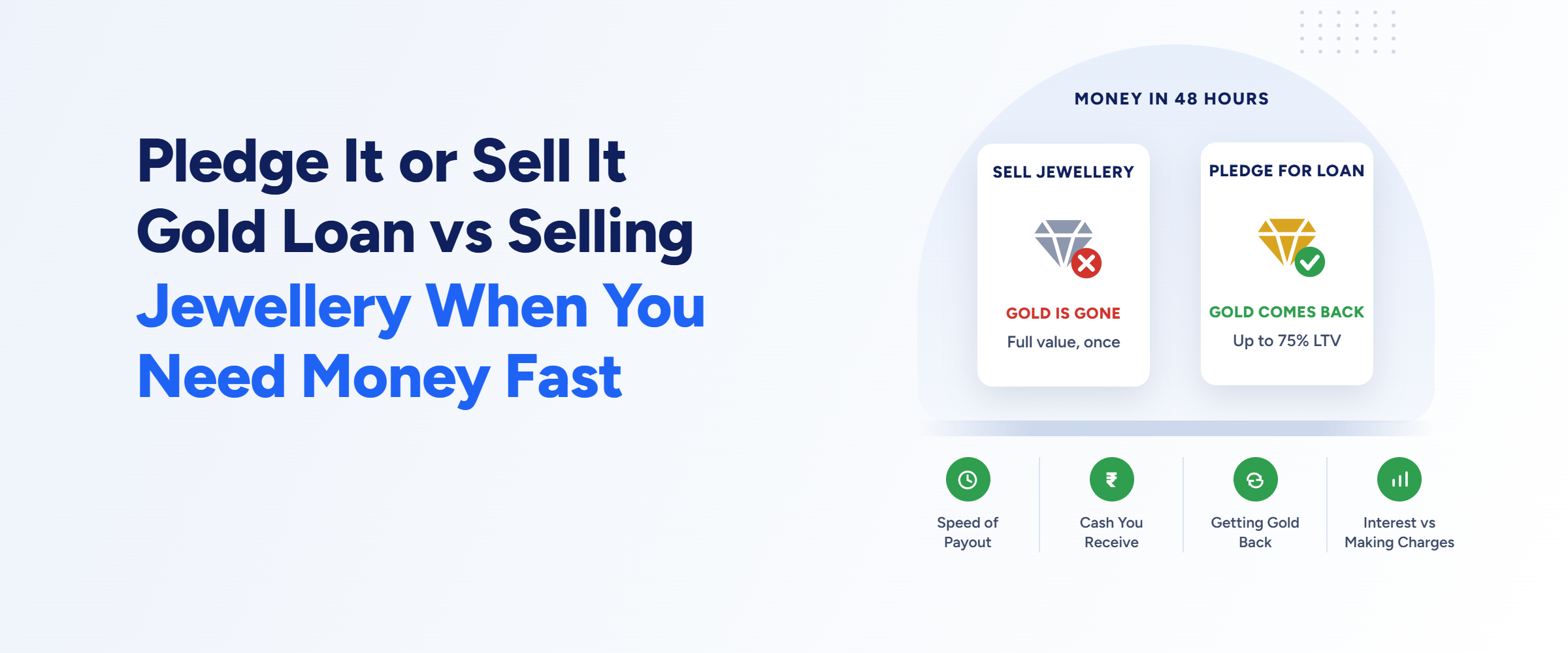
Gold Loan vs Selling Gold: What to Do When You Need Money in 48 Hours
A medical bill, a sudden business shortfall, a deposit that can't wait, when you need money urgently, gold is often the fastest asset you can convert to cash in India. But the moment you open that jewellery box, a real question comes up: should you pledge it for a gold loan, or just sell it outright?
Both get you money fast. But they lead to very different financial outcomes, one you keep your gold and repay over time, the other you lose it permanently, often at a real cost you don't immediately notice.
This guide breaks down exactly how to decide, based on your situation, not just gut instinct.
The Core Difference: Temporary vs Permanent
A gold loan is a secured loan where you pledge your jewellery as collateral and get it back once you repay the loan with interest. Ownership never transfers; the lender simply holds your gold as security during the loan tenure.
Selling jewellery means the gold is gone permanently, in exchange for a one-time cash payment based on its current market value (minus deductions the jeweller applies).
This single distinction, temporary access to cash vs permanent loss of the asset, should be the starting point of your decision, before you even look at numbers.
1. Making Charges Lost on Sale
This is the part most people underestimate.
When you originally bought your gold jewellery, you paid for the gold itself (by weight and purity), making charges (craftsmanship cost, often 8-25% of gold value depending on design complexity), and GST on the total amount.
When you sell that jewellery back, jewellers typically pay you only for the gold content, rarely for the making charges you originally paid. That craftsmanship cost is essentially lost the moment you sell.
When you take a gold loan, you don't lose this at all, since you get the jewellery back after repayment, the making charges you invested remain intact as part of an asset you still own.
Example: You bought a gold necklace for ₹1,20,000, of which ₹18,000 was making charges and GST. If you sell it back later, the jeweller pays based on current gold value of the net weight, the ₹18,000 you spent on craftsmanship is simply gone. A gold loan avoids this loss entirely, since you keep the piece.
2. Gold Loan Interest vs Gold Price Rise
Here's a nuance that can actually work in your favour with a gold loan.
Gold prices in India have historically trended upward over long periods, though with short-term volatility. If you take a gold loan instead of selling, and gold prices rise during your loan tenure, the jewellery you eventually reclaim is now worth more than when you pledged it, a benefit you'd have missed entirely had you sold it outright.
Of course, this cuts both ways, if gold prices fall, you don't lose anything extra by having taken a loan (your repayment amount is fixed, unrelated to gold price movement), but you also don't benefit from any appreciation on jewellery you no longer own if you'd sold it.
| Scenario | If You Took a Gold Loan | If You Sold the Gold |
|---|---|---|
| Gold price rises during the period | You benefit; you reclaim appreciated jewellery after repaying a fixed loan amount | You miss out; you already sold at the lower price |
| Gold price falls during the period | No extra loss, your repayment is fixed regardless of price | No extra loss, you already have your cash in hand |
3. Emotional Value vs Liquidity
Not every financial decision is purely mathematical and gold jewellery in Indian households often carries emotional weight that doesn't show up on a balance sheet. Heirloom pieces, wedding jewellery, or gifts from parents often can't simply be replaced with a fresh purchase, even if you could technically afford to buy similar gold later.
If the piece has strong sentimental value, a gold loan almost always makes more sense than selling, you get the liquidity you need today, while preserving the option to reclaim the exact piece once your financial situation stabilises.
Buyback After Gold Loan: Understanding Redemption
If you choose the gold loan route, "buyback" isn't really the right term, it's redemption. Once you repay the principal and interest in full, the lender is required to return your exact pledged jewellery, in the same condition it was received, within a defined timeframe (typically within 7 working days of full repayment under current RBI norms).
This is a meaningful advantage over selling: you're not buying back "equivalent" gold at a later market price, you get back the identical piece you pledged, regardless of how gold prices moved during the tenure.
Should I Sell Jewellery or Take a Gold Loan? A Decision Framework
| Your Situation | Better Option |
|---|---|
| You need cash for a short-term need and expect to repay within months | Gold loan |
| The jewellery has strong sentimental/heirloom value | Gold loan |
| You don't intend to ever wear or use the jewellery again | Selling may make sense |
| You have stable income to service EMI or bullet repayment | Gold loan |
| You genuinely have no repayment capacity in the foreseeable future | Selling may be more realistic than risking auction |
| You want to benefit from potential future gold price appreciation | Gold loan |
| You need the absolute maximum cash today with no repayment obligation | Selling |
Example: Two Borrowers, Two Choices
Case 1 – Gold Loan: Meera needs ₹2,00,000 for her daughter's school admission fees. She pledges gold worth ₹2,80,000 (net value) and gets a loan at 75-85% LTV depending on the tier, repayable over 12 months. She continues paying EMIs from her salary and reclaims her jewellery in full once the loan closes, while also retaining the making charges she'd originally paid.
Case 2 – Selling: Suresh needs ₹2,00,000 urgently but has no stable income to commit to a repayment plan. He sells jewellery worth ₹2,80,000 in market value, receiving roughly ₹2,45,000 after the jeweller deducts making charges and applies their own margin. He has the cash immediately, with no repayment obligation but the jewellery, and any future gold price appreciation on it, is gone for good.
Both made the right choice for their specific situation, the deciding factor wasn't the amount needed, but repayment capacity and intent.
Common Mistakes People Make
Expert Tips for Making the Right Call
Compare Gold Loan Offers Before You Decide
Check your gold loan eligibility on IndiaLends and compare transparent offers from multiple lenders, so you can make an informed choice between pledging and selling, based on real numbers.
Check Your Gold Loan Eligibility Now
Conclusion
There's no universally "better" option between a gold loan and selling jewellery, it genuinely depends on your repayment capacity, the sentimental value of the piece, and how urgently and permanently you need the cash. If you can realistically repay within a reasonable timeframe, a gold loan almost always preserves more value, both financial (making charges, potential price appreciation) and emotional. If repayment isn't realistic, selling honestly may be the more responsible choice than risking default and auction.
Related reading: Gold Loan LTV Explained: Why You Never Get 100% of the Jeweller's Quote.

Scan this QR Code


Latest Articles
Can You Pledge Your Mother's or Wife's Gold for a Loan? Rules Explained
09 Sep 2026
Bullet Repayment vs EMI Gold Loan: Which Fits a 6-Month Cash Crunch?
09 Sep 2026
Gold Loan Auction Process in India: Timeline, Notice & Borrower Rights
08 Sep 2026
Why Making Charges, Stones & Kundan Work Don't Count in a Gold Loan
08 Sep 2026
Gold Loan LTV Explained: Why You Never Get 100% of the Jeweller's Quote
08 Sep 2026
Relevant Articles
Can You Pledge Your Mother's or Wife's Gold for a Loan? Rules Explained
09 Sep 2026
Bullet Repayment vs EMI Gold Loan: Which Fits a 6-Month Cash Crunch?
09 Sep 2026
Gold Loan Auction Process in India: Timeline, Notice & Borrower Rights
08 Sep 2026
Why Making Charges, Stones & Kundan Work Don't Count in a Gold Loan
08 Sep 2026
Gold Loan LTV Explained: Why You Never Get 100% of the Jeweller's Quote
08 Sep 2026
FAQ’s
It depends on your repayment timeline. For short-to-medium term needs, a gold loan is often more cost-effective since you avoid permanently losing the making charges you originally paid, a cost that selling always includes.
Yes, typically. Jewellers generally pay based on the gold content and current market rate, not the craftsmanship or making charges you originally paid, that cost is usually not recovered when selling.
Nothing changes for your repayment amount, which is fixed at the time of borrowing. However, once you repay and reclaim your jewellery, it's now worth more at current market prices, a benefit you wouldn't get if you'd already sold it.
Yes. Lenders are required to return the exact pledged item, not an equivalent value in gold, once the loan is fully repaid, typically within a defined timeframe after closure.
If the piece is an heirloom or has emotional significance, a gold loan is generally the better choice, since it lets you access funds while preserving your ability to reclaim the exact item later.
 URL copied to clipboard successfully !
Download the IndiaLends App Now
Scan this QR code to download the app