Loans 

Credit Card
IndiaLends App is available in


Personal Loan Co-Applicant: Benefits, Risks & Impact on Approval
You've applied for a personal loan, and the lender says your loan amount is lower than you hoped, or worse, your application gets rejected. Before you give up, there's an option many first-time borrowers overlook: adding a co-applicant.
A personal loan co-applicant can be the difference between a "sorry, not eligible" and a smooth approval at a better interest rate. But it also comes with shared responsibility that both parties need to fully understand before signing up.
This guide breaks down exactly how a co-applicant affects your personal loan, the benefits, the real risks, and when it actually makes sense.
What Is a Personal Loan Co-Applicant?
A co-applicant is a second person who applies for the loan alongside the primary borrower. Both individuals are equally responsible for repaying the loan, and both are assessed by the lender during underwriting.
This is different from a guarantor, who only becomes liable if the primary borrower defaults. A co-borrower personal loan means both people are on the hook from day one, not just as backup.
Common co-applicant combinations in India include:
1. Combined Income Assessment
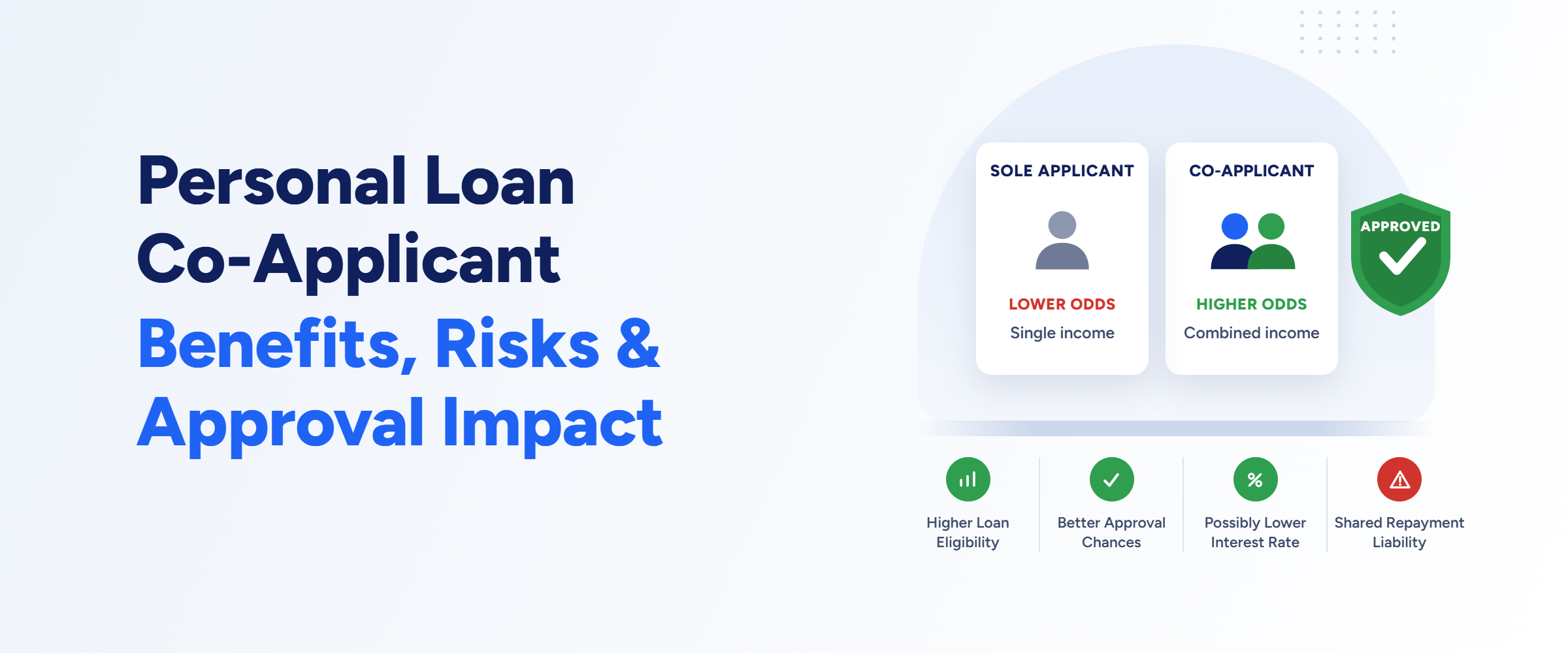
When you apply solo, the lender looks only at your income to decide your loan eligibility. With a co-applicant, many lenders consider combined household income, which can significantly increase the loan amount you qualify for.
2. Combined CIBIL Score Impact
Both applicants' CIBIL scores are usually checked. A strong co-applicant score can help offset a weaker primary applicant score, but a poor co-applicant score can also drag down an otherwise strong application.
3. Shared Legal Liability
This is the part people underestimate. In a joint personal loan, both applicants are 100% liable for the full loan amount, not 50% each. If one person stops paying, the lender can pursue the other for the entire outstanding balance.
4. Impact on Both Credit Reports
EMI payments (and any missed payments) reflect on both applicants' credit reports, not just the primary borrower's. A joint loan managed well can help both build credit history. Managed poorly, it damages both scores simultaneously.
Benefits of Adding a Co-Applicant
Risks of Adding a Co-Applicant
Personal Loan With Spouse: A Common Example
Example: Ankit and Divya
Ankit earns ₹45,000/month and wanted a personal loan of ₹6,00,000 for home renovation. On his individual income, the bank offered only ₹3,50,000 based on his debt-to-income ratio.
His wife Divya earns ₹38,000/month with a clean credit history. Applying as co-applicants, their combined income supported a loan eligibility of ₹6,50,000, comfortably covering the renovation cost, at a slightly better interest rate because Divya's CIBIL score was 790.
This is a textbook case of how a personal loan with spouse can unlock both higher eligibility and better pricing.
Co-Applicant Eligibility: What Lenders Typically Check
| Criteria | Primary Applicant | Co-Applicant |
|---|---|---|
| Minimum age | 21–60 years (varies by lender) | 21–60 years |
| Income proof | Salary slips / ITR | Salary slips / ITR (usually required) |
| CIBIL score | Ideally 700+ | Ideally 700+ |
| Relationship proof | Not applicable | Required (marriage certificate, ID proof linking relationship) |
| Employment status | Salaried/self-employed | Salaried/self-employed (some lenders allow homemakers with limited criteria) |
Note: exact eligibility criteria and accepted co-applicant relationships vary by bank and NBFC, always confirm specifics with the lender before applying.
When Does Adding a Co-Applicant Actually Make Sense?
| Situation | Should You Add a Co-Applicant? |
|---|---|
| Your income alone doesn't meet the loan amount needed | Yes, if the co-applicant has stable income |
| Your CIBIL score is low or you have no credit history | Yes, if co-applicant has a strong score |
| You want a lower interest rate | Yes, if co-applicant's profile is stronger than yours |
| You're unsure about repayment discipline together | No, resolve this first, liability is shared fully |
| You just want a "backup" without shared responsibility | No, consider a guarantor structure instead, if offered |
Common Mistakes Borrowers Make
Expert Tips Before You Add a Co-Applicant
Apply for Your Personal Loan
Whether you're applying solo or with a co-applicant, comparing your eligibility across lenders helps you find the best loan amount and interest rate for your situation.
Check Your Personal Loan Eligibility Now
Conclusion
A personal loan co-applicant can genuinely improve your approval chances, increase your eligible loan amount, and even help you land a better interest rate, but only when both parties clearly understand that liability is shared in full, not split. Before adding anyone to your loan application, have an honest conversation about repayment responsibility, check both credit profiles, and compare offers across lenders to find the structure that works best for your situation.

Scan this QR Code


Latest Articles
Udyam Registration and Business Loans: Does MSME Registration Help?
03 Sep 2026
Seasonal Business Loan: Planning Funds Around Inventory & Revenue Cycles
03 Sep 2026
Why Do Two Lenders Offer Different Interest Rates to the Same Borrower?
03 Sep 2026
How to Compare Loan Offers Beyond the Interest Rate
03 Sep 2026
Bank vs NBFC Loan: How to Choose the Right Offer in 2026
03 Sep 2026
Relevant Articles
Why Do Two Lenders Offer Different Interest Rates to the Same Borrower?
03 Sep 2026
How to Compare Loan Offers Beyond the Interest Rate
03 Sep 2026
Bank vs NBFC Loan: How to Choose the Right Offer in 2026
03 Sep 2026
Personal Loan Top-Up vs Fresh Loan: Which Option Is Cheaper for Existing Borrowers?
26 Aug 2026
Personal Loan for Medical Emergencies: How to Compare Speed, Cost, and Repayment Risk
26 Aug 2026
FAQ’s
Yes, in most cases. Lenders often consider combined income of the applicant and co-applicant, which can increase the loan amount you qualify for compared to applying individually.
Yes. In a joint personal loan, both applicants are fully liable for the total outstanding amount, not a proportional share. If one stops paying, the lender can recover the full amount from the other.
Most lenders accept spouses, parents, adult children, or siblings as co-applicants, provided they meet the lender's income and credit criteria. Acceptable relationships vary by bank and NBFC.
Yes. EMI payments and any missed payments are reported on both applicants' credit reports, affecting both scores equally.
Generally, no, not without closing or refinancing the loan. Most lenders require the loan to be settled or restructured solely under one applicant's name to remove the other.
 URL copied to clipboard successfully !
Download the IndiaLends App Now
Scan this QR code to download the app