Loans 

Credit Card
IndiaLends App is available in


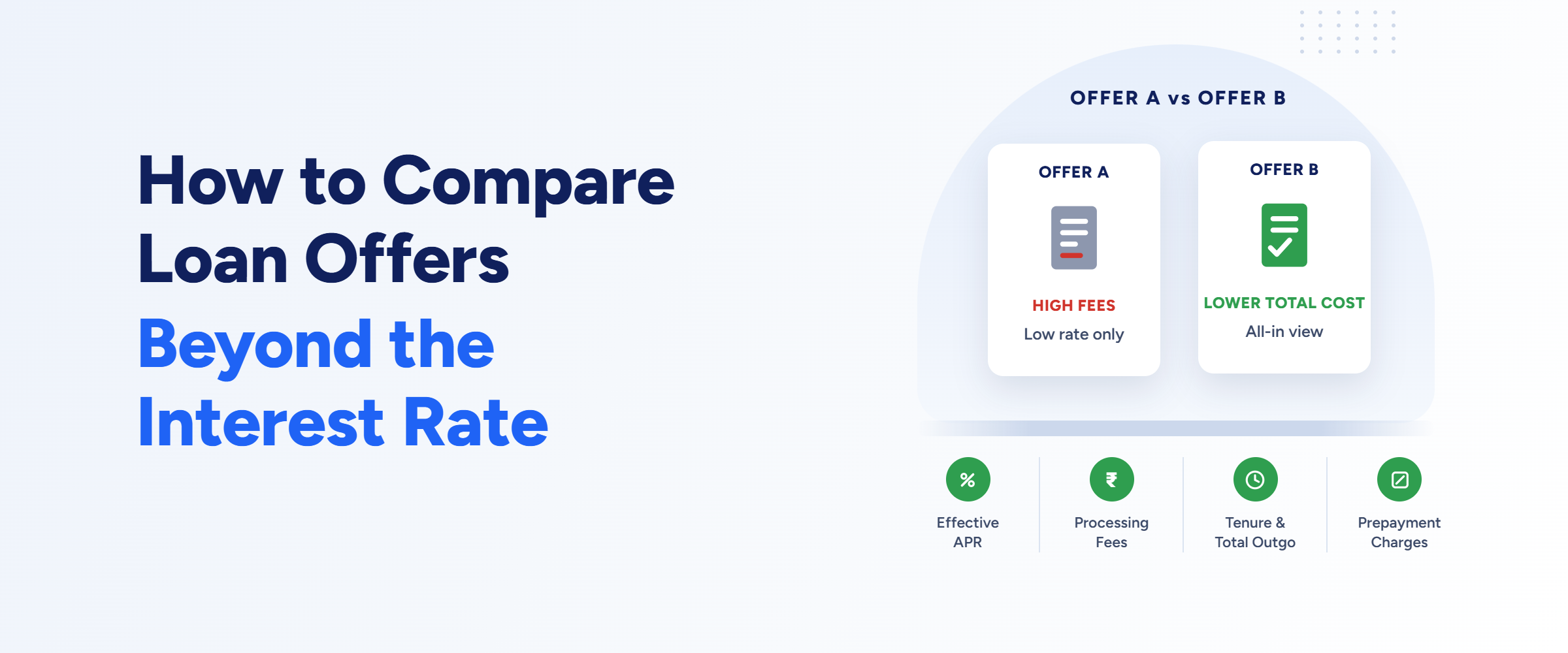
How to Compare Loan Offers Beyond the Interest Rate
"12% interest" sounds cheaper than "13.5% interest," right? Not always.
One of the most common mistakes Indian borrowers make is picking a loan purely based on the advertised interest rate, only to discover later that processing fees, foreclosure charges, or other costs made the "cheaper" loan more expensive overall.
If you want to truly compare loan offers, you need to look at the full picture, not just the headline number. Here's how to do it properly.
Why Interest Rate Alone Doesn't Tell the Whole Story
Lenders advertise interest rates because it's the number that catches attention. But your actual repayment cost depends on several other factors working together:
Two loans with different interest rates can end up costing you almost the same, or one can turn out significantly more expensive, once all these factors are added up.
1. APR vs Interest Rate
This is where most confusion happens.
Interest rate is simply the cost of borrowing the principal amount, expressed as a percentage.
APR (Annual Percentage Rate) includes the interest rate plus other charges like processing fees, spread over the loan tenure, giving you a more accurate picture of the true annual cost of the loan.
| Term | What It Includes | What It Tells You |
|---|---|---|
| Interest Rate | Cost of borrowing principal only | Base cost, not the full picture |
| APR | Interest rate + processing fee + other charges | Real annual cost of the loan |
Why this matters: A loan advertised at 12% interest but with a 3% processing fee could have a higher effective APR than a loan advertised at 13% interest with a 1% processing fee, especially on shorter tenures.
2. Processing Fee Comparison
Processing fees are usually charged as a percentage of the loan amount, deducted upfront from your disbursed amount.
Example: You're approved for a ₹5,00,000 personal loan with a 2% processing fee. You don't actually receive ₹5,00,000, you receive ₹4,90,000, but you still repay EMIs calculated on the full ₹5,00,000.
| Loan Amount | Processing Fee % | Fee Amount | Amount Actually Disbursed |
|---|---|---|---|
| ₹5,00,000 | 1% | ₹5,000 | ₹4,95,000 |
| ₹5,00,000 | 2% | ₹10,000 | ₹4,90,000 |
| ₹5,00,000 | 3% | ₹15,000 | ₹4,85,000 |
On shorter-tenure loans, this fee has a bigger proportional impact on your effective cost than on longer-tenure loans.
3. Foreclosure and Prepayment Charges
If you plan to close your loan early, say, after receiving a bonus or increment, foreclosure charges matter a lot.
Some lenders charge 2-5% of the outstanding principal as a foreclosure fee, while others (especially on floating-rate loans, per RBI guidelines for individual borrowers) may charge nil foreclosure fees after a lock-in period.
If you're someone who typically prepays loans early, prioritise lenders with low or zero foreclosure charges, even if their interest rate is marginally higher.
4. Total Loan Cost
The only reliable way to compare loan offers is to calculate the total loan cost: total interest paid + processing fee + any other charges, over the full tenure.
Total Loan Cost Formula (Simplified)
Total Cost = Total EMIs Paid Over Tenure + Processing Fee + Other Charges
This single number cuts through marketing and shows you the real cost difference between offers.
Example: Comparing Two Loan Offers Side by Side
Loan requirement: ₹6,00,000, tenure 3 years (36 months)
| Factor | Offer A (Bank) | Offer B (NBFC) |
|---|---|---|
| Interest rate | 12.5% p.a. | 14% p.a. |
| Processing fee | 2% (₹12,000) | 0.5% (₹3,000) |
| Approx. monthly EMI | ₹20,075 | ₹20,505 |
| Total interest paid (approx.) | ₹1,22,700 | ₹1,38,180 |
| Processing fee | ₹12,000 | ₹3,000 |
| Approximate total cost | ₹1,34,700 | ₹1,41,180 |
Even though Offer A has a lower interest rate, once you factor in tenure and fees, the actual cost gap (~₹6,480) is smaller than the interest rate difference alone would suggest. In some cases, a higher-rate, lower-fee offer can even come out cheaper on shorter tenures, which is exactly why total cost comparison matters more than eyeballing the rate.
(Figures are illustrative and rounded for explanation; always check the lender's official amortisation schedule for exact numbers.)
How to Compare Loan Offers: Step-by-Step
Common Mistakes Borrowers Make
Expert Tips for Smarter Loan Comparison
Compare Real Loan Offers, Not Just Advertised Rates
Check your loan eligibility on IndiaLends and get personalised offers from multiple banks and NBFCs complete with transparent processing fees and terms, so you can compare the real cost, not just the headline rate.
Compare Your Personalised Loan Offers Now
Conclusion
The interest rate is just one piece of the puzzle. To truly compare loan offers, you need to look at APR, processing fees, foreclosure charges, and the total cost over your chosen tenure. A little extra math upfront can save you thousands of rupees and help you choose a loan that's genuinely cheaper, not just cheaper-looking.

Scan this QR Code


Latest Articles
Udyam Registration and Business Loans: Does MSME Registration Help?
03 Sep 2026
Seasonal Business Loan: Planning Funds Around Inventory & Revenue Cycles
03 Sep 2026
Why Do Two Lenders Offer Different Interest Rates to the Same Borrower?
03 Sep 2026
Bank vs NBFC Loan: How to Choose the Right Offer in 2026
03 Sep 2026
Personal Loan Co-Applicant: Benefits, Risks & Impact on Approval
03 Sep 2026
Relevant Articles
Why Do Two Lenders Offer Different Interest Rates to the Same Borrower?
03 Sep 2026
Bank vs NBFC Loan: How to Choose the Right Offer in 2026
03 Sep 2026
Personal Loan Co-Applicant: Benefits, Risks & Impact on Approval
03 Sep 2026
Personal Loan Top-Up vs Fresh Loan: Which Option Is Cheaper for Existing Borrowers?
26 Aug 2026
Personal Loan for Medical Emergencies: How to Compare Speed, Cost, and Repayment Risk
26 Aug 2026
FAQ’s
Interest rate reflects only the cost of borrowing the principal, while APR (Annual Percentage Rate) includes the interest rate plus processing fees and other charges, giving a more accurate picture of the loan's true annual cost.
Processing fees are usually deducted upfront as a percentage of the loan amount, reducing what you actually receive while EMIs are still calculated on the full loan amount, increasing your effective cost, especially on shorter tenures.
No. Foreclosure and prepayment charges vary by lender and loan type, ranging from nil (common on floating-rate loans for individual borrowers) to 2–5% of the outstanding principal on some fixed-rate loans.
Not necessarily. A lower interest rate combined with a high processing fee or steep foreclosure charges can sometimes cost more overall than a slightly higher interest rate with lower fees. Always compare total loan cost.
Add up the total interest payable over the full tenure, the processing fee, and any other charges like documentation or insurance add-ons. This total cost figure gives a far more accurate comparison than the interest rate alone.
 URL copied to clipboard successfully !
Download the IndiaLends App Now
Scan this QR code to download the app