Loans 

Credit Card
IndiaLends App is available in


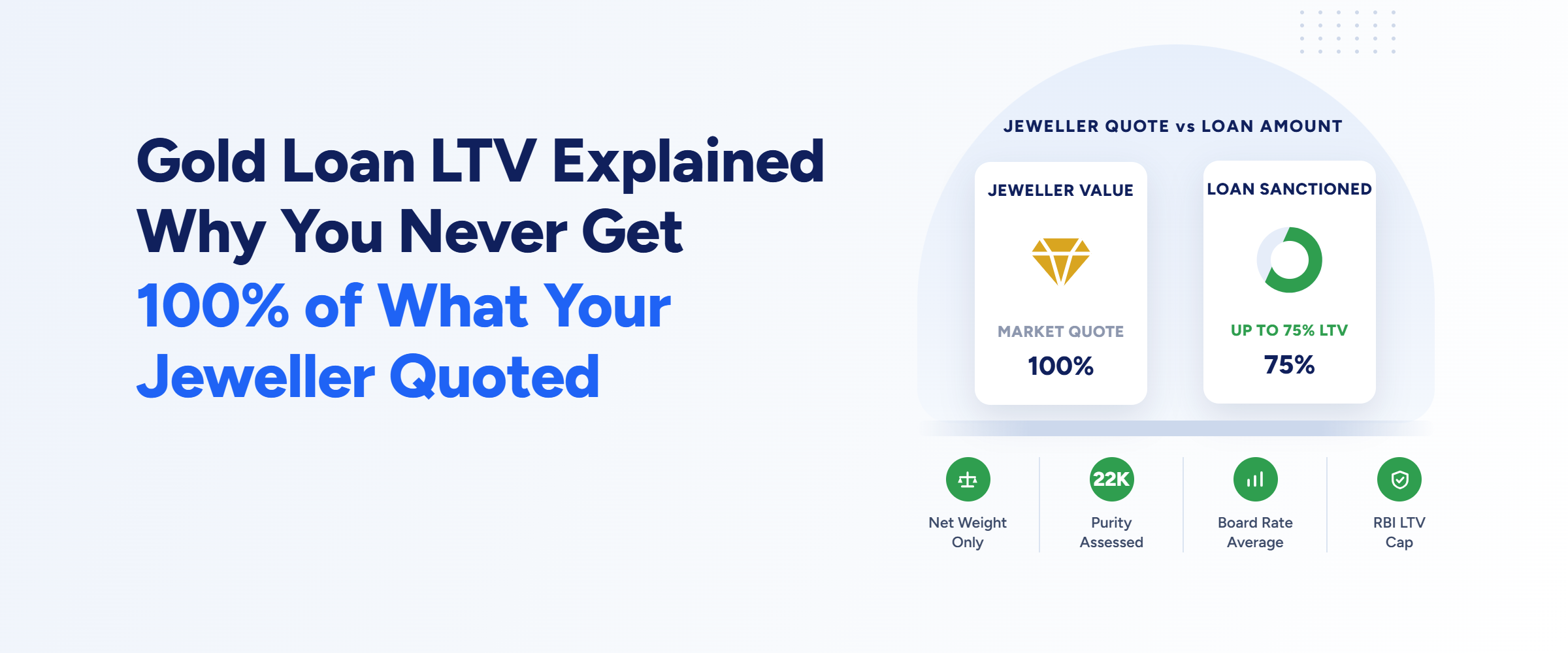
Gold Loan LTV Explained: Why You Never Get 100% of the Jeweller's Quote
You walk into a lender's branch with your mother's gold bangles, mentally calculating the loan amount based on what your jeweller once quoted you. Then the sanctioned amount comes back and it's noticeably lower than you expected.
This isn't a lender shortchanging you. It's how gold loan LTV (Loan-to-Value) works, and it's a rule set by the Reserve Bank of India itself, not something individual lenders decide on a whim.
Understanding this one concept before you walk into a branch can save you from disappointment and help you plan exactly how much you can actually borrow.
What Is Gold Loan LTV?
LTV, or Loan-to-Value ratio, is the maximum percentage of your gold's assessed value that a lender is permitted to lend you. It exists purely as a safety cushion, if gold prices fall or you default, the lender still holds collateral worth more than the outstanding loan.
In simple terms: if your gold is valued at ₹1,00,000 and the applicable LTV is 75%, the maximum loan you can get is ₹75,000, not the full ₹1,00,000.
This cushion is exactly why your loan amount will always be lower than what a jeweller might quote you for buying that same gold outright.
1. RBI Gold Loan Guidelines on LTV
The RBI gold loan guidelines don't leave LTV to individual lender discretion beyond a prescribed ceiling. Under the Reserve Bank of India's Directions on lending against gold and silver collateral, the LTV cap follows a tiered structure based on loan size, replacing the earlier flat 75% ceiling that applied to all gold loans regardless of amount.
| Loan Amount | Maximum LTV Permitted |
|---|---|
| Up to ₹2.5 lakh | Up to 85% |
| Above ₹2.5 lakh and up to ₹5 lakh | Up to 80% |
| Above ₹5 lakh | Up to 75% |
This tiered approach means smaller borrowers, often those relying on gold loans for genuine emergencies, can now access a higher proportion of their gold's value, while larger loans continue to carry a more conservative ceiling.
Important: These are maximum limits, not guaranteed rates. A lender can offer you a lower LTV than the ceiling based on their internal risk policy, gold purity, or your loan tenure, but they cannot legally exceed the RBI-prescribed cap.
2. Net Weight vs Gross Weight
This is where a lot of confusion happens.
Gross weight is the total weight of your jewellery piece, including stones, enamel work, and any non-gold attachments.
Net weight is only the actual gold content, after deducting the weight of stones, beads, meenakari work, or other non-gold materials.
Your loan is calculated only on the net gold weight, never the gross weight of the ornament.
Example: A necklace weighs 40 grams gross, but has 6 grams of stones and enamel work embedded in it. Net gold weight = 34 grams. Your loan eligibility is calculated only on those 34 grams, not the full 40 grams you might have assumed.
3. Purity Matters – 22K vs 24K
Gold purity is measured in karats, and it directly affects how much your gold is worth for loan purposes.
| Purity | Approximate Gold Content | Loan Relevance |
|---|---|---|
| 24K | 99.9% pure gold | Rarely used in loan jewellery (too soft for ornaments) |
| 22K | ~91.6% pure gold | Most common purity for gold loan jewellery in India |
| 18K | ~75% pure gold | Lower valuation per gram; less commonly pledged |
Most lenders value gold loan jewellery based on 22K rates, and if your jewellery is a lower purity (like 18K), the valuation is adjusted downward proportionately. Higher purity means a higher per-gram valuation and therefore a higher loan amount for the same weight.
How Much Loan on 10 Grams of Gold? A Worked Example
Let's walk through the full calculation so you can see exactly how gold loan LTV translates into your final loan amount.
Assume:
Ornament weight (gross): 10 grams
Stones/non-gold weight: 1 gram
Net gold weight: 9 grams
Purity: 22K
Prevailing 22K gold rate: ₹6,800/gram (illustrative, always check current rates)
Applicable LTV: 75% (assuming loan amount falls in the above-₹5 lakh tier for illustration; smaller loans may get a higher LTV)
| Step | Calculation | Result |
|---|---|---|
| Net gold value | 9 grams × ₹6,800 | ₹61,200 |
| Maximum loan (at 75% LTV) | ₹61,200 × 75% | ₹45,900 |
| Maximum loan (at 85% LTV, if eligible) | ₹61,200 × 85% | ₹52,020 |
Notice the difference, the same jewellery can fetch a meaningfully different loan amount depending on which LTV tier applies, which is why smaller-ticket borrowers benefit from the revised tiered structure.
Why the Jeweller's Quote Is Always Higher
When a jeweller quotes a "buyback" or resale value for your gold, that quote is based on the full weight and current market rate, sometimes even including some allowance for craftsmanship, depending on the jeweller. A loan valuation, on the other hand, strips out:
This combination is exactly why the number you see on your loan sanction letter can look noticeably smaller than a rough jeweller estimate, even before considering RBI's specific valuation methodology, which typically uses a conservative average of recent gold prices rather than the day's peak price.
Common Mistakes Borrowers Make
Expert Tips to Maximise Your Gold Loan Amount
Get the Best Value for Your Gold
Check your gold loan eligibility on IndiaLends and compare transparent, RBI-compliant offers from multiple lenders, so you know exactly how your gold is being valued before you pledge it.
Check Your Gold Loan Eligibility Now
Conclusion
The gap between your jeweller's quote and your actual gold loan amount isn't a lender trying to shortchange you, it's the combined effect of net weight calculation, purity-based valuation, and RBI's LTV safety cushion, all working together to protect both you and the lender. Once you understand how each of these factors into the final number, you can walk into any lender with realistic expectations and even structure your loan amount to make the most of the tiered LTV rules.

Scan this QR Code


Latest Articles
Can You Pledge Your Mother's or Wife's Gold for a Loan? Rules Explained
09 Sep 2026
Bullet Repayment vs EMI Gold Loan: Which Fits a 6-Month Cash Crunch?
09 Sep 2026
Gold Loan Auction Process in India: Timeline, Notice & Borrower Rights
08 Sep 2026
Why Making Charges, Stones & Kundan Work Don't Count in a Gold Loan
08 Sep 2026
Gold Loan vs Selling Gold: What to Do When You Need Money in 48 Hours
08 Sep 2026
Relevant Articles
Can You Pledge Your Mother's or Wife's Gold for a Loan? Rules Explained
09 Sep 2026
Bullet Repayment vs EMI Gold Loan: Which Fits a 6-Month Cash Crunch?
09 Sep 2026
Gold Loan Auction Process in India: Timeline, Notice & Borrower Rights
08 Sep 2026
Why Making Charges, Stones & Kundan Work Don't Count in a Gold Loan
08 Sep 2026
Gold Loan vs Selling Gold: What to Do When You Need Money in 48 Hours
08 Sep 2026
FAQ’s
Under RBI's tiered structure, gold loans up to ₹2.5 lakh can carry an LTV of up to 85%, loans between ₹2.5 lakh and ₹5 lakh up to 80%, and loans above ₹5 lakh up to 75%.
Loan valuation is based on the net gold weight (excluding stones and non-gold materials), a conservative average gold price, and the RBI-mandated LTV cap, all of which typically result in a lower figure than a jeweller's resale or buyback quote.
Yes. Higher-purity gold (like 22K) is valued at a higher per-gram rate than lower-purity gold (like 18K), directly affecting your total loan eligibility for the same weight of jewellery.
Loans are calculated on the net gold weight only, the gross weight of the ornament minus the weight of stones, beads, or other non-gold materials.
Potentially, yes. Since RBI's tiered LTV structure allows up to 85% for loans up to ₹2.5 lakh, borrowers with smaller funding needs may be eligible for a higher LTV than those seeking larger loan amounts against the same gold.
 URL copied to clipboard successfully !
Download the IndiaLends App Now
Scan this QR code to download the app