Loans 

Credit Card
IndiaLends App is available in


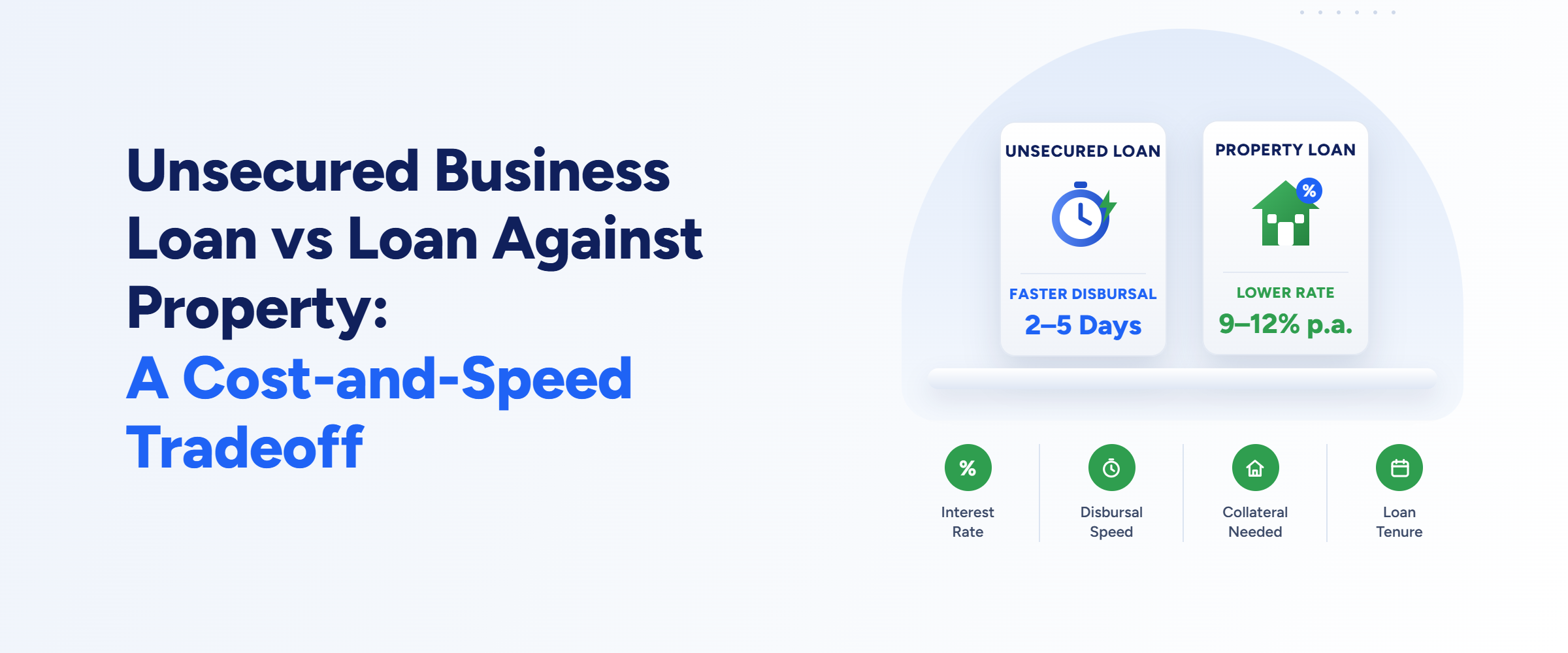
Unsecured Business Loan vs LAP: The Cost and Speed Tradeoff
You need ₹25,00,000 to expand your business; new equipment, additional inventory, maybe a second outlet. You own a flat or a shop that could be pledged as collateral, and you're wondering: is it worth putting that property on the line for a lower interest rate, or should you just take an unsecured business loan and keep your property completely untouched?
This is one of the most consequential financing decisions a small business owner makes, and it genuinely comes down to a tradeoff between cost and speed on one side, and risk and flexibility on the other.
The Fundamental Difference
An unsecured business loan is exactly what it sounds like, no collateral required. The lender assesses your business's cash flow, credit history, and financials to decide your eligibility and pricing.
A Loan Against Property (LAP) requires you to pledge real estate, residential, commercial, or industrial, as collateral. Because the lender has a tangible asset to fall back on, LAP is priced and structured very differently.
| Factor | Unsecured Business Loan | Loan Against Property (LAP) |
|---|---|---|
| Collateral required | No | Yes (residential/commercial property) |
| Typical interest rate | Higher | Lower |
| Loan amount potential | Generally lower, tied to business cash flow | Generally higher, tied to property value |
| Processing time | Faster | Slower (property valuation, legal checks) |
| Tenure | Shorter (typically up to 5 years) | Longer (can extend to 15–20 years) |
| Risk if you default | Credit score damage, legal recovery action | Risk of losing the pledged property |
1. LAP Interest Rate vs Business Loan – The Real Numbers
The interest rate gap between these two products is usually the single biggest factor driving the decision.
Why LAP is cheaper: the lender's risk is significantly lower, since they hold a tangible, valuable asset as security. This translates directly into a meaningfully lower interest rate compared to an unsecured facility, where the lender has no such backstop.
Why unsecured loans cost more: without collateral, the lender is pricing in pure credit risk, the possibility that your business's cash flow falters and there's no asset to recover from. This risk premium is baked into the higher rate.
| Loan Type | Typical Rate Positioning |
|---|---|
| Unsecured business loan | Meaningfully higher, reflecting pure credit risk |
| LAP for business purposes | Meaningfully lower, reflecting the security of pledged property |
Practical implication: for large loan amounts over long tenures, even a few percentage points' difference in interest rate can translate into lakhs of rupees in total cost over the loan's life, which is exactly why LAP becomes attractive for big-ticket, long-term business financing needs.
2. Collateral vs Unsecured MSME Loan – Eligibility Differences
Eligibility criteria for these two products differ substantially, which often decides the question before cost even enters the picture.
Unsecured MSME loan eligibility typically depends on:
LAP eligibility typically depends on:
Practical implication: if your business is relatively new, has limited formal documentation, or inconsistent cash flow on paper, LAP can sometimes be easier to get approved than an unsecured loan because the lender's confidence comes from the property, not solely from your business's financial history.
3. Speed – Where Unsecured Loans Have a Clear Edge
If your need is urgent, this factor can outweigh the interest rate difference entirely.
Unsecured business loans typically move faster because: no property valuation is required, no legal title verification or encumbrance checks needed, and digital underwriting based on financial documents and bank statements can be completed within days.
LAP typically takes longer because: a qualified valuer must physically assess the property, legal teams need to verify clear title and check for any existing liens or disputes, and documentation (property papers, ownership proof, approved building plans, etc.) is more extensive.
| Factor | Unsecured Business Loan | LAP |
|---|---|---|
| Typical processing time | Days to about a week | Several weeks, sometimes longer |
| Key bottleneck | Financial documentation review | Property valuation and legal verification |
When to Pledge Your Shop or Flat: A Decision Framework
| Your Situation | Better Fit |
|---|---|
| Need funds urgently, moderate amount | Unsecured business loan |
| Need a large amount for expansion/capex, can wait a few weeks | LAP |
| Business has limited formal financial history | LAP (if you own eligible property) |
| Strong, well-documented business financials, don't want to risk property | Unsecured business loan |
| Long repayment horizon suits your cash flow better | LAP |
| Short-term working capital need | Unsecured business loan (better tenure fit) |
| Uncertain about long-term repayment stability | Carefully reconsider LAP, the property is genuinely at risk |
Loan Against Property for Business: What Makes It Work Well
LAP is particularly well-suited for:
Because tenures can extend well beyond what unsecured loans offer, LAP EMIs are often more manageable for a given loan amount, spreading repayment over a longer period reduces the monthly burden, even though total interest paid over the full tenure may be higher in absolute terms due to the longer duration.
Working Capital vs LAP: Matching the Loan to the Need
This is a distinction worth being precise about, since mismatching loan type to need is a common and costly mistake.
Working capital needs: inventory purchases, bridging payment cycles, seasonal cash flow gaps are inherently short-term and recurring. These are generally better matched to unsecured working capital loans or overdraft facilities, not LAP.
Why LAP is a poor fit for pure working capital: pledging property for a long-tenure loan to solve a short-term cash flow gap means you're carrying collateral risk for far longer than the actual need requires, and potentially paying processing costs and time investment disproportionate to a recurring, smaller need.
LAP is a better fit for: one-time, larger capital needs, buying commercial space, major equipment purchase, business expansion, where the long tenure genuinely matches the nature of the investment.
Example: Two Business Owners, Two Choices
Case 1: Unsecured Business Loan — Kavya runs a growing digital marketing agency with strong, well-documented cash flow over the past 3 years. She needs ₹8,00,000 to hire additional staff and invest in software tools, a moderate amount, needed relatively quickly. She takes an unsecured business loan, gets approved within 4 days based on her financials, and avoids putting any personal or business property at risk.
Case 2: Loan Against Property — Suresh owns a hardware store and wants to open a second outlet, requiring ₹40,00,000, a much larger amount than his business cash flow alone would support through an unsecured facility. He pledges his residential flat, and after property valuation and legal checks (taking about 3 weeks), receives the loan at a meaningfully lower interest rate than any unsecured quote he'd received, with a longer tenure that keeps his EMI manageable.
Both made the right choice for their specific loan size, urgency, and risk comfort, there's no universal "better" option.
Common Mistakes Business Owners Make
Expert Tips for Choosing Between the Two
Compare Business Financing Options for Your Needs
Check your business loan eligibility on IndiaLends and compare both unsecured and property-backed loan offers side by side, so you can choose based on your real cost, speed, and risk priorities.
Check Your Business Loan Eligibility Now
Conclusion
The choice between an unsecured business loan and a Loan Against Property isn't just about which one is "cheaper", it's a genuine tradeoff between cost, speed, and risk. LAP offers a lower interest rate and higher loan amounts, but at the cost of time, paperwork, and putting a real asset on the line. Unsecured loans offer speed and zero collateral risk, at a higher price. Match the loan type to the actual nature and urgency of your business need, not just the interest rate you see advertised.
Related reading: Bank vs NBFC Loan: How to Choose the Right Offer, Business Loan for Seasonal Businesses, Using a Gold Loan as Working Capital, and Udyam Registration and Business Loans.

Scan this QR Code


Latest Articles
Merchant Cash Advance vs Business Loan: The Real Cost Comparison
30 Sep 2026
Business Loan Turnover Calculation: Why Cash Sales Don't Count
30 Sep 2026
Should I Prepay My Personal Loan? Bonus vs EMI Decision Guide
30 Sep 2026
RBI Cooling-Off Period on Personal Loans: What You Can Actually Undo
18 Sep 2026
Should You Take a Personal Loan During Your Notice Period?
18 Sep 2026
Relevant Articles
Merchant Cash Advance vs Business Loan: The Real Cost Comparison
30 Sep 2026
Business Loan Turnover Calculation: Why Cash Sales Don't Count
30 Sep 2026
Udyam Registration and Business Loans: Does MSME Registration Help?
03 Sep 2026
Seasonal Business Loan: Planning Funds Around Inventory & Revenue Cycles
03 Sep 2026
How Bank Statements Influence Business Loan Approval
10 Aug 2026
FAQ’s
Generally, yes. Since LAP is backed by collateral, lenders offer meaningfully lower interest rates compared to unsecured business loans, which carry higher pricing to offset the lender's pure credit risk.
Unsecured business loans are typically faster, since they don't require property valuation or legal title verification. LAP usually takes several weeks due to these additional steps.
LAP makes sense for large, one-time capital needs like business expansion or equipment purchase, where you need a bigger loan amount and a longer repayment tenure, and you're comfortable pledging property as collateral.
It's generally not the best fit. Working capital needs are short-term and recurring, better suited to unsecured working capital loans or overdraft facilities, rather than a long-tenure, property-backed loan like LAP.
If you default on a LAP, the lender has the legal right to initiate recovery proceedings against the pledged property, which could ultimately result in its sale to recover the outstanding dues, a risk that doesn't exist with an unsecured loan.
 URL copied to clipboard successfully !
Download the IndiaLends App Now
Scan this QR code to download the app