Credit Card 
IndiaLends App is available in


How Much Personal Loan Can You Get on a 40,000, 60,000, or 1 Lakh Salary?
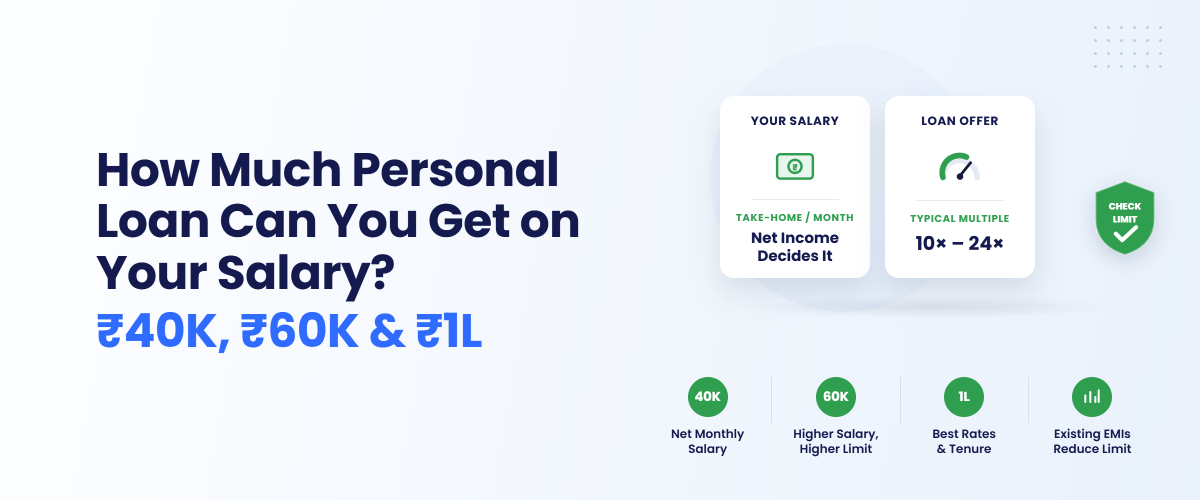
One of the first questions every salaried professional asks before applying for a personal loan is simple: "How much can I actually get?" The honest answer is that it depends on more than just your salary, but your income is still the biggest starting point.
Let's break down realistic personal loan amounts across different salary levels, and the factors that shift these numbers up or down.
How Lenders Calculate Your Loan Amount
Most banks and NBFCs use a combination of these factors to determine your eligible personal loan amount.
The General Formula Lenders Use
While exact formulas vary, many lenders estimate eligibility using a multiple of your net monthly income, adjusted for existing obligations. A simplified way to think about it:
Eligible EMI ≈ (FOIR % × Monthly Income) − Existing EMIs
Once the eligible EMI is calculated, the lender works backward using the interest rate and tenure to arrive at your maximum eligible loan amount.
Personal Loan Amount Estimate by Salary
The table below gives a general, illustrative sense of how eligible loan amounts might scale with salary, assuming no existing EMIs and a reasonably healthy CIBIL score. Actual amounts will vary by lender, city, and individual profile.
| Monthly Salary | Illustrative Eligible EMI Range (35–40% of income) | Relative Loan Amount Potential |
|---|---|---|
| ₹40,000 | ₹14,000 – ₹16,000 | Moderate |
| ₹60,000 | ₹21,000 – ₹24,000 | Higher than ₹40,000 salary |
| ₹1,00,000 | ₹35,000 – ₹40,000 | Significantly higher |
The actual loan amount you're offered depends on translating this eligible EMI into a principal amount using the applicable interest rate and chosen tenure, which is why the same eligible EMI can support a larger loan amount over a longer tenure, and a smaller amount over a shorter one.
Example: ₹40,000 Salary
Suppose Ritika earns ₹40,000 per month and has no existing EMIs. If a lender applies a FOIR of around 40%, her eligible EMI works out to roughly ₹16,000. Depending on the interest rate and tenure she chooses, this EMI capacity could translate into a moderate personal loan amount, sufficient for needs like a medical expense, a small home improvement, or short-term debt consolidation.
Example: ₹60,000 Salary
Rahul earns ₹60,000 per month but already pays ₹8,000 toward an existing car loan EMI. His eligible EMI headroom is reduced accordingly, since lenders account for this existing obligation before calculating how much additional EMI he can take on. Even so, his higher base income generally supports a larger eligible loan amount compared to a ₹40,000 salary, assuming a similar tenure and interest rate.
Example: ₹1 Lakh Salary
Ananya earns ₹1,00,000 per month with no existing EMIs and a strong CIBIL score. Her higher income significantly increases her eligible EMI capacity, which combined with a favorable interest rate she may qualify for due to her strong credit profile, can support a considerably larger personal loan amount than someone earning ₹40,000 or ₹60,000, for the same tenure.
How Existing EMIs Reduce Your Eligible Loan Amount
This is one of the most overlooked factors. Two people with the same salary can have very different loan eligibility if one has existing debt and the other doesn't.
| Scenario | Monthly Salary | Existing EMIs | Eligible EMI Headroom (approx. 40% FOIR) |
|---|---|---|---|
| Applicant A | ₹60,000 | None | ~₹24,000 |
| Applicant B | ₹60,000 | ₹15,000 | ~₹9,000 |
Applicant A has significantly more room for a new personal loan, despite having the same salary as Applicant B.
How Tenure Affects the Loan Amount You Can Get
For the same eligible EMI, a longer tenure allows you to qualify for a larger loan amount, since the EMI is spread over more months. A shorter tenure means a higher EMI for the same loan amount, which can reduce how much you're eligible for within your EMI headroom.
This is why two applicants with identical salaries might get different maximum loan amounts if they choose different repayment tenures.
How CIBIL Score Influences the Amount (Not Just Approval)
A strong CIBIL score doesn't just improve your chances of approval, it can also influence the interest rate you're offered, which affects how much loan amount your eligible EMI can support, and the lender's willingness to extend a higher loan amount within their internal policies.
A borrower with a CIBIL score of 750+ may be offered a more competitive rate than one with a score of 680, which even at the same salary and EMI capacity can translate into a meaningfully different loan amount.
Common Mistakes When Estimating Loan Eligibility by Salary
Expert Tips to Maximize Your Eligible Loan Amount
Check Your Personal Loan Eligibility Now
Conclusion
Your salary is the starting point for personal loan eligibility, but it's far from the whole story. Existing EMIs, your CIBIL score, and the tenure you choose all play a meaningful role in determining exactly how much you can borrow. Using an eligibility calculator with your real numbers rather than relying on rough salary-based assumptions is the most reliable way to know where you stand. Check your eligibility and explore personal loan offers on IndiaLends.

Scan this QR Code


Latest Articles
Why Self-Employed Borrowers Are Charged Higher Personal Loan Rates in India
05 Aug 2026
How Personal Loan Tenure Changes Your Total Interest Outgo
05 Aug 2026
How Long Does It Take to Recover From a Loan Default in India?
04 Aug 2026
Credit Card vs Personal Loan in India: Which Is Cheaper for a 50,000 Emergency?
31 Jul 2026
Business Loan for New Business in India: What Options Exist Without Strong Revenue History
31 Jul 2026
Relevant Articles
Why Self-Employed Borrowers Are Charged Higher Personal Loan Rates in India
05 Aug 2026
How Personal Loan Tenure Changes Your Total Interest Outgo
05 Aug 2026
Personal Loan EMI Calculator Guide – How to Calculate Your EMI
29 Jul 2026
Personal Loan Eligibility Criteria in India – Complete Guide
29 Jul 2026
12 Common Personal Loan Myths That Most Borrowers Believe
28 Jul 2026
FAQ’s
Loan eligibility depends on your existing EMIs, CIBIL score, and the lender's policies, but a ₹40,000 salary with no existing debt generally supports a moderate loan amount based on an eligible EMI of roughly 35-40% of income.
With a ₹60,000 salary and no major existing EMIs, eligible loan amounts are typically higher than at a ₹40,000 salary, though existing obligations can reduce this significantly.
A ₹1,00,000 salary generally supports a considerably higher eligible loan amount, especially when combined with a strong CIBIL score and minimal existing debt.
Yes, existing EMIs and credit card dues reduce your eligible EMI headroom, which directly lowers the maximum personal loan amount you can qualify for.
Yes, a longer tenure spreads the EMI over more months, which can allow you to qualify for a higher loan amount within the same eligible EMI capacity.
 URL copied to clipboard successfully !
Download the IndiaLends App Now
Scan this QR code to download the app