Credit Card 
IndiaLends App is available in


Why Self-Employed Borrowers Are Charged Higher Personal Loan Rates in India
If you're a self-employed professional or business owner who's applied for a personal loan, you may have noticed something frustrating: your interest rate often looks less favorable than what a salaried friend with a similar income gets. This isn't random, it comes down to how lenders assess risk differently for self-employed applicants.
Let's unpack why this happens and what you can do about it.
Salaried vs Self-Employed: Why Lenders Treat Them Differently
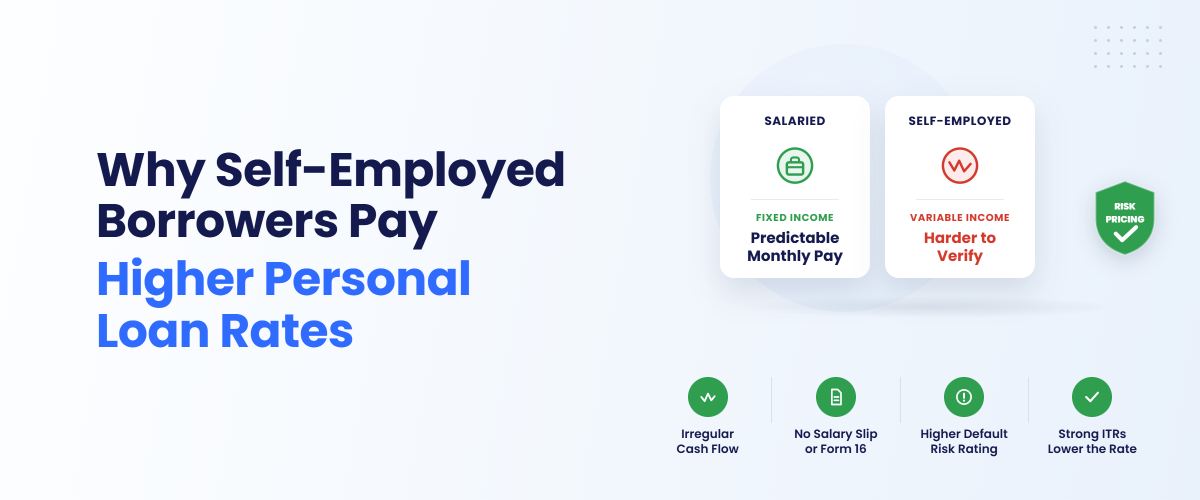
For a salaried employee, income is predictable, a fixed amount, credited on a fixed date, from an identifiable employer. For a self-employed individual, whether a freelancer, consultant, or business owner, income can vary month to month, and verifying it is inherently more complex.
This difference in predictability is the root cause of the rate gap.
Key Reasons Self-Employed Borrowers Face Higher Rates
Salaried vs Self-Employed: Risk Factors Compared
| Factor | Salaried Applicant | Self-Employed Applicant |
|---|---|---|
| Income Predictability | High | Variable |
| Income Verification | Simple (salary slips, Form 16) | Complex (ITR, bank statements, P&L) |
| Employer Stability Signal | Yes | Not applicable |
| Business/Market Risk Exposure | Low (personal income independent of employer performance in most cases) | Higher (income tied to business performance) |
| Typical Rate Impact | Often more competitive | Often relatively higher |
Does This Mean Self-Employed Borrowers Always Pay More?
Not necessarily. The interest rate gap can narrow significantly for self-employed applicants who present a strong overall profile. Lenders do adjust their assessment based on individual factors, not just the broad "self-employed" label.
What Improves Rates for Self-Employed Borrowers
Example: How Two Self-Employed Applicants Compare
Consider two self-employed applicants seeking a personal loan of similar amount and tenure.
Applicant A: 5 years of consistent ITR filings with steady income growth, a CIBIL score of 760, and no major existing business debt.
Applicant B: 1 year of ITR filings, with fluctuating income, a CIBIL score of 660, and an existing business loan EMI already active.
Even though both are "self-employed," Applicant A is likely to be offered a meaningfully more competitive interest rate than Applicant B, since their financial profile signals significantly lower risk, illustrating that the self-employed rate gap isn't fixed, but shaped by individual financial strength.
Documents That Help Self-Employed Applicants Get Better Terms
Common Mistakes Self-Employed Borrowers Make
Expert Tips for Self-Employed Borrowers Seeking Better Rates
Check Your Personal Loan Eligibility Now
Conclusion
Self-employed borrowers often face higher personal loan rates because of income variability and verification complexity, not because lenders view business owners unfavorably by default. By maintaining consistent documentation, a strong CIBIL score, and healthy financial habits, self-employed applicants can significantly narrow this rate gap and access more competitive personal loan terms. Check your eligibility and explore personal loan offers on IndiaLends.

Scan this QR Code


Latest Articles
How Personal Loan Tenure Changes Your Total Interest Outgo
05 Aug 2026
How Long Does It Take to Recover From a Loan Default in India?
04 Aug 2026
How Much Personal Loan Can You Get on a 40,000, 60,000, or 1 Lakh Salary?
04 Aug 2026
Credit Card vs Personal Loan in India: Which Is Cheaper for a 50,000 Emergency?
31 Jul 2026
Business Loan for New Business in India: What Options Exist Without Strong Revenue History
31 Jul 2026
Relevant Articles
How Personal Loan Tenure Changes Your Total Interest Outgo
05 Aug 2026
How Much Personal Loan Can You Get on a 40,000, 60,000, or 1 Lakh Salary?
04 Aug 2026
Personal Loan EMI Calculator Guide – How to Calculate Your EMI
29 Jul 2026
Personal Loan Eligibility Criteria in India – Complete Guide
29 Jul 2026
12 Common Personal Loan Myths That Most Borrowers Believe
28 Jul 2026
FAQ’s
Self-employed income is generally seen as less predictable and harder to verify compared to salaried income, which leads lenders to price in additional risk through a higher interest rate.
Yes, self-employed applicants with strong, consistent income documentation, a high CIBIL score, and an established business vintage can often access rates that are much closer to those offered to salaried applicants.
Consistent ITR filings, healthy bank statements, GST returns, and audited financial statements (for larger amounts) all help strengthen a self-employed applicant's profile.
Yes, a longer, established business track record is generally viewed more favorably than a very new business, positively influencing the interest rate offered.
Yes, a strong personal CIBIL score remains one of the most influential factors for self-employed borrowers, just as it is for salaried applicants.
 URL copied to clipboard successfully !
Download the IndiaLends App Now
Scan this QR code to download the app