Credit Card 
IndiaLends App is available in


How Personal Loan Tenure Changes Your Total Interest Outgo
When you apply for a personal loan, the tenure selector often feels like the least important part of the process, just a dropdown between 12 and 60 months. But this single choice can quietly change how much you end up paying in total interest, sometimes by a significant margin.
Let's understand exactly how personal loan tenure affects your total interest outgo, and how to choose the right one for your situation.
What Does Loan Tenure Actually Mean?
Loan tenure is simply the time period over which you repay your personal loan through EMIs. It's usually expressed in months, common tenures range from 12 months to 60 months, depending on the lender and loan amount.
Tenure affects two things simultaneously: your monthly EMI amount, and the total interest you pay over the life of the loan. These two move in opposite directions, which is exactly why tenure selection deserves more thought than it usually gets.
The Core Relationship: Tenure, EMI, and Total Interest
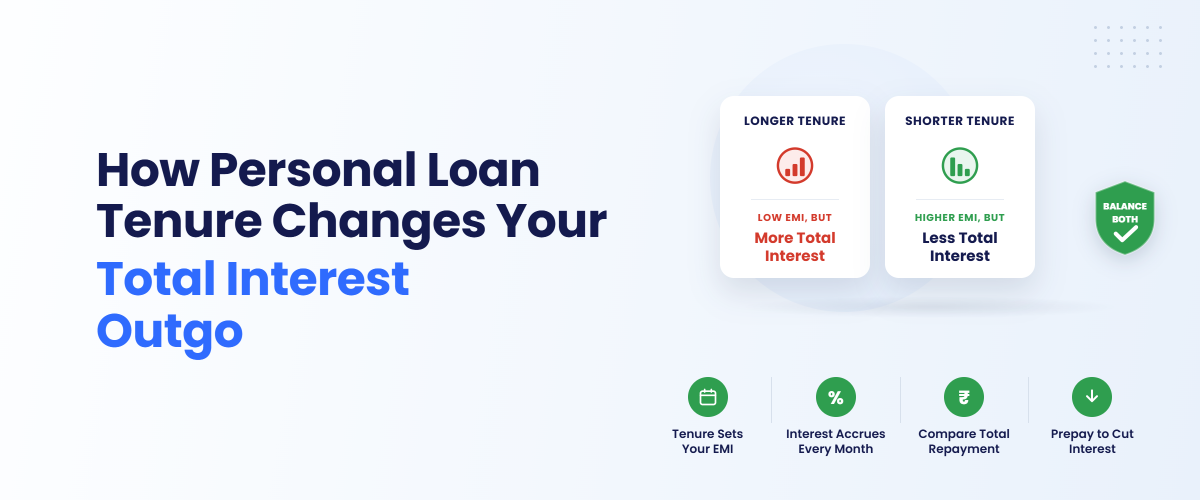
Here's the fundamental trade-off:
This happens because interest is calculated on the outstanding principal balance. The longer that balance takes to reduce, the more months it accrues interest, even if the interest rate itself stays exactly the same.
Why a Longer Tenure Costs More in Interest (Even at the Same Rate)
This is the part that surprises a lot of borrowers. Even if your interest rate doesn't change, choosing a longer tenure means your principal reduces more slowly each month, interest keeps getting calculated on a larger outstanding balance for a longer period, and the cumulative interest across all those months adds up to a bigger number.
It's not that a longer tenure is a "bad deal" from the lender, it's simply the mathematical result of spreading repayment over more months.
Illustrative Example: ₹5,00,000 Loan Across Different Tenures
Let's look at a ₹5,00,000 personal loan and see how the tenure choice might affect EMI and total interest, assuming the same interest rate throughout for a fair comparison.
| Tenure | Relative EMI Level | Relative Total Interest Paid |
|---|---|---|
| 12 months | Highest EMI | Lowest total interest |
| 24 months | High EMI | Low total interest |
| 36 months | Moderate EMI | Moderate total interest |
| 48 months | Lower EMI | Higher total interest |
| 60 months | Lowest EMI | Highest total interest |
Notice the pattern: as tenure increases, the EMI keeps dropping, but the total interest paid keeps climbing. This is the core trade-off every borrower needs to weigh.
Example: Priya's Decision Between 24 and 60 Months
Priya needs a ₹4,00,000 personal loan. She's comparing a 24-month tenure against a 60-month tenure at the same interest rate offered by her lender.
Neither choice is automatically "wrong," it depends on whether Priya prioritizes lower monthly outflow or minimizing total cost.
How to Decide the Right Tenure for You
Ask yourself these questions:
The Role of Prepayment in Reducing Total Interest
If you've already chosen a longer tenure, you're not stuck paying the maximum interest by default. Making partial prepayments, especially earlier in the tenure, when a larger share of your EMI goes toward interest, can meaningfully reduce your total interest outgo.
Common Mistakes When Choosing Loan Tenure
Expert Tips for Choosing Loan Tenure Wisely
Calculate Your Personal Loan EMI Now
Conclusion
Loan tenure isn't just a scheduling detail, it's one of the biggest levers affecting how much your personal loan actually costs you in total. Balancing a comfortable EMI with a tenure that keeps total interest reasonable is the real skill here, and using an EMI calculator to compare options before applying makes that decision far easier. Check your eligibility and explore personal loan offers on IndiaLends.

Scan this QR Code


Latest Articles
Why Self-Employed Borrowers Are Charged Higher Personal Loan Rates in India
05 Aug 2026
How Long Does It Take to Recover From a Loan Default in India?
04 Aug 2026
How Much Personal Loan Can You Get on a 40,000, 60,000, or 1 Lakh Salary?
04 Aug 2026
Credit Card vs Personal Loan in India: Which Is Cheaper for a 50,000 Emergency?
31 Jul 2026
Business Loan for New Business in India: What Options Exist Without Strong Revenue History
31 Jul 2026
Relevant Articles
Why Self-Employed Borrowers Are Charged Higher Personal Loan Rates in India
05 Aug 2026
How Much Personal Loan Can You Get on a 40,000, 60,000, or 1 Lakh Salary?
04 Aug 2026
Personal Loan EMI Calculator Guide – How to Calculate Your EMI
29 Jul 2026
Personal Loan Eligibility Criteria in India – Complete Guide
29 Jul 2026
12 Common Personal Loan Myths That Most Borrowers Believe
28 Jul 2026
FAQ’s
Yes, for the same loan amount and interest rate, a longer tenure results in higher total interest paid, even though the monthly EMI is lower.
The best tenure is one where the EMI is comfortably affordable within your monthly budget while keeping the total interest outgo as low as possible, often the shortest tenure you can manage without straining your finances.
Yes, making partial prepayments, especially earlier in the tenure, can meaningfully reduce your total interest outgo, subject to any applicable prepayment charges.
A shorter tenure results in a higher EMI since the loan is repaid over fewer months, while a longer tenure spreads repayment over more months, resulting in a lower EMI.
If you can comfortably afford the higher EMI without straining your budget, a shorter tenure is generally more cost-effective since it minimizes total interest paid.
 URL copied to clipboard successfully !
Download the IndiaLends App Now
Scan this QR code to download the app